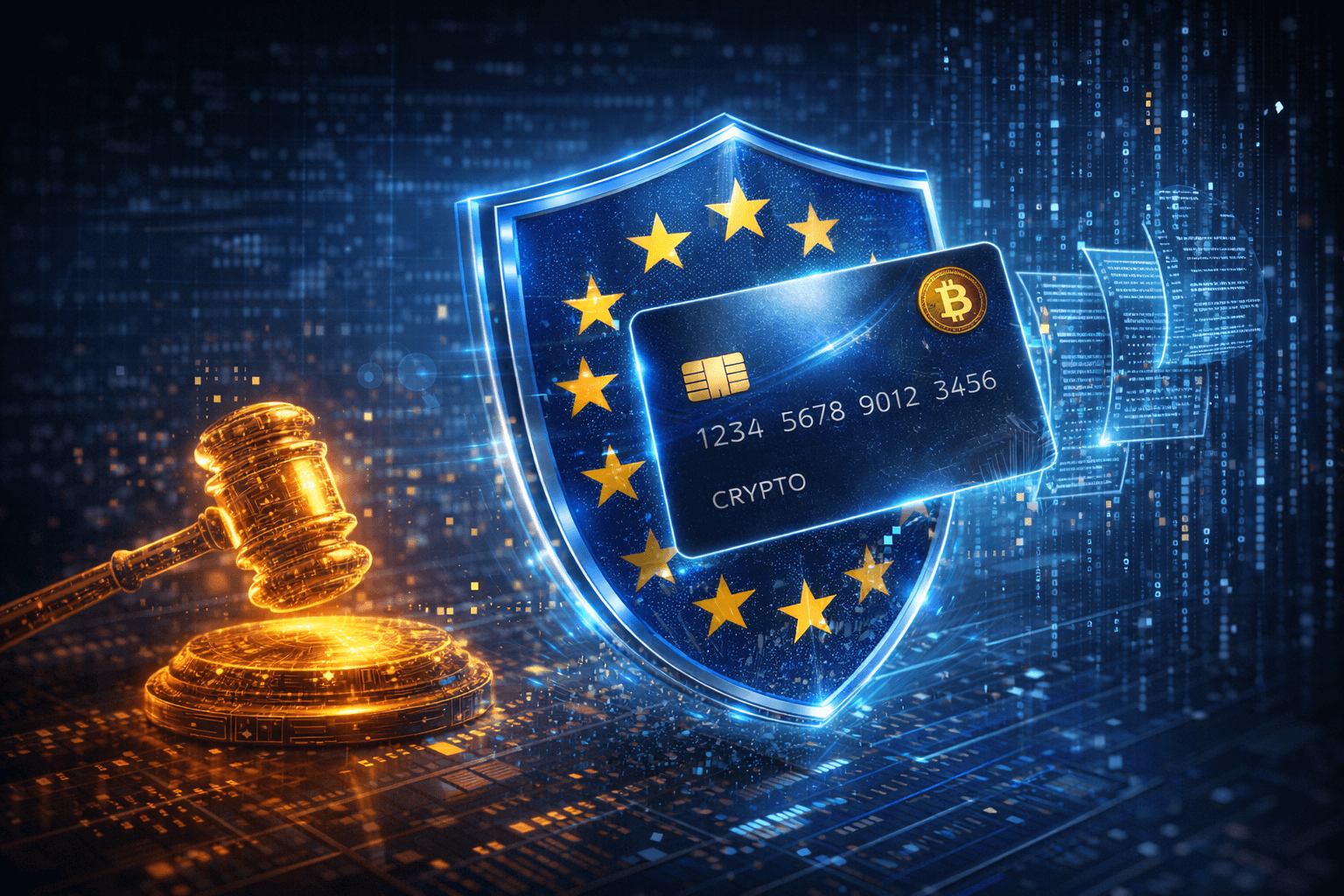
The "Wild West" era of crypto cards has officially ended. In 2026, the regulatory framework has solidified, led by the European Union’s Markets in Crypto-Assets (MiCA 2.0) regulation. For the first time, there is a clear set of rules for card issuers, but these rules come with significant trade-offs for privacy, jurisdictional availability, and reward structures.
Why MiCA 2.0 Changes Everything
Regulations are no longer "theoretical." In 2026, several popular cards have been forced to exit the US and EU markets because they couldn't meet the new compliance standards. For a user, choosing a card that is "Non-Compliant" is a high-risk move that could lead to your funds being frozen or your account being closed with zero notice.
What MiCA 2.0 Requires from Card Issuers
MiCA 2.0 is a comprehensive regulatory framework that requires all crypto card issuers operating in the EU to be licensed as Crypto-Asset Service Providers (CASPs) and to adhere to strict rules regarding capital reserves, consumer protection, and transaction reporting.
The Death of "Anonymous" Cards
Under MiCA and the FATF Travel Rule, "No-KYC" cards have become effectively extinct in regulated markets. Any transaction over a small threshold (typically €1,000) must be accompanied by the identity of both the sender and the receiver. This means your crypto card is now just as "Visible" to the state as your traditional bank account.
Stablecoin Restrictions
MiCA has introduced strict limits on the issuance and use of non-Euro stablecoins (like USDC and USDT) for payments within the EU. This has led to the rise of "Euro-Native" cards that prioritize EURC or Monerium (EURe) to ensure they remain compliant with the law.
Market Benchmarking & ROI Math
What is the "Compliance Premium" you pay for a regulated card?
| Feature | Unregulated/Offshore Card | Regulated (MiCA Compliant) |
|---|---|---|
| KYC Level | Minimal (Email/Phone) | Full (ID/Video/Proof of Address) |
| Fund Safety | No Guarantee | Safeguarded (Tier 1 Banks) |
| Spending Limits | High (until frozen) | Structured (based on income) |
| Legal Recourse | None (Seychelles/BVI) | Full (EU Ombudsman/Courts) |
The "Risk ROI" Math: An unregulated card might offer 5% Cashback, while a regulated card offers 1%. However, the "Risk of Total Loss" on an unregulated card is estimated at 5-10% per year (due to platform failure or regulatory seizure). On a "Risk-Adjusted" basis, the 1% regulated card is actually the more profitable long-term choice.
Real-World Implications & Regulatory Context
The "Travel Rule" now applies to almost all card-linked wallets. If you send crypto from your self-custody wallet to your card to "Top Up," the issuer must verify that you are the owner of that wallet. This has led to the rise of Wallet Verification (AIV) tools. If you can't prove you own the source wallet, your card funds may be held in "Compliance Limbo" for weeks.
Common Mistakes or Myths
A common myth is that "Crypto is global, so MiCA doesn't apply to me if I'm in the US." In reality, global issuers (like Binance or Coinbase) tend to apply the "Strictest Common Denominator." If they have to build a compliance engine for Europe, they will likely use the same engine for their global user base to save costs. Another mistake is thinking a VPN can bypass these rules. Card issuers use "Financial Geofencing"—they look at your IP, your ID, and your Shipping Address.
How This Relates to Crypto Cards
At SpendNode, we have a "Regulatory Status" badge for every card. We distinguish between cards that are "Licensed in the EEA," "Registered with the FCA (UK)," and "US FinCEN Registered." We strongly advise users to keep the majority of their "Spending Capital" in cards that have a clear, transparent regulatory footprint.
Overview
Regulation is the "Price of Admission" for crypto to become a global payment standard. While we have lost some of the "Anonymity" of the early years, we have gained a level of "Institutional Safety" that was previously unthinkable.
When choosing a card in 2026, the most important "Feature" isn't the cashback or the lounge access—it's the License. A card with a solid regulatory foundation is a card you can rely on for the next decade.