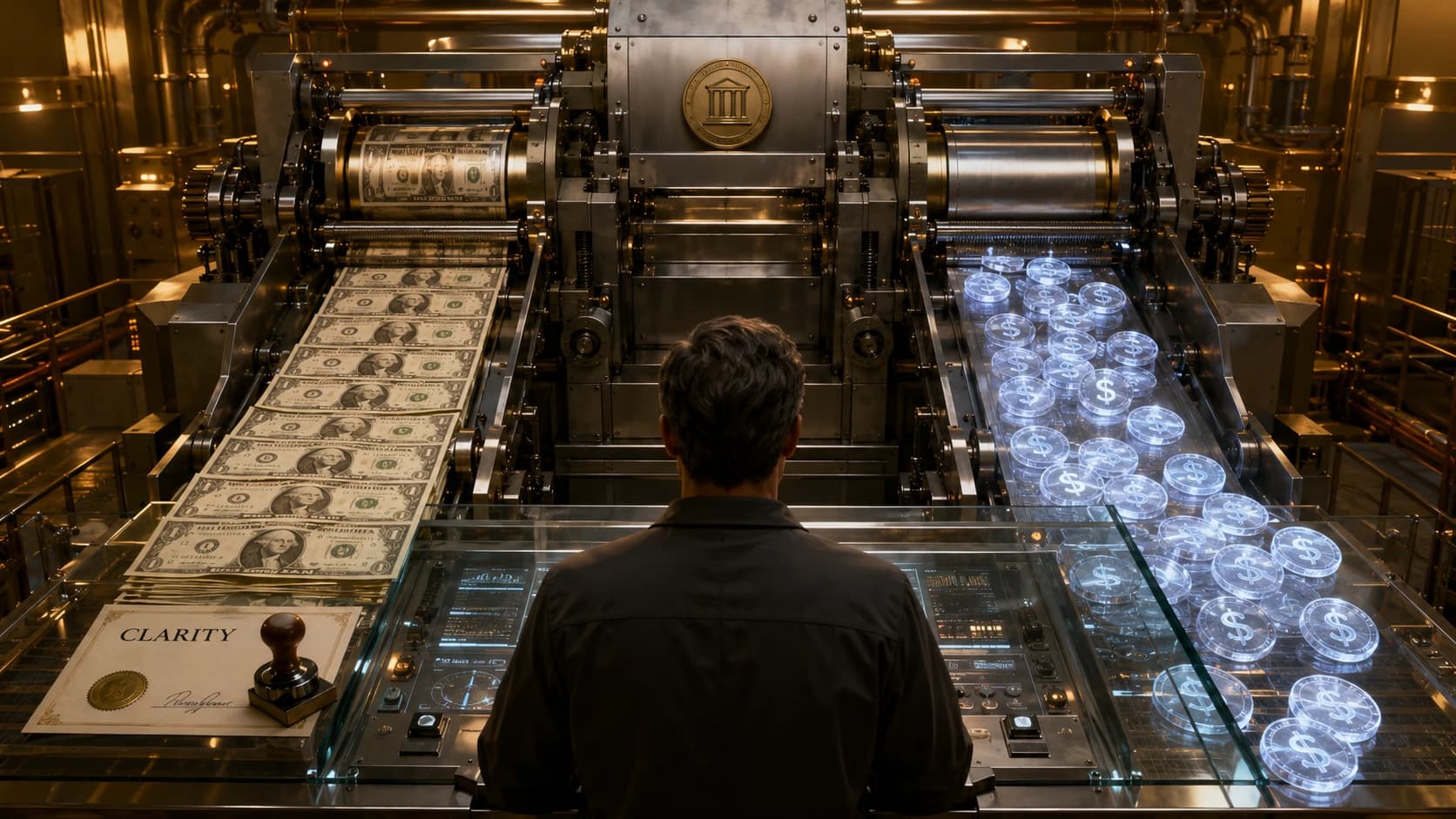
Senator Cynthia Lummis told supporters on Thursday that the US dollar will become a digital asset under the bank permissibility language in the CLARITY Act, the crypto market structure bill currently being marked up by the Senate Banking Committee. The quote was carried via a Coin Bureau post on X with roughly 10,000 views and 173 likes in under an hour, as of May 15, 2026.
The framing matters because Lummis chairs the Senate Banking subcommittee on digital assets and has been the chamber's most consistent crypto voice. Her line was not a future promise. It was a description of what the bill does once enacted.
The permissibility clause is doing the work
The CLARITY Act includes a set of provisions clarifying that federally chartered banks may custody, hold, and transact in digital assets without that activity being treated as outside the business of banking. Lummis pointed to that section as the load-bearing piece. In her reading, once banks can hold the dollar as a tokenized claim on their own books, the dollar effectively becomes a digital asset in legal status, not just in form.
That is a different argument from the one usually associated with stablecoin issuance. Stablecoin issuers like Circle and Paxos already produce dollar-denominated tokens, and the GENIUS Act sets the federal floor for that activity. Bank permissibility is the other half of the conversation: not a private token pegged to the dollar, but bank-issued dollar liabilities that exist natively as on-chain instruments.
The bill is moving alongside heavy opposition
The Senate Banking Committee held a markup on the CLARITY Act this week, with Coinbase CEO Brian Armstrong publicly cheering the process. More than 100 amendments were filed before the markup, and the banking lobby submitted around 8,000 letters opposing provisions that would let stablecoin issuers pay yield. Senator Jack Reed has also introduced a competing measure that would block crypto from federal payment rails and tax remittance.
Lummis's "digital asset" framing reads as a deliberate counter to that opposition. If banks themselves are the issuers, the political argument that stablecoins are a parallel monetary system competing with chartered institutions becomes harder to make. The bill, in her telling, is the path that brings the dollar into the on-chain economy through the banking system rather than around it.
Market context
Bitcoin traded at $80,816, up 1.8% in the prior 24 hours as of May 15, 2026, with ETH at $2,264 and XRP at $1.48 (+3.2%). The CoinMarketCap Fear and Greed index sat at 49, neutral. Crypto funds drew in roughly $858 million in inflows last week as CLARITY Act optimism built, per CoinShares. ETF activity has been choppy: Bitcoin spot funds bled $635 million in a single day earlier this month, then recorded $131 million of inflows on Thursday alongside the markup.
In other words, the bill is moving against a market that has priced in some legislative progress but is far from euphoric. A vote against the bill at this stage would likely hit harder than a vote in favor would help.
Implications for the dollar as an asset
If Lummis's reading holds and the permissibility language survives the amendment process, the practical change is that US banks gain a direct seat at the digital asset table. Custody, tokenization of deposits, and issuance of bank-backed dollar tokens all become activities that sit within the normal regulatory perimeter rather than outside it. Stablecoin issuers would still operate, but their main customer base may shift toward the parts of the market the banks do not want to touch.
For crypto card programs that depend on stablecoin rails, the change would arrive slowly. Bank-issued dollar tokens would need to plug into existing settlement infrastructure before they reach consumer products. The faster effect would land at the wholesale layer: interbank transfer, tokenized money market funds, and treasury operations.
Overview
Senator Cynthia Lummis said the bank permissibility section of the CLARITY Act is the provision that turns the US dollar into a digital asset. The bill is in markup at the Senate Banking Committee, with more than 100 amendments filed and the banking lobby pushing back on stablecoin yield. Whether the permissibility language survives the markup will determine if her framing holds.