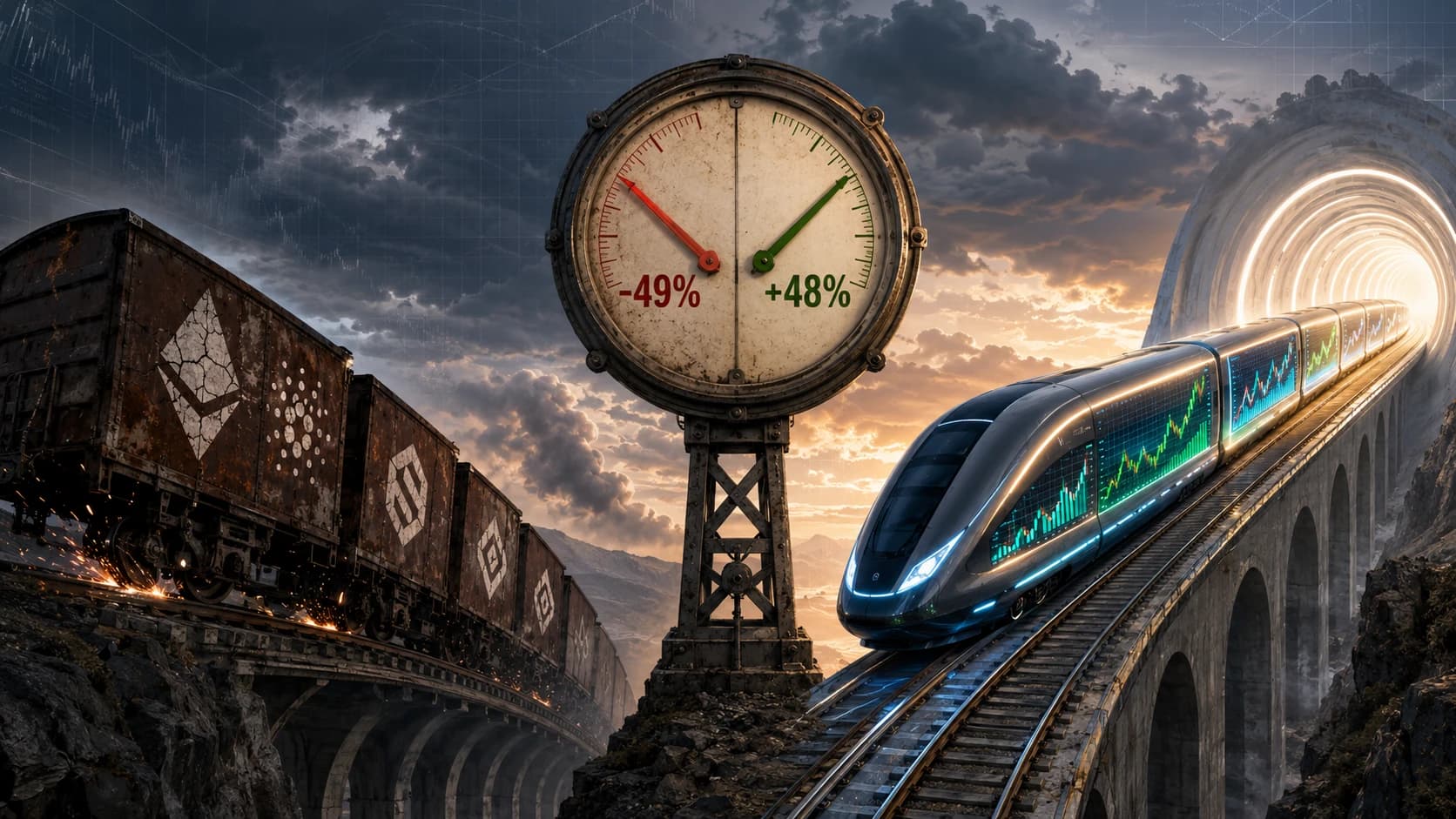
Layer 1 blockchain tokens have lost 49% of their value since the start of 2025, while listed crypto equities are up 48% over the same period, according to a VanEck snapshot circulated on May 12, 2026. The two figures sit roughly 100 percentage points apart and capture how differently public-market investors and on-chain token holders have been priced through this cycle.
The data point lands against a soft tape. As of May 12, 2026, BTC trades at $80,590 (down 0.4% on the day), ETH at $2,272 (down 2.0%), SOL at $94.65 (down 0.6%), and the Fear and Greed index reads 48, or Neutral. The broader L1 cohort, which includes mid-cap chains beyond the top names, has fared materially worse than these majors over the 16-month window.
A 100-point spread between two ways to own crypto
The headline is the gap itself. An investor who bought a basket of L1 tokens at the start of 2025 is sitting on roughly a 49% drawdown. An investor who bought a basket of crypto-linked equities, mining stocks, exchanges, treasury companies, payment infrastructure names, is up roughly 48%. Together that is a spread of about 97 points over the same 16 months on what is nominally the same sector.
Two things are happening at once.
First, listed equities benefit from earnings, buybacks, and treasury accumulation strategies that pull capital in through traditional brokerage rails. Names like miners and treasury vehicles use balance-sheet leverage that token prices alone do not have access to.
Second, L1 tokens have absorbed heavy supply pressure. Unlock schedules, validator emissions, and rotation into newer infrastructure plays (rollups, app-chains, AI-adjacent compute tokens) have left many 2021-era L1s with weaker spot bids than their associated equities.
Why the divergence matters for token holders
A 100-point spread is not a normal year-to-year noise band. It is the kind of separation that usually shows up after a structural change in how money enters the sector.
Routes for capital have shifted. Spot ETFs, public miners, and now treasury companies give traditional allocators a way to take crypto exposure without touching a chain, a wallet, or a token contract. That capital tends to stay inside the listed equity stack. It does not reliably leak down into governance tokens, ecosystem tokens, or smaller L1s.
A reader who already holds L1 tokens directly should read the VanEck print as a reminder that the equity wrapper has been the better expression of "long crypto" since January 2025, not the token itself. Whether that holds for the next 16 months is a separate question.
Equity outperformance lines up with a wider 2026 pattern
The print also lines up with reporting elsewhere this quarter. Crypto-linked funds pulled in $858M of inflows on rising CLARITY Act optimism, and treasury vehicles continue to file fresh share issuances tied to token accumulation. Morgan Stanley's bitcoin trust crossed $194M of net inflows in its first month without a single day of net outflows.
On the token side, the picture is rougher. April 2026 was the worst exploit month of the year at $635M in losses across 28 incidents, and bitcoin wallet holders have been shrinking, down 245,000 in five days at the fastest pace since 2024.
Put together: equity capital is showing up, token capital is leaving, and the gap in 2025-to-date returns reflects both flows.
For spending and card users
If you spend from a self-custody balance using a self-custody card, the L1 underperformance is not abstract. A balance held in a mid-cap L1 governance token is roughly half what it was at the start of 2025 in dollar terms, before any spending. Top-of-stack assets (BTC, ETH, USDC) have done meaningfully better than the L1 basket.
Two practical points for readers who route real spend through crypto rails:
- A stablecoin spending setup avoids exactly the L1 drawdown the VanEck print measures. The trade-off is no upside if the basket reverses.
- If you do hold native L1 tokens for staking yield through providers like ether.fi or Solflare, the staking APY needs to clear a much wider underlying price gap than it did in 2024 to be net-positive in dollar terms.
None of this changes the long-term thesis on a given chain. It does change what the last 16 months have actually rewarded.
Overview
A VanEck snapshot dated May 12, 2026 shows Layer 1 blockchain tokens are down 49% since the start of 2025 while listed crypto equities are up 48%, a near 100-point divergence. The split reflects new capital routing into ETFs, treasuries, and listed crypto companies while token-level supply and rotation pressure has weighed on the L1 basket. BTC sits at $80,590 and ETH at $2,272 as of the same date.