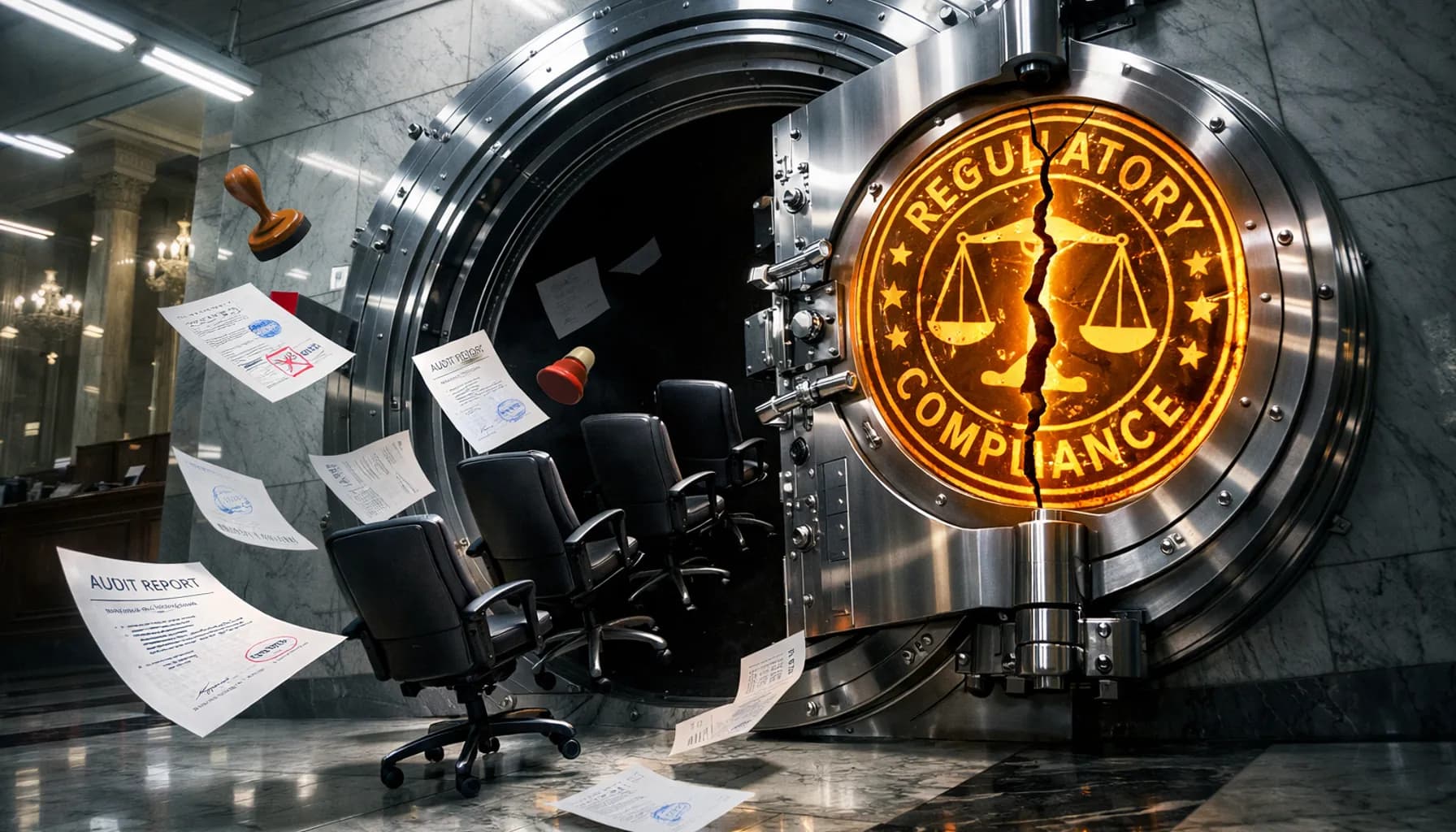
Austria's financial regulator has banned KuCoin EU from onboarding any new customers after the exchange lost all four of its mandatory anti-money laundering and sanctions compliance officers, as of February 23, 2026. The order, issued by the Austrian Financial Market Authority (FMA), arrived just 87 days after KuCoin EU received its MiCA license on November 27, 2025, making it one of the fastest compliance failures in European crypto regulatory history.
87 Days From License to Freeze
KuCoin EU Exchange GmbH, the Vienna-based entity authorized under the Markets in Crypto-Assets Regulation (MiCA), is now prohibited "with immediate effect from concluding business relationships of any kind with new customers," according to the FMA's administrative order. The exchange also cannot offer new contracts or products to existing customers until the compliance gaps are filled.
The positions that are vacant: the anti-money laundering officer and their deputy, plus the sanctions compliance officer and their deputy. Under MiCA and Austria's Financial Markets Anti-Money Laundering Act (FM-GwG), these are not optional roles. They are mandatory key function holders that any licensed crypto-asset service provider must maintain at all times.
What makes this unusual is the speed. KuCoin EU spent months pursuing MiCA authorization, finally securing it on November 27, 2025. The exchange even hosted a launch event in Vienna featuring cycling champion Tadej Pogacar. Less than three months later, the compliance infrastructure has collapsed.
Trading Was Already Dark Since February 4
The FMA's public order is not the first sign of trouble. KuCoin EU's own website disclosed that trading and deposit services were suspended on February 4, 2026 at 14:30 UTC+1, citing "improvement of system stability." That language now reads as a euphemism. The platform has been effectively frozen for nearly three weeks.
For EU users who were relying on KuCoin as their primary exchange, the suspension means no deposits, no trading, and now no path for new users to join. Existing customers can likely withdraw funds, but the scope of available services is severely limited until KuCoin fills the four vacant compliance positions.
The timeline raises a question: did the compliance officers depart voluntarily, or were they part of broader cost-cutting? KuCoin has not disclosed the circumstances of the departures. What is clear is that the exchange published a press release on February 20 announcing it was "expanding its local compliance and governance team in Austria," with Managing Director Sabina Liu stating that "trust must be built on structure, not slogans." Three days later, the FMA made public the reason why that expansion was so urgent.
The First Real MiCA Enforcement Test
This is significant beyond KuCoin. MiCA went into full effect across the European Economic Area in late 2024, and exchanges have been racing to secure licenses. Austria, alongside France and a handful of other member states, became a popular licensing jurisdiction. KuCoin's freeze is the first high-profile enforcement action against a MiCA-authorized exchange, and it sets a precedent for how seriously regulators will police ongoing compliance, not just the initial application.
The message from the FMA is blunt: getting the license is not the finish line. Maintaining the compliance apparatus is a continuous obligation. If your AML officer leaves on a Friday, the regulator expects a replacement before Monday, not a months-long vacancy.
For the dozens of exchanges that obtained or are pursuing MiCA licenses, this is a warning. The regulatory framework is not a rubber stamp. Austrian, French, and other EEA regulators are actively monitoring whether licensed entities maintain the staffing, governance, and controls that were promised in their applications. A license can be effectively suspended through administrative orders like this one without being formally revoked.
What This Means for KuCoin Users in Europe
EU-based users of KuCoin face immediate practical consequences. No new accounts can be created. Existing users cannot access new products or services. Trading and deposits have been offline since February 4. The only activity available appears to be withdrawals.
For users who hold funds on the platform, the priority should be evaluating whether to move assets to an alternative exchange or self-custody wallet. The FMA order is not yet legally final and can be appealed, but there is no timeline for resolution. KuCoin must hire qualified AML and sanctions officers, have them approved by the FMA, and then wait for the regulator to lift the restriction.
KuCoin already carried geo-bans in SpendNode's database for the Philippines and Canada. This Austrian action effectively extends the freeze across all 27 EU member states plus the broader EEA, a far larger user base.
Counterparty Risk and the MiCA Mirage
The broader lesson here is about counterparty risk. A MiCA license provides regulatory legitimacy, but it does not guarantee operational continuity. FTX was regulated in the Bahamas. Wirecard had European banking licenses. Regulatory approval is a necessary condition for trust, not a sufficient one.
For crypto card users, the calculus is straightforward. If your card is tied to an exchange that is your sole on-ramp and that exchange gets frozen, your spending pipeline breaks. Users who spread their crypto across multiple platforms, or who use non-custodial card options that do not depend on a single exchange's operational status, are insulated from this type of disruption.
The KuCoin situation also highlights a gap in the MiCA framework. The regulation sets clear requirements for initial authorization but relies heavily on national regulators for ongoing supervision. Austria's FMA acted quickly here, but the question is whether all 27 member states will be equally vigilant. Regulatory arbitrage, where exchanges pick the softest supervisor, remains a risk even under a theoretically harmonized framework.
What Happens Next
The FMA's order requires KuCoin EU to restore "legal compliance" without delay. The exchange is actively recruiting for Head of Compliance and Head of AML positions in Vienna, according to job postings. Once those roles are filled and the FMA is satisfied, the restriction can be lifted.
But the reputational damage is done. KuCoin EU launched with fanfare, celebrity endorsements, and a MiCA trophy license. Within 87 days, it became the first MiCA-authorized exchange to face a compliance-driven customer freeze. For competitors with cleaner compliance records, this is an opportunity to absorb displaced EU users. For regulators across the EEA, this is proof that the enforcement machinery works.
The order is not yet legally final, meaning KuCoin EU can appeal. But appealing while simultaneously admitting you have no AML officers is a difficult legal position.
Overview
Austria's Financial Market Authority has banned KuCoin EU from accepting new customers after the exchange lost all four of its mandatory AML and sanctions compliance officers, just 87 days after receiving its MiCA license. Trading and deposits have been suspended since February 4. The action is the first major enforcement test of the MiCA regime and sends a clear signal to all licensed exchanges in the EEA: maintaining compliance staff is not optional, and regulators will act immediately when key positions go unfilled. KuCoin EU is recruiting replacements but faces an indefinite freeze until the FMA is satisfied.