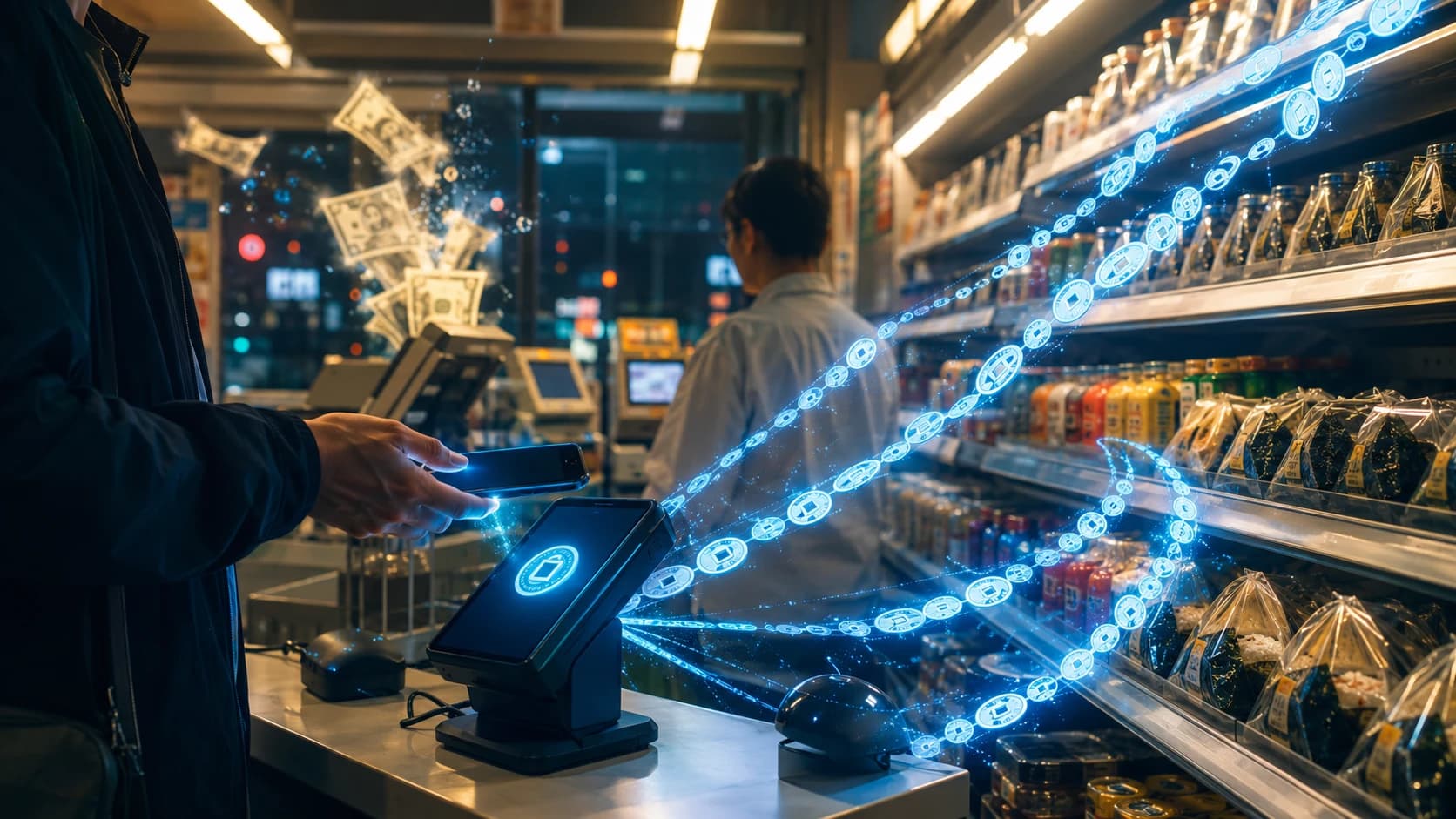
Lawson, one of Japan's three largest convenience store operators, is preparing the country's first point-of-sale stablecoin payment trial, according to a July 13 report from crypto news outlet WuBlockchain. The trial would put stablecoin settlement directly into checkout terminals at a retail network that Japanese shoppers use daily, rather than confining it to a standalone app or a card pilot.
The detail that matters is the phrase "POS-integrated." Most retail crypto experiments in Japan have lived one step removed from the register: a wallet app, a gift-card workaround, or a card that converts crypto to yen before the merchant ever sees it. Wiring stablecoins into the point-of-sale system itself means the payment rail sits where cash and contactless taps already are, at the counter of a chain with roughly 14,000 stores nationwide.
A konbini is an unusual place to test settlement
Japan's convenience stores are not a fringe venue. They handle bill payments, ticket pickups, ATM withdrawals, and tax remittances alongside food and drink. That makes Lawson's counter one of the densest payment surfaces in the country, and a demanding one. A stablecoin trial there has to clear transactions in the seconds a cashier expects, reconcile against a merchant back office built for yen, and do it without the customer needing to understand what a stablecoin is.
That operational bar is the real story. A protocol demo can tolerate a slow confirmation or a failed transaction. A register cannot. If Lawson runs stablecoin payments through live POS hardware, the trial is effectively a stress test of whether stablecoin settlement can meet retail-grade reliability in a market known for exacting service standards. Japan has moved deliberately here, with a licensing regime for yen-referenced stablecoins that took shape well before this kind of retail pilot.
Japan's regulatory groundwork made this possible
The trial does not appear in a vacuum. Japan legally recognized stablecoins as a distinct category under its revised Payment Services Act, creating a framework for licensed issuers rather than leaving them in a gray zone. That legal clarity is part of why a mainstream retailer can even consider putting a stablecoin rail at the register without regulatory ambush. A supermarket chain in most jurisdictions would not touch this without a clear answer on who is liable when a payment fails.
The report does not name which stablecoin Lawson will use, the trial's start date, or how many stores are involved. Those are the variables worth watching. A single-store proof of concept is a press release; a multi-store rollout with a licensed yen stablecoin is infrastructure. Until Lawson or its partners confirm scope, the announcement sits closer to the former.
The retail rail race is widening
Lawson's move lands in a stretch of announcements aimed at pushing stablecoins toward everyday spending. PayPal recently issued its PYUSD token natively on Polygon in a bid to court merchants, and MetaMask has tied a stablecoin balance to card spending. Each attacks the same gap from a different side: getting a stablecoin to the moment of purchase without asking the shopper to think about blockchains.
For crypto card users, the Lawson trial is a useful signal even though it is not a card product. Cards exist partly because merchants do not accept crypto directly, so a card converts crypto to fiat behind the scenes. If a major retailer accepts stablecoins natively at the register, part of that reason-to-exist narrows, at least for stablecoin holders in Japan. That does not make cards obsolete. Cards still handle cross-border spend, rewards, and the thousands of merchants that will never integrate a crypto rail. But direct merchant acceptance and card rails are now competing for the same checkout, and a konbini counter is a fair place to see which one shoppers actually reach for.
The near-term impact is narrow. One chain, one country, an unspecified number of stores, and no confirmed timeline. The longer-term question is whether a stablecoin can behave like money at a register that processes millions of small transactions, and Japan's convenience stores are one of the harder environments to prove that in.
Overview
Lawson, a top-three Japanese convenience store chain, is preparing the country's first POS-integrated stablecoin payment trial, per a July 13 WuBlockchain report. The significance is the point-of-sale integration itself, putting stablecoin settlement at the register of a ~14,000-store network rather than in a separate app. Japan's stablecoin licensing framework under its revised Payment Services Act laid the groundwork. Key unknowns remain: the specific stablecoin, the start date, and the number of stores. Until scope is confirmed, treat it as an early signal rather than a finished rollout.