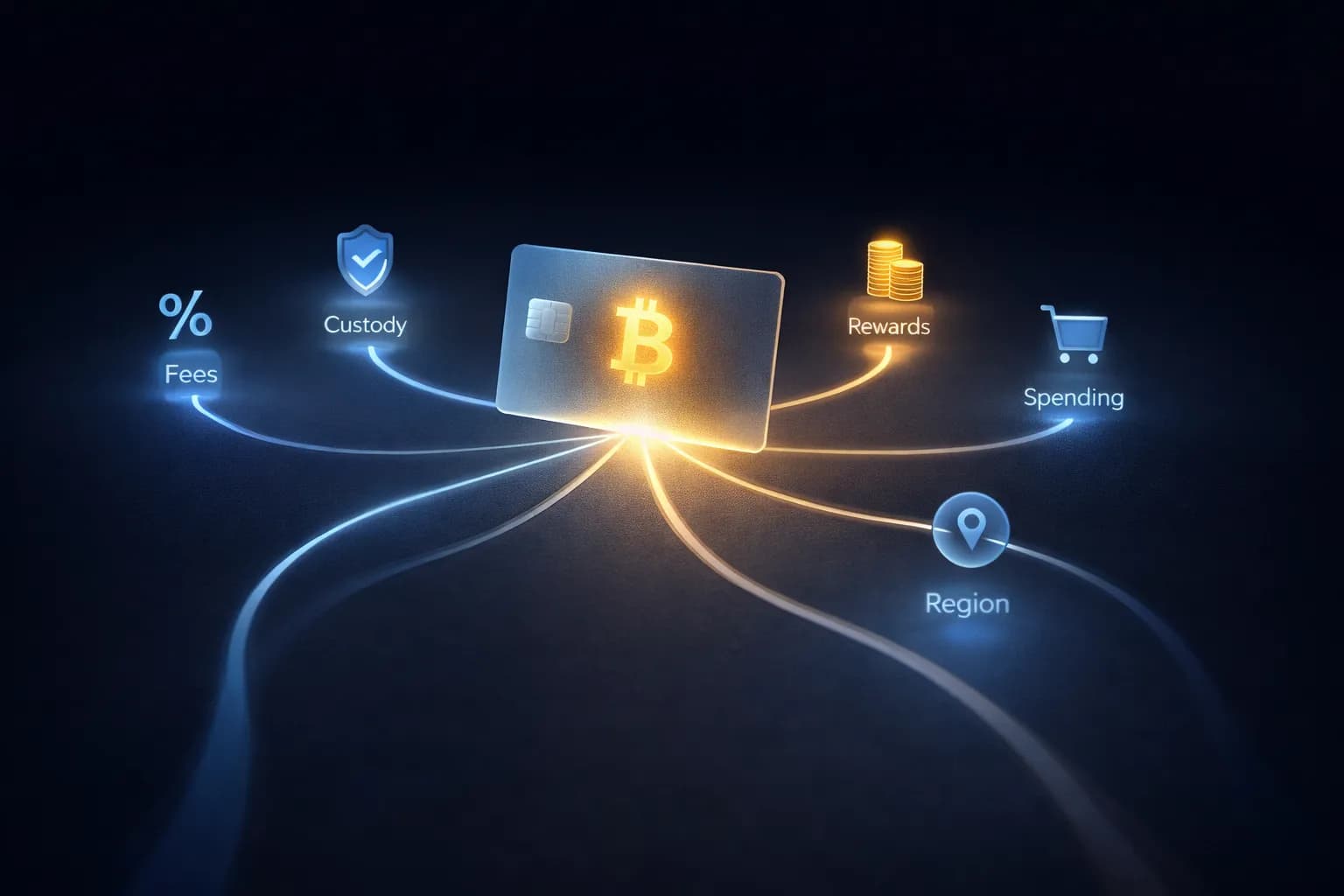
Choosing your first crypto card should be simpler than it usually feels.
Instead, most people start with the wrong filter. They look at the highest cashback rate, the nicest card design, or whichever issuer gets mentioned most often on social media. Then they find the catch later: bad FX, awkward funding, limited availability, or a reward tier they were never realistically going to reach.
The good news is that your first card does not need to be the perfect card. It just needs to be the right starting point.
If you want the shortest version, start with our beginners page. If you want the longer decision framework, use the five questions below and answer them in order.
Your first crypto card should usually be boring in a good way: available in your country, easy to fund, low-friction to use, and hard to misuse. Save the experimental reward stacks and token-tier games for your second card, not your first.
The Five Questions That Matter
1. Can You Actually Get the Card Where You Live?
This is the first filter because it removes fantasy choices immediately.
A card can look perfect in a comparison table and still be useless if:
- it does not ship to your country
- it does not support your region in the app
- local regulation blocks the product
- your state or jurisdiction is excluded
This is especially relevant in:
- the US, where state-level licensing still matters
- the EU, where availability is broad but not uniform
- countries outside the main issuer corridors, where cards often market themselves as "global" but mean only selected markets
So the first real question is not "What earns the most?" It is "What can I actually use where I live?"
If you are unsure, start from country pages or the issuer's own availability list before reading any deeper.
2. Do You Want Simplicity or Self-Custody?
This is the second big fork.
Custodial cards are easier for most first-time users. You hold funds with the provider, top up inside the app, and spend like you would with a normal prepaid or debit product. The tradeoff is obvious: the provider holds the funds between deposit and spend.
Self-custodial cards keep the asset closer to your own wallet until the moment of purchase. That reduces counterparty risk, but it also raises the chance that your first setup feels more complicated than it needs to.
For most people getting their first card, the practical answer is still:
- start with a smoother custodial experience
- learn how funding, conversion, and rewards actually work
- move toward self-custody later if that tradeoff matters to you
That is not because custodial is "better." It is because many first-card mistakes come from taking on too many moving parts at once.
If you already know you care most about self-custody, skip straight to self-custody cards. Otherwise, keep it simple first.
3. What Will You Actually Spend With It?
Most people answer this too vaguely.
"Everyday spending" is not enough. A card that works well for:
- groceries and subscriptions
is not automatically the right card for:
- international travel
- ATM-heavy use
- large occasional purchases
- stablecoin off-ramping
The most useful split looks like this:
| Spending pattern | What matters most |
|---|---|
| Domestic everyday use | low friction, easy top-up, no annual fee |
| Travel and cross-border spend | low FX and good network acceptance |
| Online subscriptions | virtual card quality, Apple Pay / Google Pay, stable funding |
| Larger periodic purchases | higher limits, cleaner funding, lower conversion drag |
This is where a lot of first-card disappointment comes from. Users think they picked a cashback card, but what they really needed was a cleaner FX card. Or they think they picked a travel card, but what they really needed was one with a smoother stablecoin funding path.
4. Are the Rewards Real, or Just Loud?
This is where beginners get pulled off course.
A headline like:
- 5% cashback
- 8% rewards
- free airport lounge
- premium metal card
can be real and still be the wrong reason to start there.
The better questions are:
- Is the reward rate available without staking a large token position?
- Is there a monthly cap?
- Are rewards paid in something I actually want to hold?
- Does a lower-fee card beat this one once the real math is done?
For a first card, it is usually better to choose:
- lower but cleaner rewards
- clearer fee structure
- easier funding
than to chase the highest advertised tier.
That is why cashback pages are useful, but only after you have already filtered for geography, custody, and spend pattern.
5. What Is More Important to You: Rewards, Fees, or Risk?
Your first card should match the one thing you care about most.
Not everything at once.
If your real priority is:
- low stress and easy onboarding, start with a beginner-friendly, low-friction card
- tight economics, look at no annual fee and no FX fee options first
- keeping your own keys, start with self-custody and accept the extra setup
- higher upside, then you can start looking at staking tiers, token rewards, and more complex card stacks
Trying to optimize all four on your first card is how people end up with a card they technically admire and practically stop using.
A Better First-Card Decision Table
This is the simpler way to think about it.
| If you care most about... | Start here |
|---|---|
| Lowest learning curve | major custodial issuer in your region |
| Low recurring cost | no annual fee cards |
| Travel and cross-border use | zero FX fee cards |
| Self-custody from day one | self-custody cards |
| Stablecoin spending | stablecoin-friendly cards |
| Reward optimization later | cashback cards after you understand the fee side |
That is more useful than pretending there is one universally best starter card.
The Mistakes First-Time Users Make
Mistake 1: Picking Based on Cashback Alone
This is still the biggest one.
A beginner sees 3%, 5%, or 8% and assumes the answer is obvious. Then the details show up:
- staking threshold
- monthly cap
- token lockup
- weak FX
- conversion spread
At that point the "high reward" card can easily become the worse economic choice.
Mistake 2: Starting With a Card That Is Too Complex
A first crypto card should not require you to learn:
- seed phrase management
- gas budgeting
- token-tier reward unlocks
- yield mechanics
- tax edge cases
all at the same time.
You can learn those later. Your first card should mostly teach you:
- how funding works
- how spending works
- how rewards are credited
- what the real fee drag looks like
Mistake 3: Ignoring the Funding Asset
Funding with BTC or ETH is not the same as funding with stablecoins.
For many users, stablecoins make the first-card experience much cleaner:
- less volatility
- smaller disposal swings
- easier budgeting
If your first card is going to be your test environment, stablecoin funding is usually the calmer way to start.
Mistake 4: Treating "Global" as Meaning Universally Usable
Many cards market themselves as global. That often means:
- many countries supported
not:
- every country supported
- identical protections everywhere
- physical shipping everywhere
- same fees and features in every market
That distinction matters more than it sounds.
Our usual first-card path
In our view, the safest path for a first crypto card usually looks like this:
- pick a card that is clearly available in your country
- favor lower friction over maximum reward
- fund with stablecoins first, if possible
- avoid staking-heavy or token-tier setups on day one
- use it for one month before deciding whether you need something more advanced
That one month tells you more than another three hours of comparison reading.
You will quickly find out:
- whether the top-up flow annoys you
- whether the card gets accepted where you shop
- whether the reward rate survives the real fee stack
- whether you actually want self-custody for spending
At that point, your second decision is much easier and much cheaper.
Do not let your first crypto card become your first crypto reward strategy, first self-custody experiment, first tax complexity lesson, and first travel card at the same time. Pick one clean use case and start there.
Overview
The best first crypto card is usually not the most rewarding one. It is the one that works cleanly in your region, matches your spending pattern, keeps the fee stack understandable, and does not ask you to learn five other parts of crypto on day one. Geography, custody, funding asset, reward realism, and your actual spending habits matter more than the headline cashback number. Start simple, use the card for a month, and let real usage tell you what to optimize next.