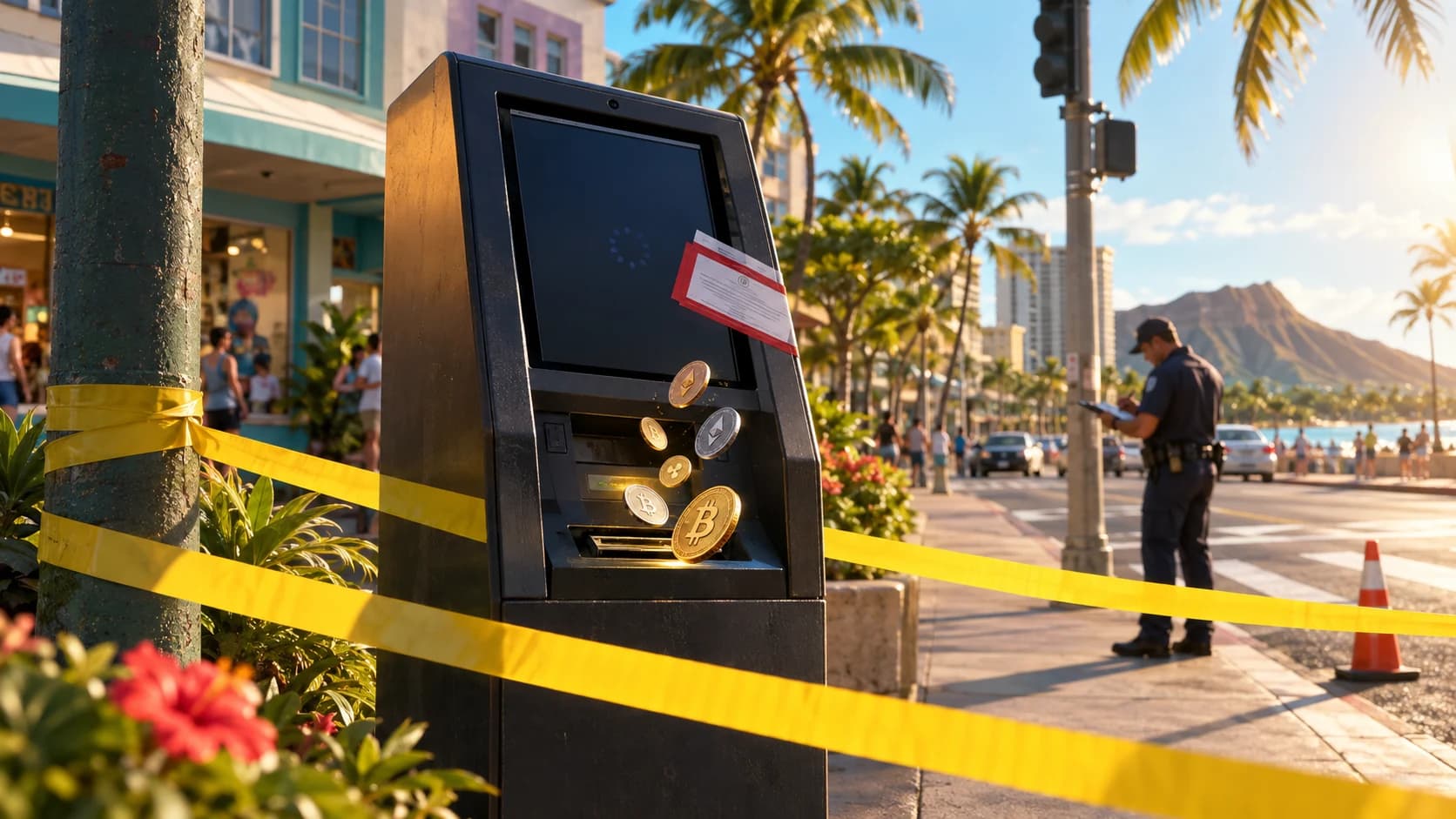
Hawaii will ban cryptocurrency ATMs and kiosks across the state starting October 1, becoming the fourth US state to move against the machines. Cointelegraph reported the ban on August 13, 2026, citing the growing use of the kiosks in fraud schemes that target older and less experienced users.
The decision puts Hawaii among a small but expanding group of states treating physical crypto on-ramps as a consumer protection problem rather than a payments convenience. For anyone in the islands who relied on a corner-store kiosk to buy Bitcoin with cash, the option disappears in roughly seven weeks.
The machines regulators keep pointing at
Crypto ATMs look like ordinary cash machines but work in reverse for most users: you insert bank notes, and the kiosk sends the equivalent in Bitcoin or another asset to a wallet address you scan or type in. The convenience is real for people without a bank account or a verified exchange login. So is the fraud exposure.
The scam pattern is consistent enough that law enforcement now describes it in near-identical terms across jurisdictions. A victim gets a call, a text, or a pop-up claiming their account is compromised, they owe back taxes, or a relative is in trouble. The caller directs them to withdraw cash, drive to a specific kiosk, and deposit it into a wallet address the scammer controls. Once the transaction confirms on-chain, the money is gone. There is no chargeback, no reversal, and usually no way to identify the recipient.
Kiosk operators typically charge fees far above what a regulated exchange would, often stacking a flat markup on top of a spread that can run well into double digits. That combination, high fees plus a fraud vector aimed at vulnerable people, is what has drawn regulators in.
A pattern spreading across states
Hawaii's ban is not happening in isolation. Several US states have already restricted or effectively banned crypto kiosks over the past year, and others have imposed transaction caps, mandatory refund windows for first-time victims, and clearer on-screen fraud warnings. The measures vary, but the direction is the same: tighter limits on machines that let strangers move cash into irreversible crypto payments with minimal checks.
Framing matters here. A statewide ban is a harder line than a cap or a disclosure rule. It removes the on-ramp entirely rather than trying to slow it down, which tells you regulators in Honolulu concluded the fraud risk outweighed the legitimate use case. That is a meaningful signal for operators weighing where to deploy hardware next.
The counterargument, which the industry has raised elsewhere, is that banning kiosks pushes cash-preferring users toward less regulated channels or cuts them off from crypto access altogether. Neither side of that debate changes the immediate fact on the ground in Hawaii.
The options left for Hawaii residents
Residents who want to buy or spend crypto will need to route through regulated exchanges or card products instead of a physical kiosk. That shift is not necessarily a downgrade. Mainstream exchange onboarding usually costs far less than a kiosk's fees, and card-based access has broadened well beyond what it offered a couple of years ago.
For everyday spending, a crypto card converts holdings to fiat at the point of sale and settles over the Visa or Mastercard rails, with fee structures that are at least disclosed up front. Users who care about keeping control of their funds can look at self-custody options that spend directly from a wallet rather than parking balances with a custodian. Those who value cash-like anonymity may find the closest fit in cards with simplified onboarding, though the trade-offs differ from a kiosk and vary by provider and region.
One caution worth carrying over from the kiosk debate: the disclosed fee is rarely the full cost. Card products layer a network spread of roughly 0.5 to 0.9 percent and a crypto-to-fiat conversion spread at checkout on top of any headline rate. Reading the fee page before committing is the same discipline that would have protected kiosk users, just applied to a different rail.
Market backdrop
The ban lands during a soft stretch for crypto prices. Bitcoin traded near $63,560 as of August 13, 2026, down about 0.8 percent on the day, with the Fear and Greed Index sitting at 38, in "Fear" territory. Ether was around $1,883 and Solana near $75.84 over the same window. None of that is driven by a single state's kiosk policy, but the regulatory tightening does add to a cautious tone across US crypto markets, where policy divergence between states and federal agencies keeps operators guessing about the next rule.
For crypto users elsewhere in the United States, Hawaii is a data point rather than a national mandate. States continue to set their own course on kiosks, licensing, and consumer protection, and the gap between the strictest and most permissive jurisdictions is widening rather than closing.
Overview
Hawaii will prohibit crypto ATMs and kiosks statewide from October 1, 2026, becoming the fourth US state to shut the machines down over fraud concerns. The kiosks have become a favored tool in cash-deposit scams that hit older and less experienced users, and their high fees make them a poor deal even for legitimate buyers. Hawaii residents who still want crypto access will need to shift to regulated exchanges or card products, where fees are disclosed and, in most cases, lower. The move fits a broader pattern of US states tightening rules on physical crypto on-ramps while federal policy remains unsettled.