GameStop kept its Bitcoin. Every last coin except one.
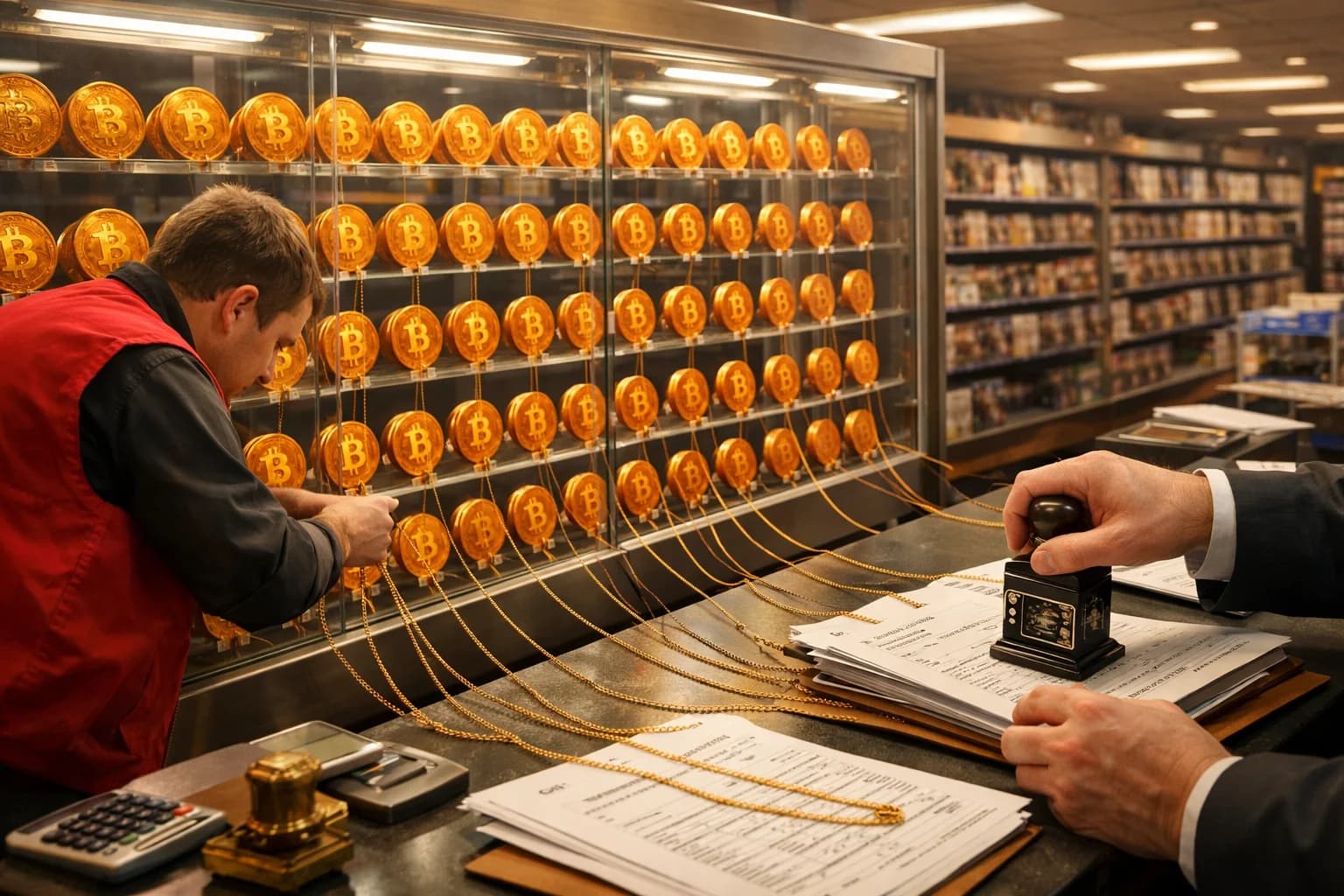
The video game retailer's SEC 10-K filing, submitted March 24, 2026, reveals that GameStop transferred 4,709 of its 4,710 BTC to Coinbase Credit as collateral for a covered-call options strategy. The move, which initially triggered speculation that the company had liquidated its crypto treasury, was an income play, not an exit.
The options carry strike prices between $105,000 and $110,000, with maturities running through March 27, 2026, today. With Bitcoin trading at $69,067 as of March 27, 2026, well below those strikes, the calls will almost certainly expire worthless. GameStop keeps the premium income, keeps the Bitcoin, and keeps the full downside.
How a Retailer Became an Options Desk
GameStop bought 4,710 BTC in May 2025 for approximately $500 million, paying an average of roughly $106,000 to $107,900 per coin. At the time, the purchase looked like a straightforward corporate treasury play, following the playbook that Strategy (formerly MicroStrategy) had been running for years.
But the 10-K shows GameStop did something different. Rather than simply holding, the company entered a collateral agreement with Coinbase Credit, Inc. and began selling over-the-counter covered-call options against nearly the entire stack. This is a strategy institutional traders use to generate yield on holdings they plan to keep: you sell someone the right to buy your asset at a higher price, collect the premium, and accept that your gains are capped if the asset rallies past the strike.
The strikes, $105,000 to $110,000, sat close to GameStop's cost basis. That means the company was not betting on a moonshot. It was trying to earn income while waiting for Bitcoin to recover to roughly where it bought in.
The $131.6 Million Loss
The strategy did not work out the way the spreadsheet projected.
Bitcoin's decline from GameStop's entry price produced a total loss of $131.6 million on digital assets and related receivables for fiscal 2025 (ending January 31, 2026). The filing breaks it down:
- $71.8 million realized loss upon derecognition, the accounting hit from transferring the BTC to Coinbase under terms that allow rehypothecation
- $59.7 million unrealized loss on the digital assets receivable, reflecting Bitcoin's price decline from the original purchase price to the January 31 valuation
- $0.1 million remeasurement loss on the single Bitcoin GameStop kept on its own balance sheet
- $2.3 million unrealized gain on the options themselves, partially offset by a $0.7 million derivative liability
The net picture: GameStop is underwater on its Bitcoin bet, the options generated some premium income, and the accounting treatment created a strange side effect.
The Accounting Quirk That Dropped GameStop 169 Spots
Because Coinbase can rehypothecate or redeploy the pledged Bitcoin under the collateral agreement, GameStop no longer classifies the 4,709 BTC as directly held assets. Instead, it records a "digital assets receivable," the contractual right to reclaim equivalent Bitcoin when the agreement concludes.
This accounting treatment dropped GameStop from approximately 21st among global corporate Bitcoin holders to 190th, according to Bitcoin Treasuries tracking data. The company still has the economic exposure. It still bears the price risk. But on paper, it does not "hold" the Bitcoin anymore, Coinbase does.
For anyone tracking corporate Bitcoin treasuries, this creates a blind spot. A company can maintain full economic exposure to thousands of BTC while falling off the leaderboard entirely. If other corporations adopt similar collateral-based strategies, the public Bitcoin treasury rankings will become less reliable as a gauge of institutional conviction.
What Happens When the Options Expire
The covered calls mature today, March 27, 2026. With BTC at $69,067, roughly $36,000 below the lowest strike, the calls expire out of the money. The option buyers lose their premium. GameStop keeps the income and regains full discretion over the collateral.
The question is what comes next. GameStop can:
- Reclaim the 4,709 BTC and hold outright
- Roll into new covered calls at different strikes and maturities
- Sell the position entirely, now that the collateral agreement is unwinding
The 10-K does not indicate which path the company will take. But the filing's detailed disclosure of the strategy suggests GameStop views this as an ongoing treasury operation, not a one-time experiment.
A Corporate Playbook Taking Shape
GameStop is not the first public company to use Bitcoin as collateral, but it may be the first retailer to run covered-call options on a crypto treasury this large. The strategy borrows directly from how institutional equity investors manage large stock positions: write calls to generate income, accept capped upside, and ride out downturns.
The $131.6 million loss is real. But GameStop entered fiscal 2026 with $4.77 billion in cash and investments. The Bitcoin position, even underwater, represents less than 8% of the company's liquid resources. This is not an existential bet. It is an experiment in corporate treasury management using digital assets as the underlying.
Whether other companies follow, or whether GameStop itself doubles down, will depend on where Bitcoin trades over the next few quarters. The covered-call playbook only works if you believe the asset will recover to your strikes eventually. At $69,000, GameStop needs a 52% rally to reach $105,000.
Overview
GameStop's 10-K filing reveals the company pledged 4,709 BTC to Coinbase Credit as collateral for covered-call options with $105,000 to $110,000 strikes, expiring March 27, 2026. The strategy generated premium income but left GameStop with a $131.6 million total loss on digital assets for fiscal 2025. The accounting treatment reclassified its Bitcoin as a receivable, dropping the company from 21st to 190th on corporate Bitcoin holder rankings. With options expiring today and BTC at $69,067, GameStop will likely reclaim full discretion over the collateral.