Seven Forks, Five North Stars, and a 2029 Deadline
Ethereum Foundation researcher Justin Drake published a document called the "Strawmap" on February 25, 2026, laying out seven planned hard forks on a roughly six-month cadence through 2029. Within hours, Vitalik Buterin publicly endorsed the plan and added his own technical commentary on how Ethereum should approach faster block times and quantum resistance. As of February 26, 2026, ETH trades near $2,100 with a market cap of roughly $253 billion.
The Strawmap is not a binding schedule. Drake described it as "a technical coordination tool for the EF protocol team" and "an invitation to view L1 protocol upgrades through a holistic lens." It is hosted as a living document at strawmap.org and will receive at least quarterly updates. But the scope is the most ambitious since the Merge: five "north star" end-states that, if achieved, would turn Ethereum's Layer 1 into a 10,000 TPS chain with seconds-level finality, native privacy, and cryptography that survives quantum computing.
The first two forks, Glamsterdam (H1 2026) and Hegota (H2 2026), are already in active development. The remaining five use placeholder names and will be defined as research matures, with the final fork targeting roughly 2029.
Cointelegraph first reported on Vitalik's detailed commentary on the roadmap.
The Five North Stars: What Ethereum Wants to Be by 2029
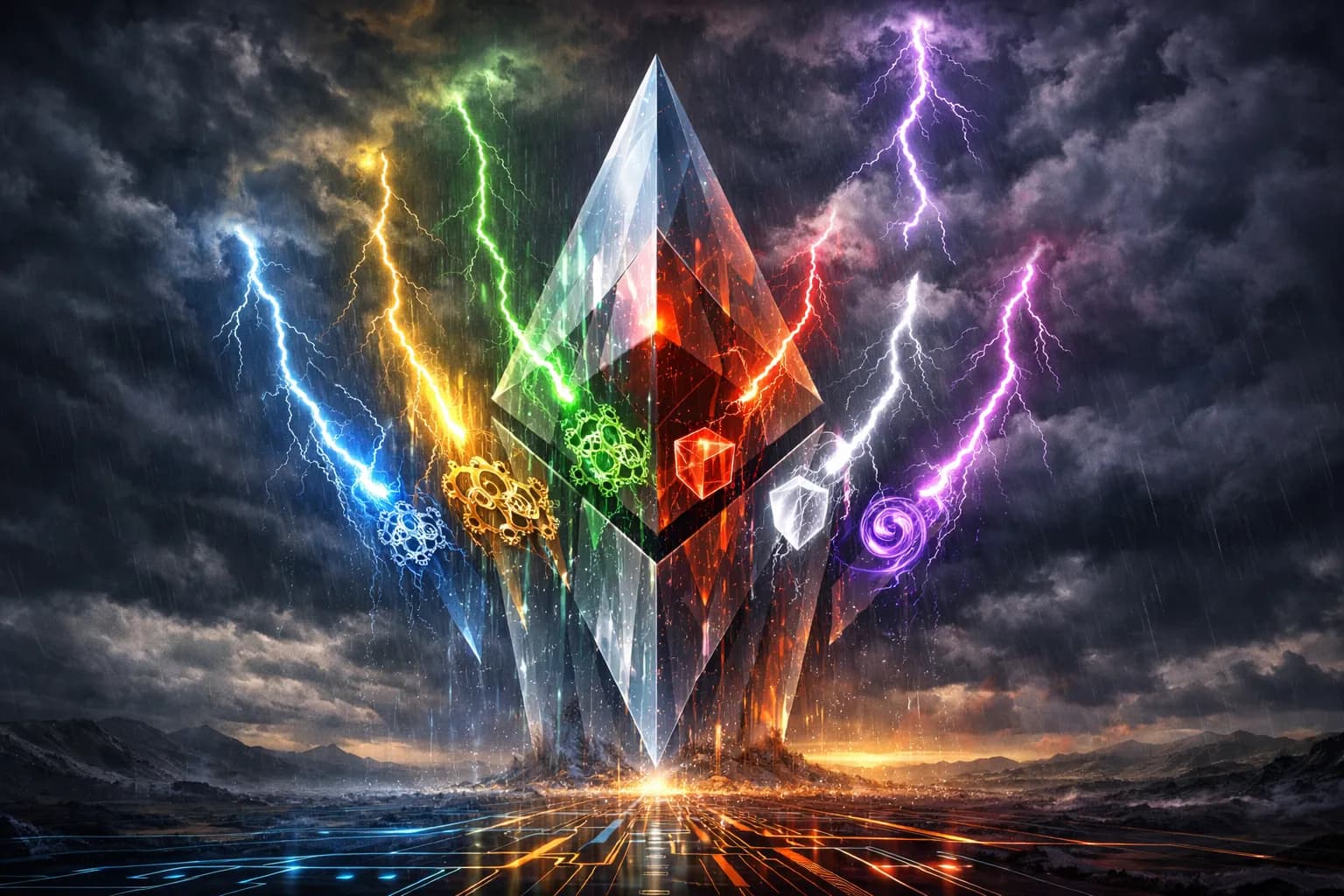
The Strawmap organizes Ethereum's long-term goals around five "black box" targets. Each describes an end-state, not a specific implementation, giving researchers and client teams flexibility in how they get there.
1. Fast L1. Reduce slot times from the current 12 seconds to as low as 2 seconds, and achieve finality in single-digit seconds instead of the current 16-minute confirmation window. This is the north star that drew Vitalik's most detailed commentary.
2. Gigagas L1. Process one billion gas per second on Layer 1, translating to roughly 10,000 transactions per second. The path runs through enshrined zkEVMs that verify execution using zero-knowledge proofs, allowing validators to confirm blocks without re-executing every transaction. No additional hardware requirements for node operators.
3. Teragas L2. Provide one teragas per second of data availability for Layer 2 rollups, enabling approximately 10 million TPS across the ecosystem. PeerDAS (Peer-to-Peer Data Availability Sampling), which already shipped in 2025, is the foundation. Further parameter increases and sampling improvements will push throughput higher.
4. Post-Quantum L1. Replace ECDSA signatures with quantum-resistant alternatives based on hash functions or lattice cryptography. The 2025 announcement of Google's Willow quantum chip and subsequent research suggesting cryptographic breakage could arrive by 2028 added urgency to this track.
5. Private L1. Embed first-class privacy into the protocol through shielded ETH transfers, allowing users to conceal balances and transaction histories without relying on third-party mixers or rollups. This is the most politically charged of the five north stars, given regulatory pushback against privacy tools like Tornado Cash.
Vitalik's Formula for Faster Slots
Vitalik's commentary zeroed in on the first north star: speed. He proposed an incremental approach to cutting slot times rather than a single dramatic change. His preferred formula follows a square-root-of-two reduction pattern: 12 seconds to 8, then 6, then 4, then 3, then 2.
"I like the sqrt(2) at a time formula," Vitalik wrote. "Though the last two steps are more speculative and depend on heavy research."
The technical challenge is real. Each reduction requires faster block propagation across Ethereum's global peer-to-peer network. Moving from 12 to 8 seconds is achievable with current client optimizations. Going below 4 seconds demands fundamental improvements in how nodes gossip blocks, validate state transitions, and reach consensus.
On finality, Vitalik wants to decouple it from slot times entirely. "The goal is to decouple slots and finality, to allow us to reason about both separately," he explained. The proposed replacement for Ethereum's current multi-round finality mechanism is an algorithm called Minimmit, a one-round BFT (Byzantine Fault Tolerance) protocol that could achieve finality in 6 to 16 seconds, down from the current 16 minutes.
The combination of 2-second slots and single-digit-second finality would make Ethereum's base layer competitive with Solana (400ms finality) and Monad (0.8s finality) for the first time, though still meaningfully slower. The difference: Ethereum would achieve this speed with a validator set of hundreds of thousands, not hundreds.
The Quantum Clock Is Ticking
One of Vitalik's most striking observations is about the order of quantum resistance. The Strawmap's architecture allows slots to become quantum-resistant before finality does. This creates a temporary but critical safety net: if quantum computers capable of breaking ECDSA emerge sooner than expected, Ethereum's chain would keep producing blocks (slots are protected), even though the finality guarantee would be temporarily lost.
"There is a pathway to making the slots quantum-resistant much sooner than making the finality quantum-resistant," Vitalik noted, "so Ethereum may quickly get to a regime where, if quantum computers suddenly appear, the chain keeps chugging along even though the finality guarantee is lost."
This is not an academic concern. Google's Willow chip demonstrated meaningful progress in error correction for quantum computing in late 2025, and multiple research teams have published timelines suggesting cryptographically relevant quantum computers could arrive between 2028 and 2035. Ethereum's current ECDSA signatures would be vulnerable, and the Strawmap's post-quantum track is designed to complete the migration before that window opens.
The migration path itself leans on the account abstraction work already shipping in 2026. Because smart contract wallets can swap their signature verification logic without changing addresses, users can transition to quantum-resistant schemes gradually rather than through a single disruptive hard fork.
What This Means for Ethereum Users and Card Holders
The practical impact of the Strawmap unfolds across multiple timelines. The nearest-term changes arrive with Glamsterdam in H1 2026, which includes enshrined Proposer-Builder Separation (ePBS) and Block-level Access Lists (BALs) to support higher gas limits. Hegota follows in H2 2026 with further scaling and UX improvements.
For the 65+ crypto cards that settle transactions on Ethereum or its rollups, faster finality is the headline upgrade. Current 16-minute finality means card issuers using Ethereum for settlement carry significant confirmation risk. Reducing that to under 16 seconds changes the cost-benefit calculation for issuers like Gnosis Pay, which settles directly on Gnosis Chain (an Ethereum sidechain), and ether.fi, which processes transactions through Ethereum-native DeFi.
The Gigagas target of 10,000 TPS on L1 would also dramatically reduce gas costs for on-chain top-ups and self-custody wallet operations. Cards that require users to fund from on-chain wallets, including MetaMask, Ledger, and Bleap, would see meaningful UX improvements as base-layer transactions become faster and cheaper.
Native privacy through shielded ETH transfers, if it ships, would address one of the persistent criticisms of using transparent blockchains for everyday spending: anyone who knows your address can see your entire transaction history.
Ethereum's Competitive Response to Solana and Monad
The Strawmap reads as a direct response to the competitive pressure Ethereum has faced over the past 18 months. Solana's Alpenglow upgrade brought finality down to 150 milliseconds. Monad launched with 0.8-second finality and 10,000 TPS. Both chains have attracted card issuers and payment companies that prioritize speed over Ethereum's security and decentralization advantages.
Vitalik's commentary acknowledged this dynamic without naming competitors directly. The incremental approach to slot reduction, he argued, allows Ethereum to ship meaningful speed improvements at each step rather than waiting years for a single massive upgrade that may never land.
The seven-fork cadence is itself a statement of intent. Ethereum shipped two major upgrades (Pectra and Fusaka) in 2025 and already has two more (Glamsterdam and Hegota) confirmed for 2026. If the Strawmap holds, Ethereum will execute more protocol-level upgrades between 2025 and 2029 than it did in its entire first decade.
Whether the plan survives contact with implementation reality is the central question. Ethereum's client diversity, with five major execution clients and five consensus clients, makes coordination harder than monolithic chains. Each fork requires all client teams to implement, test, and ship changes in sync. The Merge took years of preparation for a single consensus change. The Strawmap asks for seven forks in four years.
Overview
The Ethereum Foundation's Strawmap is the most comprehensive L1 upgrade plan since the Merge, plotting seven hard forks through 2029 across five north star goals. Vitalik Buterin's endorsement and detailed technical commentary on faster slots (targeting 2-second block times via an incremental sqrt(2) formula) and decoupled quantum-resistant finality (via the Minimmit algorithm) signal that Ethereum's core developers are serious about competing on speed without sacrificing decentralization. The first two forks, Glamsterdam and Hegota, land in 2026. Execution risk is high given the coordination required across ten major client teams, but the ambition is unmistakable: Ethereum wants to be a 10,000 TPS, quantum-resistant, privacy-preserving settlement layer by the end of the decade.