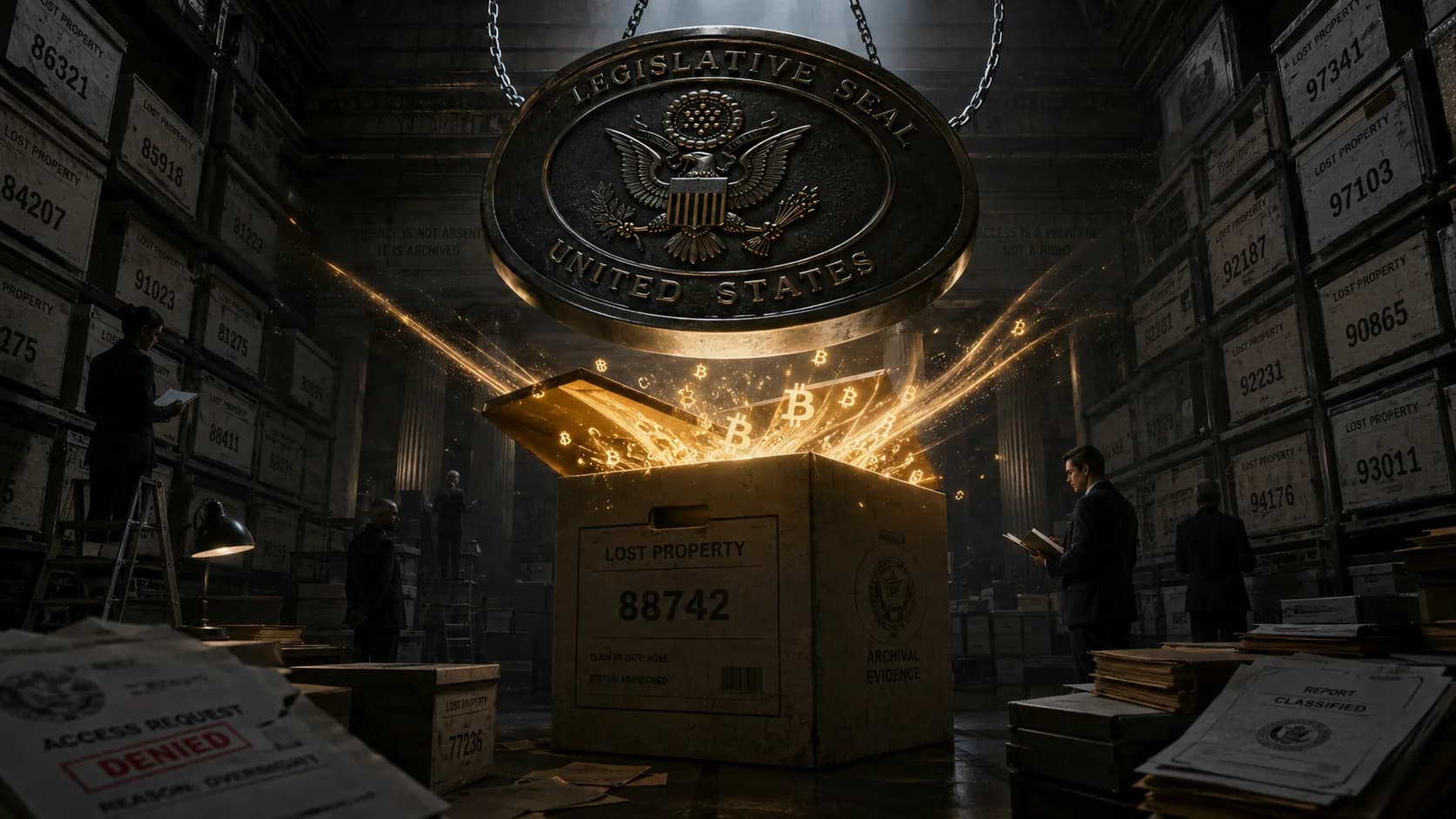
A lawsuit working its way through the US courts is testing a question most Bitcoin holders assumed was settled: can coins that sit untouched for years be treated as lost or abandoned property, and claimed by someone else? The suit, reported by CryptoSlate on July 26, 2026, argues that roughly 3.8 million dormant Bitcoin could fall under the same lost-and-found framework that lets police departments and states take custody of unclaimed goods. Bitcoin traded at $64,647 as of July 26, 2026, which values that dormant pool at well over $200 billion.
Lawmakers are moving to shut the argument down before a court can rule on it. A draft section of the CLARITY Act, numbered 20216, states that a self-custodied digital asset cannot become abandoned or unclaimed property purely because the owner has not moved it. The timing is not subtle. The legislation is racing the litigation.
The lost-property theory
Unclaimed property law is old and mostly boring. When a bank account, safe deposit box, or uncashed check sits idle past a statutory dwell period, custody escheats to the state, which holds it until the rightful owner appears. Police lost-and-found rules work on similar logic: found goods with no claimant eventually transfer to whoever is holding them.
The lawsuit stretches that logic onto the blockchain. Dormant Bitcoin, the argument goes, is functionally abandoned, no transactions, no signs of an active owner, in some cases wallets untouched since the network's earliest years. If a court accepted that framing, the coins could in theory be declared unclaimed and become available to claimants under existing property statutes.
The 3.8 million figure is not random. It roughly tracks long-dormant supply, including coins tied to Satoshi-era wallets and lost keys that have not moved in over a decade. That supply has always been treated as economically dead. Reclassifying it as legally claimable would be a different matter entirely.
Section 20216 as a firewall
The CLARITY draft response is direct. Section 20216 draws a line: holding your own keys and simply not spending is not abandonment. Custody through possession of the private key is ownership, full stop, regardless of how long the wallet has been quiet.
For anyone who spends from their own wallet or holds long-term without touching a balance, the distinction matters. Self-custody is built on the premise that control of the key equals control of the asset. A ruling that dormant equals abandoned would undercut that premise and inject a new counterparty into an arrangement designed to have none: the state, or a private claimant, asserting rights over coins the holder never gave up.
The provision would also protect estates and inheritance cases, where a wallet can legitimately sit still for years between an owner's death and an heir gaining access to the keys.
The stakes beyond the headline number
The $200 billion figure grabs attention, but the precedent is the real prize. If dormancy could trigger a property claim, the effect would ripple far past Satoshi's coins. Any cold-storage holder, any long-term saver, any wallet parked for a multi-year horizon would carry a new legal question mark.
Markets have not reacted to the suit, which reads as early-stage and speculative rather than an imminent threat. Bitcoin's price moved less than one percent on the day. That calm reflects a view that Section 20216, or something like it, closes the gap before a judge ever weighs the merits. This is speculative analysis, not financial advice, and the outcome depends on both the litigation calendar and whether CLARITY passes the Senate with the provision intact.
The CLARITY Act has been grinding through Congress for weeks, with the Senate floor timeline still contested. Section 20216 adds one more reason for the industry to want it finished. A property-law challenge to dormant coins is the kind of edge case that only becomes real if the legislative fix stalls.
For holders in the United States, the practical takeaway is narrow for now. Nothing about the suit changes control of your keys today. The risk is precedent, not enforcement, and the drafted statute is aimed squarely at making sure that precedent never forms.
Overview
A lawsuit is testing whether 3.8 million dormant Bitcoin, worth more than $200 billion at current prices, can be treated as lost or abandoned property under existing found-goods rules. Congress is countering with CLARITY Act Section 20216, which would declare that self-custodied assets never become abandoned simply because they sit unmoved. The legislation is racing the litigation, and markets are betting the law arrives first.