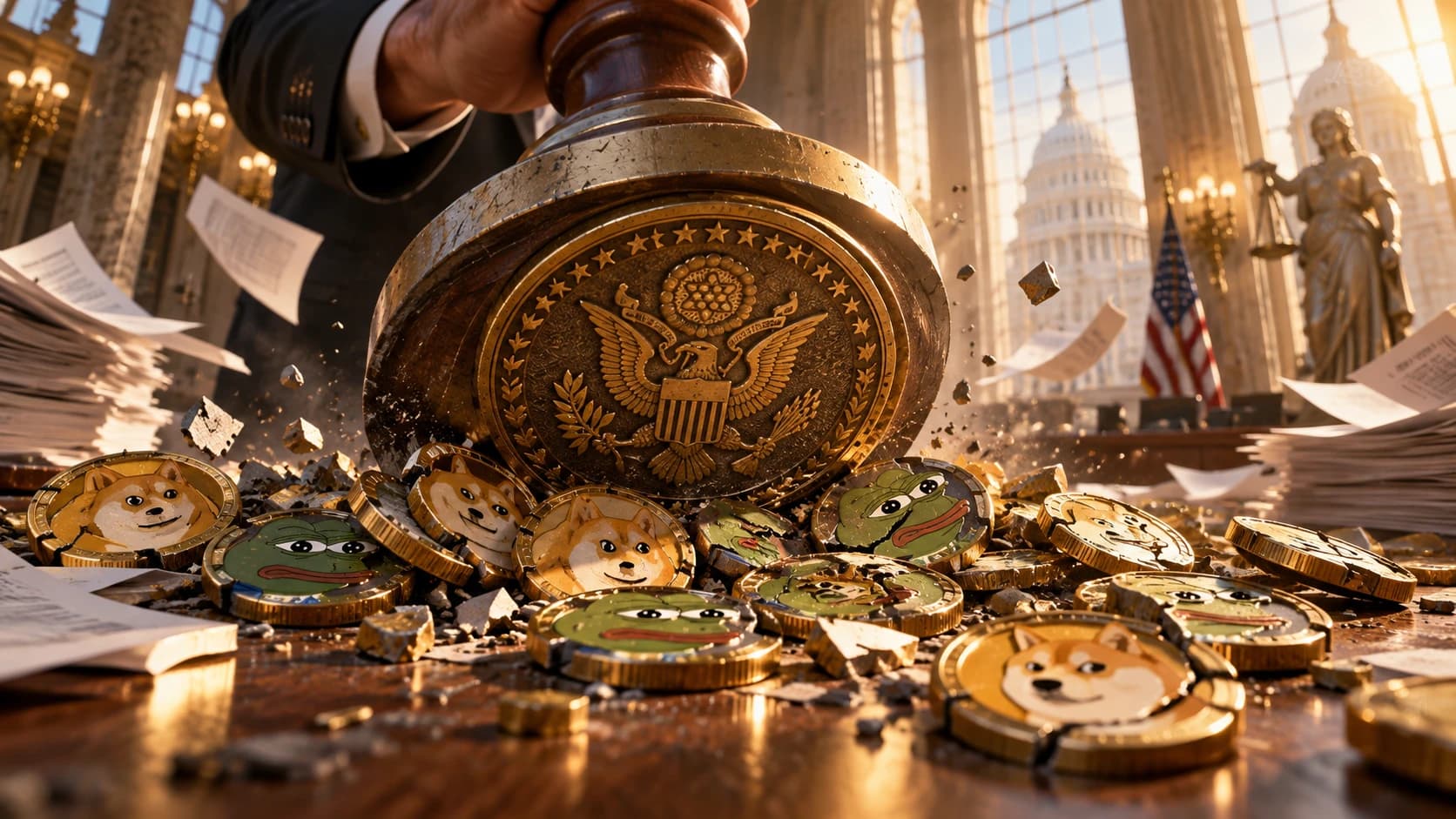
California signed a memecoin ban into law, becoming the first US state to prohibit the token category outright. Governor Gavin Newsom framed the move as "the opposite of Trump," according to CoinDesk, tying the signature directly to a political split with the federal administration's crypto agenda.
The framing matters as much as the statute. Newsom did not present the ban as a narrow consumer-protection measure. He positioned it as a deliberate contrast to Washington, where the current administration has leaned into crypto through stablecoin legislation, friendlier enforcement, and public support for the industry. California drew the opposite line.
A state drawing its own line on crypto
The federal direction in 2026 has been permissive. The GENIUS Act put the first stablecoin rules on the books, the SEC has softened parts of its enforcement posture, and senior regulators have talked openly about moving markets onchain. California's action cuts against that current. By banning memecoins specifically, the state is carving out a category that federal policy has largely left to market forces.
Memecoins sit at the speculative edge of the market. They usually carry no revenue, no product, and no claim beyond attention and momentum. That profile is exactly what makes them a target for state consumer-protection officials, who tend to focus on retail losses rather than market-structure questions. The category has also been politically charged, given the prominence of token launches tied to public figures over the past two years.
For residents, a state-level ban raises immediate practical questions about what can be held, traded, or spent locally, even as those same tokens remain legal elsewhere in the country. That gap between one US jurisdiction and the federal baseline is the part worth watching.
A fractured regulatory map
US crypto rules have never been uniform, but the memecoin ban sharpens the divergence. States set their own money-transmission licensing, and now at least one has drawn a hard line on an entire asset category that federal policy tolerates. If other states follow California's lead, users and businesses face a patchwork where the same token is permitted in one state and prohibited next door.
That fragmentation is not abstract for anyone building payment or spending products. Card issuers, exchanges, and wallet providers already geofence features by jurisdiction. A category-level ban adds a new axis to that map: not just which services are available, but which underlying assets a resident can legally touch. The Senate has been pressing for public hearings on prediction markets, another sign that the political fault lines over speculative crypto products are widening rather than settling.
The timing also lands against a broader federal reshuffle. The SEC recently lost Hester Peirce, long the agency's most vocal crypto advocate, and the Federal Reserve has begun proposing stablecoin rules under the GENIUS Act. Against that federal machinery, a single state banning memecoins reads as a counterweight rather than an outlier.
Markets shrug for now
The broader crypto market did not react to the news as a systemic event. As of September 28, 2026, Bitcoin traded at $83,099, down 1.7% on the day, with Ethereum at $2,650 (down 2.1%) and Solana at $118.69 (down 2.2%), per CoinMarketCap. The Fear and Greed Index sat at 69, still in "Greed" territory. Those moves track ordinary daily volatility, not a policy shock.
That muted response makes sense. Memecoins are a small slice of total market value, and a single-state ban does not touch the major assets. The significance is regulatory, not immediate price action. Whether it becomes a template for other states is the open question, and that answer will take months, not hours, to arrive.
The other unknown is enforcement. A signed ban and an enforced ban are different things, especially for permissionless tokens that trade on decentralized venues outside any single state's reach. Practical enforcement will likely fall on the on-ramps and off-ramps, the licensed exchanges and payment firms operating in California, rather than on the tokens themselves.
Overview
California became the first US state to ban memecoins, with Governor Newsom explicitly framing the signed law as "the opposite of Trump" and turning crypto policy into a state-versus-federal contest. The ban targets a small, speculative slice of the market, so major assets barely moved: Bitcoin held near $83,099 as of September 28, 2026. The real weight is regulatory. It sharpens an already fragmented US map, where one state can prohibit an asset category that federal policy tolerates, and it sets up a template other states may copy or reject. Enforcement against permissionless tokens remains the practical open question.