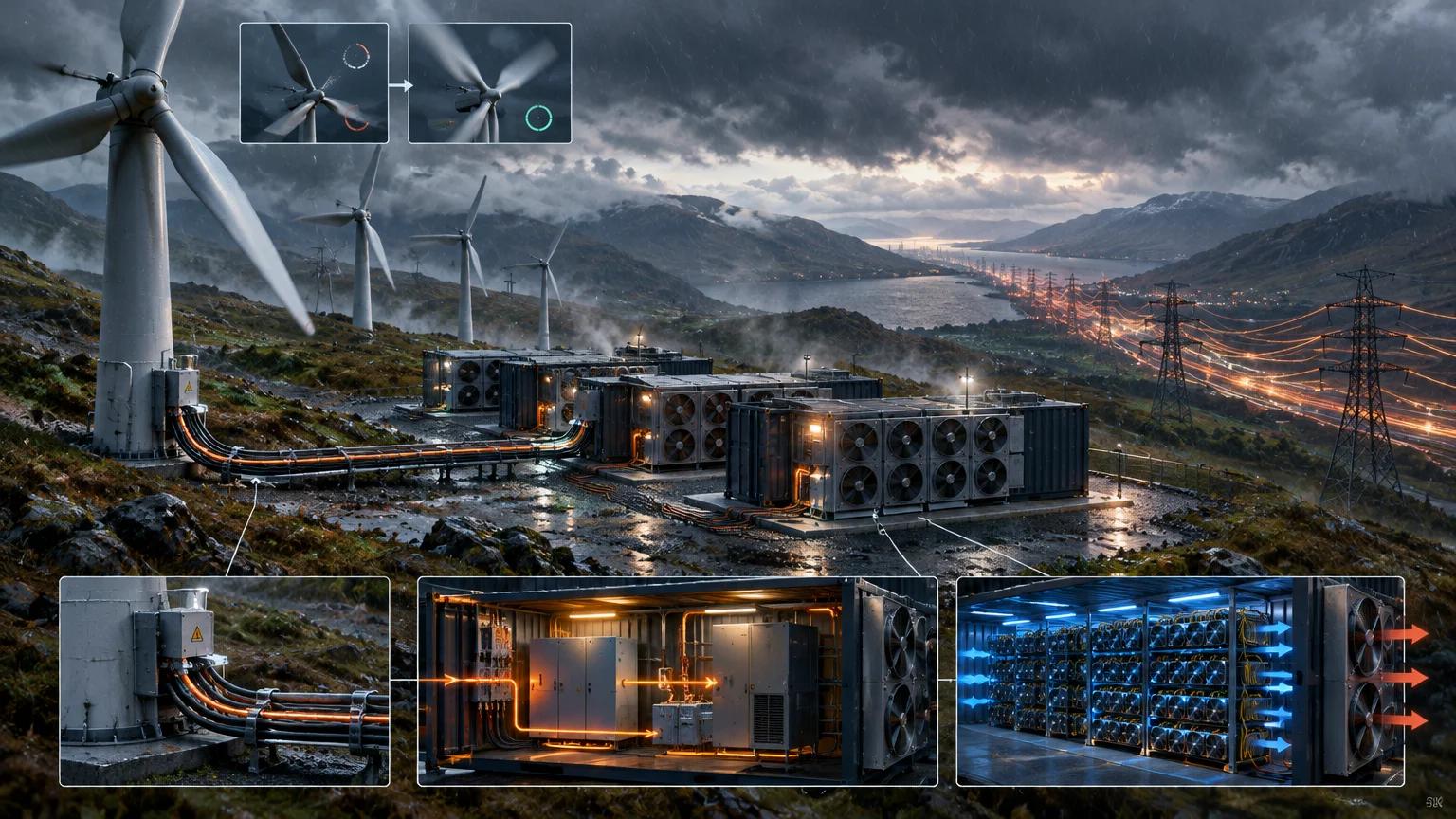
The Bitcoin Policy Institute proposes putting modular Bitcoin mines near Scottish wind generation to consume electricity that would otherwise be curtailed. CoinDesk circulated the proposal on November 16, 2026, citing a report that puts Britain's annual wind shutdown payments above £1 billion.
The report asks energy authorities to assess the idea. Its central proposition is that an electricity buyer able to stop operating when required could fit a grid with intermittent surplus generation.
The £1 billion figure describes the reported cost problem, not demonstrated savings from mining.
Scotland's bottleneck creates an opening
The proposal concerns a physical mismatch in the United Kingdom: renewable generation and electricity demand sit on opposite sides of constrained transmission infrastructure.
The House of Commons Scottish Affairs Committee explains that, during periods of high wind, the network cannot always accommodate available generation. NESO then pays wind farms to reduce output while other power stations increase production. Consumers ultimately pay these balancing costs through their bills.
The committee also identifies storage as part of the response. Batteries and pumped hydro can store surplus renewable generation and reduce pressure on the network. Mining would enter this debate as another electricity use competing for a suitable location and operating schedule.
Those alternatives perform different jobs. Storage preserves energy for later consumption. The mining proposal would consume electricity during the available window, so its usefulness depends on the value of flexible consumption at that particular connection.
A mine elsewhere in Britain would not necessarily address the same bottleneck. The location of the load is part of the proposal's economics, alongside its willingness to switch off.
Modular mines would sell flexibility through their operating schedule
According to CoinDesk's account, the report argues that mining equipment can be deployed in modules, relocated and shut down for extended periods without interrupting a customer's computing workload. It cites research covering 10 mining companies whose facilities curtailed electricity consumption between 5% and 31% of the time.
That evidence supports an operational possibility: miners can adjust their consumption. Applying it to Scotland would require a commercial arrangement that rewards that flexibility at the right connection.
For a prospective operator, the trade-off is straightforward. Accepting fewer operating hours reduces the time available to earn mining revenue. Lower electricity costs would need to compensate for that restriction and the expense of installing the equipment.
A useful assessment would compare the proposed operating schedule with the hours when local generation would otherwise be curtailed. Cheap electricity alone would be an incomplete test. A facility could be commercially attractive while delivering little benefit during the network's most expensive constraint periods.
Contracts would also need to reflect this: a project presented as flexible demand should be evaluated on its actual response to grid conditions, including shutdowns, rather than its maximum electricity consumption.
The £1 billion headline needs a narrower reading
NESO's November 9 account of the 2025/26 financial year reports £3.1 billion in total balancing costs. A little under £0.5 billion went to wind farms to turn down. It says replacement energy, predominantly from gas units, accounted for about 75% of thermal constraint costs.
That wind-payment total is lower than the £1 billion-plus annual figure cited in CoinDesk's account of the BPI report. The figures should not be treated as interchangeable estimates for the same period and cost category.
NESO also reports that constraints caused 13% of Great Britain's wind generation to be turned off during 2025/26. The operational problem is clear, and its total financial cost includes more than payments to wind generators.
A mining assessment must therefore calculate the change in the whole system's costs. Multiplying electricity consumed by an average shutdown-payment figure would miss the replacement-generation side of the calculation.
The broader demand argument already has support from the grid operator. In May, NESO said locating large electricity users closer to Scottish renewable generation could reduce payments both to turn wind down and to turn other power stations up. Its statement concerned demand planning generally, including data centres, rather than an endorsement of Bitcoin mining.
For miners, that creates a specific investment question: can their operating flexibility produce enough grid value to justify a site? For consumers, the test is the resulting bill reduction after infrastructure and operating costs.
Overview
BPI proposes assessing modular Bitcoin mining as a buyer for curtailed Scottish wind electricity. The mechanism fits an existing grid-planning discussion about locating flexible demand near constrained generation.
The immediate action sought is an assessment by the Department for Energy Security and Net Zero and NESO of mining behind transmission bottlenecks, particularly near the Scotland-England boundary. Consumer savings, emissions and infrastructure costs still require project-level modelling.