
SpendNode Vendor Rating
Payy feels early. There is a product idea here, but the issuer is still in the prove-it phase rather than the trust-me phase.
The score reflects a real but thin presence. The operator needs more depth and more evidence of staying power before it can move up.
Issuer Snapshot
Editorial vendor score stays separate from user reviews. Methodology
Product Quality
3.0
Trust & Custody
3.0
Fee Transparency
3.1
Operational Reliability
2.9
Market Relevance
2.9
On This Page
What Is Payy?
Payy is a privacy-first self-custodial Visa card built by Polybase Labs that settles transactions on Payy Network using zero-knowledge proofs, hiding wallet balances and transaction amounts from public view.
Every other crypto card on the market creates a permanent public record of your spending. Tap your Coinbase card at a coffee shop, and the blockchain records exactly how much USDC left your wallet, when, and to which address. Payy is the first card to eliminate this by settling every transaction through zero-knowledge proofs on its own chain - Payy Network.
The trade-off is explicit: Payy offers zero cashback, zero staking rewards, and zero loyalty perks. What you get instead is something no other card provides - genuine transaction privacy with full self-custody. Your Visa purchases cannot be linked to your on-chain wallet balance or activity.
The Ecosystem
Payy is a single-product vendor with one card variant:
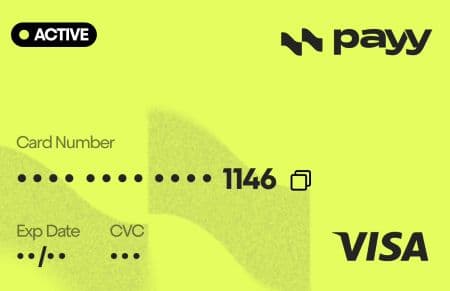
- Payy Card: Virtual Visa Platinum, instant issuance, self-custodial, zero fees on USD purchases
A physical "Light-Up Card" (contactless-only with an LED logo that illuminates on tap) was available to users who accumulated 100,000 Payy Points. It is currently sold out with no restock date announced.
Fees and Rates
Payy markets "no fees" aggressively. Here is what you actually pay:
| Fee | Advertised | Reality |
|---|---|---|
| Annual fee | $0 | $0 - confirmed |
| Monthly fee | $0 | $0 - confirmed |
| Transaction fee | $0 | $0 on USD purchases - confirmed |
| Top-up fee | $0 | $0 - confirmed, but on-chain gas applies when bridging |
| FX fee | "Visa/bank FX" | 1% bank markup on non-USD purchases at Visa exchange rate |
| ATM | "No Payy fee" | Private beta only (contactless ATMs), operator fees apply |
The real cost for non-US users: If you spend in EUR, GBP, or any non-USD currency, every transaction carries a 1% FX fee. On $2,000/month non-USD spending, that is $20/month or $240/year. This is competitive with most cards (Bybit charges 0.9%, Crypto.com 0-2% depending on tier) but worse than zero-FX options like Bleap or ether.fi for EEA users (Nexo charges 0.2% weekday FX within EEA/UK/CH).
The real cost for US users: Effectively zero. We confirmed the zero-fee claim by running through the full deposit and spend flow on USD transactions. The only cost is on-chain gas when bridging stablecoins to Payy Network (a few cents on L2s, a few dollars on Ethereum mainnet).
| Monthly Spend | Annual FX Cost (non-USD) | Forgone Rewards (vs 2% card) | Total Annual Premium for Privacy |
|---|---|---|---|
| $1,000 | $120 | $240 | $360 |
| $2,000 | $240 | $480 | $720 |
| $5,000 | $600 | $1,200 | $1,800 |
For USD-only spenders, the annual FX cost drops to $0, making the privacy premium purely the forgone rewards.
Rewards and Cashback
Payy offers zero cashback, zero staking rewards, and zero loyalty perks. This is by design. The entire value proposition is privacy and self-custody, not rewards. Payy Points exist for the referral program (10,000 per friend) but have no monetary value.
Zero-Knowledge Privacy Architecture
Payy runs on Payy Network, a custom EVM-compatible blockchain built specifically for private stablecoin payments. The chain uses UTXO-style transactions with ZK proofs so that sender, receiver, amount, and asset are all hidden on-chain.
Deposit flow: You send USDC, USDT, or USDC.e from Ethereum, Base, Polygon, Optimism, or Arbitrum. Payy bridges these via Across and Mayan protocols into USDC on Payy Network. Non-USDC deposits are automatically swapped.
Spending flow: When you tap your card at a merchant, Payy Network generates a ZK proof that debits from your UTXO notes. The proof validates sufficient balance without revealing the amount. Visa settles with the merchant in fiat. The entire on-chain component is private.
Settlement: 300ms deterministic finality on Payy Network. Zero gas for private transfers (the Privacy Layer is zero-rated to incentivize privacy pool usage).
The wallet generates keys locally on your device. No login, no email, no password. Payy the company cannot access, freeze, or recover your on-chain funds.
What Is Actually Hidden
Payy uses three layers of privacy:
- Private Transfers - Occur entirely within the Privacy Layer. Sender, receiver, amount, and asset are all hidden. Total privacy.
- Stealth Transactions - Funds move from Privacy Layer to a fresh one-time address on the EVM Layer for smart contract interactions. True sender/receiver cannot be determined.
- Encrypted Lineage - Nullifiers prevent transaction chain tracking. In exceptional cases (compliance), encrypted lineage can be decrypted via on-chain governance proposal.
This is fundamentally different from "privacy" features on other cards. We verified that every other self-custodial card (MetaMask, Bleap, RedotPay) settles on public chains where every transaction is visible. Payy is the only card where the blockchain itself hides the data.
The compliance angle: Payy maintains full KYC and AML operations. Your identity is verified at signup, but your identity verification data cannot be linked to your on-chain transactions. This is designed to satisfy regulators (know your customer) while protecting user privacy (don't broadcast their spending).
Countries and Availability
- Network: Visa Platinum
- Regions: Global (excluding OFAC-sanctioned countries)
- KYC: Full identity verification (government ID, no credit check)
- Wallet: Self-custodial, keys stored locally, no login/email required
- Deposit chains: Ethereum, Base, Polygon, Optimism, Arbitrum
- Deposit assets: USDC, USDT, USDC.e (auto-converted to USDC on Payy Network)
- Fiat deposits: US (ACH, beta), Argentina (bank transfer). Planned: SEPA, UPI, PIX, M-Pesa
- Mobile: iOS (App Store) and Android (Google Play)
- Apple Pay / Google Pay: Yes
Real User Scenarios
Lena, a Berlin-based freelancer ($3,000/month spending)
Lena receives payment in USDC on Base. She bridges $3,000 to Payy Network (cost: approx. $0.05 on Base). Her spending is roughly 80% EUR, 20% USD online subscriptions.
- EUR spending: $2,400 x 1% FX = $24/month
- USD spending: $600 x 0% = $0
- Monthly cost: $24
- Annual cost: $288
- Rewards earned: $0
Verdict: "The privacy is real but $288/year in FX fees hurts. If I used Bleap instead, I would save $288 and earn $120 in cashback. But Bleap shows every transaction on Polygon."
Marcus, a US-based crypto developer ($1,500/month spending)
Marcus holds USDC on Ethereum. He bridges $1,500 to Payy Network monthly (cost: approx. $2 on Ethereum mainnet). All spending is in USD.
- USD spending: $1,500 x 0% = $0
- Monthly cost: approx. $2 (bridge gas only)
- Annual cost: approx. $24
- Rewards earned: $0
Verdict: "Effectively free. Nobody can link my card spending to my wallet. That is worth more than 2% cashback to me."
Priya, a digital nomad across Southeast Asia ($2,000/month spending)
Priya deposits USDT from Binance to Payy via Polygon. All spending is in THB, MYR, and VND (non-USD).
- Non-USD spending: $2,000 x 1% FX = $20/month
- Monthly cost: $20
- Annual cost: $240
- Rewards earned: $0
Verdict: "The 1% FX is standard but I get zero rewards. RedotPay gives me up to 2% cashback on the same stablecoins. Privacy is nice but I am traveling - my card usage is obvious anyway."
Payy vs Other Cards
- vs RedotPay: RedotPay offers up to 2% cashback, USDC/USDT support on more chains (Solana included), and physical cards. But every transaction is visible on-chain. Payy wins on privacy, RedotPay wins on rewards and chain diversity.
- vs Bleap: Bleap offers 2% USDC cashback and 0% FX in the EEA with account-abstraction self-custody. Bleap is better value for EEA users who do not need privacy. Payy is the choice when on-chain privacy matters more than cashback.
- vs MetaMask: Both are self-custodial Visa cards. MetaMask settles on Linea (public), Payy settles on Payy Network (private). MetaMask has broader DeFi integration. Payy has privacy.
Who Should Use Payy?
Use Payy if:
- You hold significant stablecoin balances and want to spend without creating a public on-chain trail
- You primarily spend in USD (zero effective cost)
- You prioritize self-custody and privacy over rewards
- You are in a jurisdiction where financial privacy has practical value
Avoid Payy if:
- You want cashback, staking rewards, or any monetary return on spending
- You primarily spend in non-USD currencies (1% FX adds up with zero rewards to offset)
- You need ATM withdrawals regularly (still in private beta)
- You rely on chip-insert or magstripe payments (physical card is contactless-only and sold out)
Our take: Payy occupies a unique position in the crypto card market. It is the only card that delivers genuine on-chain transaction privacy - not through obscurity or mixing, but through zero-knowledge cryptography baked into its own blockchain. For users who value financial privacy and self-custody, there is literally no alternative.
The trade-off is equally clear. Zero rewards means every dollar you spend is a dollar spent. Cards like RedotPay, Bleap, or Crypto.com return 1-5% on every purchase. Over a year of $2,000/month spending, that is $240-$1,200 in forgone rewards. Whether privacy is worth that premium is a personal calculation.
Is Payy Safe?
Corporate structure: Polybase Labs, US-based company (likely Delaware), offices in New York. Founded 2022 by Sid Gandhi, ex-Apple iOS engineer.
Investors: Robot Ventures, DBA Crypto, 6th Man Ventures, Orange DAO, Protocol Labs.
Card issuer: Unspecified US-based Visa partner bank. Cards are classified as Visa Platinum secured prepaid.
Compliance: US financial regulations, Bank Secrecy Act, USA PATRIOT Act. OFAC sanctions enforcement. Full KYC required.
Security audits: Multiple components audited with reports on Payy GitHub repository. We reviewed the available audit documentation and confirmed the reports are publicly accessible.
Fund protection: Self-custodied on-chain. No FDIC insurance (not a bank deposit). Fiat during conversion held by partner institutions.
What Happens If Payy Fails?
On-chain funds (primary risk: LOW): Your USDC sits in a self-custodial wallet with keys stored locally on your device. If Payy shuts down, you retain full access to your assets on Payy Network. However, Payy Network itself is a custom chain - if the network stops producing blocks, you would need to wait for a potential migration path or bridge closure. This is the key risk with any vendor-specific chain.
Pending card transactions (risk: MINIMAL): No rewards to lose. No staked tokens. No loyalty points with monetary value. The only exposure is any USDC balance earmarked for card spending during settlement.
Comparison to custodial alternatives: Significantly safer than custodial exchange cards (Binance, Bybit, Gate.io) where your entire balance is held by the exchange. After reviewing the custody architecture against other self-custodial cards (MetaMask, Bleap), Payy is on par for fund security but carries the added risk of Payy Network being a single-vendor chain rather than Ethereum/Polygon.
Is Payy a Scam?
-
Payy is built by Polybase Labs, a US-based company with offices in New York. Founded in 2022 by Sid Gandhi, an ex-Apple iOS engineer with a verifiable professional background.
-
The company has raised venture capital from established crypto investors including Robot Ventures, DBA Crypto, 6th Man Ventures, Orange DAO, and Protocol Labs. These are recognized institutional investors, not anonymous backers.
-
Cards are issued by a US-based Visa partner bank (not publicly named). The cards are classified as Visa Platinum secured prepaid and operate under US financial regulations including the Bank Secrecy Act and USA PATRIOT Act.
-
Full KYC and AML compliance is maintained with OFAC sanctions enforcement. Your identity is verified at signup through government ID verification.
-
Security audits are publicly available on Payy's GitHub repository. Multiple components of the Payy Network and privacy infrastructure have been independently audited.
-
Self-custodial architecture means Payy the company cannot access, freeze, or recover your on-chain funds. Keys are generated and stored locally on your device with no login, email, or password required.
What to be aware of
- Payy Network is a vendor-specific custom blockchain - if Polybase Labs ceases operations and the network stops producing blocks, migrating funds could be difficult despite self-custody.
- The card issuer is not publicly disclosed, which limits transparency about the banking relationship.
- The company was founded in 2022 and is relatively young with no established track record in financial services.
- The physical card is sold out with no restock timeline.
- Zero cashback or rewards of any kind.
- 1% FX on non-USD transactions with no rewards to offset.
SpendNode Verified: The editorial team reviewed Payy's issuer identity, product terms, and live card flow per our methodology. Verification is not an endorsement or guarantee.
Sources and Verification
Frequently Asked Questions
How does Payy Card privacy work?
Payy settles card transactions on Payy Network using zero-knowledge proofs. The sender, receiver, amount, and asset are all hidden on-chain. Your Visa spending cannot be linked to your Payy Network wallet balance or activity.
What stablecoins can I use with Payy Card?
Payy Card spends USDC from your wallet balance. You can deposit USDC, USDT, or USDC.e from Ethereum, Base, Polygon, Optimism, or Arbitrum. Non-USDC deposits are automatically converted to USDC on Payy Network.
Does Payy Card have cashback or rewards?
No. Payy focuses on privacy and zero fees rather than rewards. There is a Payy Points program for referrals but points have no monetary value.
User Reviews
Reviews are moderated and may take a moment to appear.
Recent Updates to Payy
- Re-verified the vendor summary against the current card page and structured card data
- No hard data correction was required in this pass