Issued by Ledger

CASHBACK
Verified

VIRTUAL CARD
Verified

PHYSICAL CARD
Verified
Our Official Verdict
Safe Off-Ramp for Hardware Wallets: 1% BTC Back
The standard Ledger card is the safest way to maintain liquidity. By offering 1% cashback and a Free annual fee, it serves the needs of long-term HODLers who want to spend their digital assets without leaving the hardware-secured ecosystem.
Fees & Charges
Annual Fee
Free
FX Fee
1.75%
ATM Fee
1.5%
Requirements
Supported Regions
US, EEA, UK, LATAM
Spendable Assets
BTC, ETH, USDC, USDT
Ledger CL Card Review
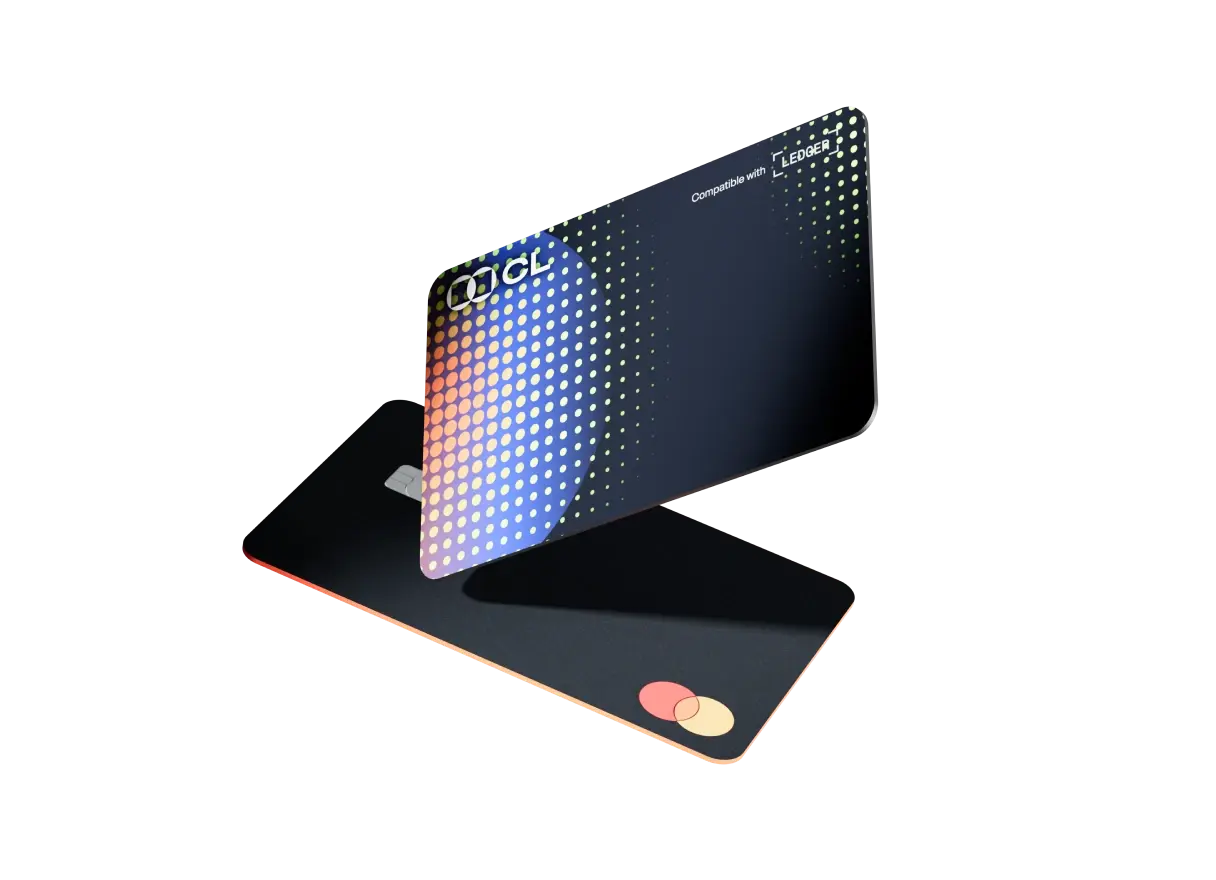
The Ledger CL Card is a Visa debit card powered by Baanx (FCA-regulated), integrated with Ledger Live, offering 1% automatic cashback in BTC or USDC, $0 annual fee, 1.75% crypto conversion fee, 1.75% FX fee on non-base currency transactions, native BTC yield via Lombard and Figment within the Ledger Live ecosystem, physical and virtual card options, Apple Pay and Google Pay support, and availability in the US, EEA, UK, and select LATAM markets (Colombia, Mexico, Brazil).
The Security-First Spending Bridge
In this SpendNode review, we break down the real costs and security trade-offs. The Ledger CL Card exists for one type of person: the long-term holder who keeps 90%+ of their portfolio in cold storage and wants a simple way to spend without moving assets to an exchange. Your Ledger hardware device protects your savings. The CL Card provides a spending rail from Ledger Live to the Visa network.
The economics are straightforward - and punishing if you use the card wrong. Fund with fiat: you earn a clean 1% BTC cashback on every purchase. Fund with crypto: the 1.75% conversion fee destroys your cashback and puts you net negative. This is the most important thing to understand about the Ledger CL Card. It is a fiat-funded spending card that happens to live inside a crypto wallet. Use it as a crypto-funded spending card and you lose money on every transaction.
For hardware wallet users who already live in Ledger Live, the card adds a spending layer to your existing security setup without compromising your cold storage keys. That is the entire value proposition.
Card Specs: What You Are Actually Getting
Physical and Virtual Cards
- Virtual card: Instant issuance through Ledger Live
- Physical card: Available upon request (Visa-branded, Ledger CL design)
- Design: Premium Ledger branding, metal-finish feel
Payment Network
- Network: Visa
- Acceptance: 100M+ merchant locations worldwide
- Contactless: Yes (NFC)
- Mobile wallets: Apple Pay, Google Pay
- Card type: Debit (funded from Ledger Live card wallet via Baanx)
Security Features
- Hardware wallet integration: Your long-term holdings stay on your Ledger device (cold storage)
- Separate card wallet: Spending balance sits in a Baanx-managed card wallet within Ledger Live
- Ledger Live app: Manage card, track spending, top-up from within the same interface as your cold storage
- Card controls: Freeze/unfreeze, spending limits via Ledger Live
- Transaction alerts: Real-time push notifications for every purchase
- Visa zero liability: Standard Visa fraud protection for unauthorized transactions
How Spending Works: Transaction Flow
Example: $85 grocery run in Austin, Texas (fiat-funded card wallet)
Step 1: Fund your card wallet
- Transfer USD from your bank to the Ledger CL card wallet via Ledger Live
- This is a fiat transfer - no crypto conversion involved
- Your BTC, ETH, and other holdings stay in cold storage on your Ledger device
Step 2: Pay at the store
- Tap your physical card or use Apple Pay
- The store charges $85
Step 3: Settlement
- USD from your card wallet pays the merchant directly
- No conversion needed (fiat-to-fiat domestic transaction)
- Conversion fee: 0% (no crypto involved)
- FX fee: 0% (domestic USD-to-USD)
- Total fees: $0
Step 4: Cashback
- 1% of $85 = $0.85 in BTC (or USDC, your choice)
- BTC reward deposited to your Ledger Live wallet
- Net on this transaction: +$0.85 (1.0% net)
Now compare: Same $85 grocery run, but crypto-funded
Step 1: Fund from crypto
- Convert BTC to USD within Ledger Live to load card wallet
- Conversion fee: 1.75% of $85 = -$1.49
Step 2-3: Same as above
- Store charges $85, no FX fee (domestic)
Step 4: Cashback
- 1% = +$0.85
- Net: $0.85 - $1.49 = -$0.64 (loss of 0.75%)
The lesson is clear: Fiat-funded spending earns you money. Crypto-funded spending loses you money. Never convert crypto through the card when you can fund with fiat.
Fee Deep Dive: The Real Cost
| Fee | Amount | Notes |
|---|---|---|
| Annual fee | $0 | No subscription or maintenance |
| Crypto conversion | 1.75% | When converting crypto to load card |
| FX fee | 1.75% | On non-base currency transactions |
| ATM fee | 1.5% | Per withdrawal |
| Cashback | +1.0% | In BTC or USDC (your choice) |
| Monthly fee | $0 | No recurring charges |
Net Return by Funding and Transaction Type
| Transaction Type | Cashback | Conversion | FX Fee | Net per $100 |
|---|---|---|---|---|
| Domestic (fiat-funded) | +$1.00 | $0 | $0 | +$1.00 |
| Domestic (crypto-funded) | +$1.00 | -$1.75 | $0 | -$0.75 |
| International (fiat-funded) | +$1.00 | $0 | -$1.75 | -$0.75 |
| International (crypto-funded) | +$1.00 | -$1.75 | -$1.75 | -$2.50 |
Annual ROI at Different Spending Levels (Fiat-Funded Domestic Only)
| Monthly Spend | Annual Cashback (1%) | Annual Cost | Net Annual Return |
|---|---|---|---|
| $500 | $60 | $0 | +$60 |
| $1,000 | $120 | $0 | +$120 |
| $2,000 | $240 | $0 | +$240 |
| $3,000 | $360 | $0 | +$360 |
Key insight: The Ledger CL Card is one of the simplest cards to optimize. Fund with fiat, spend domestically, earn 1% BTC. That is it. The moment you introduce crypto conversion (1.75%) or international spending (1.75% FX), the economics collapse. At $3,000/month of fiat-funded domestic spending, you earn $360/year in BTC - a solid return for a $0 annual fee card with hardware wallet integration.
Native BTC Yield: The Ledger Live Advantage
Ledger has added native BTC yield within Ledger Live via partnerships with Lombard and Figment. This means your BTC holdings (the ones in cold storage, not the card wallet) can earn yield without leaving the Ledger ecosystem.
How it works:
- BTC yield is offered through Lombard (DeFi) and Figment (institutional staking)
- Managed within Ledger Live alongside your card and cold storage
- Your cashback BTC rewards can be directed into yield-earning positions
- This creates a flywheel: spend with the card, earn BTC cashback, put cashback into yield
The compounding effect at $2,000/month spending:
- Year 1: $240 in BTC cashback
- BTC yield on accumulated cashback (variable APY)
- Over 3-5 years, the cashback-to-yield loop adds meaningful returns
This is unique to Ledger. No other card issuer offers hardware-secured cold storage, a spending card, and native yield all within the same application.
Limits and Restrictions
| Limit | Amount |
|---|---|
| Monthly spending | $15,000 |
| ATM daily | $500 |
| Annual fee | $0 |
| Supported assets | BTC, ETH, USDC, USDT |
| Card type | Physical + Virtual |
Availability
- US: Available (all states)
- EEA: Available (30 countries)
- UK: Available
- LATAM: Select markets (Colombia, Mexico, Brazil)
- Card issuer: Baanx (FCA-regulated)
- KYC: Standard verification required
- Network: Visa
What Happens If Ledger or Baanx Goes Down?
Your cold storage assets (BTC, ETH on Ledger device):
- Fully self-custodial. Your seed phrase gives you access regardless of what happens to Ledger the company
- Your hardware device works offline with any compatible wallet software
- Your long-term holdings are completely safe even if both Ledger and Baanx cease operations
Your card wallet balance (fiat/stablecoin held by Baanx):
- Custodial. The card wallet is managed by Baanx under FCA regulation
- Baanx is required to segregate client funds under UK financial regulations
- In a Baanx failure, recovery depends on FCA-supervised administration procedures
- Mitigation: Keep only your near-term spending balance in the card wallet. Treat it like a checking account, not savings
Your earned BTC cashback:
- If already in your Ledger wallet: self-custodial, fully safe
- If pending in the Baanx card system: at risk until settlement
- Mitigation: Cashback should settle to your Ledger wallet regularly. Verify this in Ledger Live settings
Your card functionality:
- Depends on Baanx maintaining its Visa issuing partnership
- If Baanx fails: card stops working, but your cold storage assets are unaffected
- If Ledger fails: you can still access your crypto with your seed phrase on any compatible wallet
Risk comparison:
| Card | Asset Safety | Card Dependency | Fund Recovery |
|---|---|---|---|
| Ledger CL Card | Cold storage (seed phrase) | Baanx + Visa | Import seed to any wallet |
| Coinbase Card | Exchange custodial (FDIC on USD) | Coinbase + Visa | FDIC up to $250K |
| Gnosis Pay | Self-custody (Safe account) | Gnosis + Visa | Any Safe interface |
| ether.fi Core | Self-custody (ether.fi wallet) | ether.fi + Visa | On-chain recovery |
Assessment: After reviewing the risk architecture, very low risk on main holdings (hardware cold storage), medium risk on card wallet balance (Baanx custodial but FCA-regulated). The Ledger CL Card has the best risk architecture of any crypto card because it cleanly separates your savings (cold storage, self-custodial) from your spending (card wallet, custodial). The maximum you can lose is whatever is loaded in the card wallet.
Real User Scenarios
Scenario 1: Daniel (Austin, Texas Software Engineer, $3,500/month spending)
Setup:
- Ledger CL Card (US)
- Holds 2.5 BTC + 10 ETH on Ledger Nano X (cold storage)
- Funds card wallet via bank transfer (fiat, 0% conversion)
- 95% USD domestic, 5% international (conferences)
- Cashback: BTC (adding to cold storage stack)
Results after 12 months:
- Total spending: $42,000
- Domestic ($39,900 at +1.0%): +$399.00 in BTC
- International ($2,100 at -0.75%): -$15.75 net
- Net annual return: +$383.25 in BTC
- BTC directed to Lombard yield in Ledger Live
His verdict: "I have been using Ledger since 2019. My BTC and ETH never leave the Nano X. The CL Card means I do not need Coinbase or any exchange for daily spending. I fund with fiat from my bank, earn 1% BTC back, and move that BTC into yield via Lombard - all without leaving Ledger Live. The $383 in BTC cashback is nice, but the real value is staying in one ecosystem. My seed phrase is my bank account. The card is just the ATM."
Scenario 2: Sophie (Paris Marketing Director, EUR 2,000/month spending)
Setup:
- Ledger CL Card (EEA, Ledger is headquartered in Paris)
- Holds 1 BTC + 5,000 USDC on Ledger (cold storage)
- Funds card with EUR via SEPA (fiat, 0% conversion)
- 80% EUR domestic, 20% international (travel across Europe)
- Cashback: USDC (stable value preference)
Results after 12 months:
- Total spending: EUR 24,000
- Domestic (EUR 19,200 at +1.0%): +EUR 192
- International (EUR 4,800 at -0.75%): -EUR 36
- Net annual return: +EUR 156
Her verdict: "I chose Ledger over Gnosis Pay because I already owned a Ledger Nano and was comfortable with the ecosystem. Gnosis Pay would earn me more (0% fees + cashback), but it requires moving to Gnosis Chain and using xDai. I do not want to learn a new ecosystem when Ledger already does everything I need. The EUR 156/year is modest, but the security of hardware-backed cold storage gives me peace of mind that no exchange card can match. The only thing I would change: I wish the FX fee were lower for my travel spending."
Scenario 3: Carlos (Sao Paulo Crypto Analyst, $1,200/month spending)
Setup:
- Ledger CL Card (LATAM - Brazil)
- Holds 0.5 BTC + 3,000 USDT on Ledger
- Funds card with BRL via local bank transfer (fiat)
- 100% BRL domestic spending
- Cashback: BTC (long-term accumulation)
Results after 12 months:
- Total spending: $14,400
- All domestic at 1.0%: +$144 in BTC
- Net annual return: +$144 in BTC
His verdict: "In Brazil, the Ledger CL Card is one of the only options for hardware wallet users who want a spending card. Most crypto cards available here are exchange-based - Binance, Bybit. I do not want my spending connected to an exchange. The Ledger card lets me keep my BTC in cold storage and spend fiat through the same app. $144/year in BTC cashback is not life-changing, but it stacks. I have been accumulating BTC cashback for 8 months now and it is sitting in Figment yield. The security-first philosophy is why I chose Ledger in the first place - the card is just an extension of that philosophy."
How the Ledger CL Card Compares
For security-first users:
- Gnosis Pay: 0% all fees, 1-5% GNO cashback, self-custodial via Safe smart account (EEA/UK only). Gnosis Pay is strictly superior on economics (0% fees + cashback vs 1.75% fees + 1% cashback). Ledger wins on geographic availability (US, LATAM) and hardware security integration
- ether.fi Core: 3% cashback, 1% FX, self-custodial, Ethereum ecosystem. ether.fi wins massively on rewards (3% vs 1%) and is also self-custodial. Ledger wins on hardware security and the BTC yield ecosystem
- Ready Lite: 0.5% STRK cashback, 1% FX, self-custodial on Starknet. Ready has lower fees on FX (1% vs 1.75%) but lower cashback (0.5% vs 1%). Ledger wins on hardware integration and US availability
For US users specifically:
- Coinbase Card: Up to 4% crypto rewards, 0% fees on USDC spending, FDIC insurance on USD. Coinbase is strictly superior on rewards and fees - but it is fully custodial. Ledger wins for users who prioritize self-custody and hardware security over economics
- Gemini Credit Card: Up to 4% category rewards, Mastercard credit, no staking needed. Gemini wins on reward rates but is also custodial and is a credit card (not debit). Different product category
Ledger's unique value: The only crypto card integrated with a hardware wallet ecosystem. No other card lets you manage cold storage savings and card spending in the same application. The BTC yield via Lombard/Figment adds a dimension no competitor offers. The economics are mediocre (1% cashback with high fees on crypto/international), but the security architecture is unmatched.
The Verdict: Is the Ledger CL Card Worth It in 2026?
Use the Ledger CL Card if:
- You already own a Ledger hardware wallet and want spending integrated into Ledger Live
- You can fund the card with fiat (bank transfers) to avoid the 1.75% conversion fee
- You spend primarily in your home currency (domestic) to avoid the 1.75% FX fee
- You value the security of keeping 90%+ of your crypto in cold storage while having a spending rail
- You want BTC cashback directed into native yield within the same ecosystem
Skip the Ledger CL Card if:
- You want maximum rewards - Coinbase (4%), ether.fi (3%), or Gnosis Pay (1-5%) all earn more
- You spend internationally frequently - the 1.75% FX fee wipes out your 1% cashback completely
- You plan to fund the card with crypto - the 1.75% conversion fee makes every transaction net negative
- You do not own a Ledger device - the card's value is in ecosystem integration, not standalone economics
- You are in the EEA/UK and can access Gnosis Pay (0% fees + higher cashback)
Final verdict: SpendNode verified the Ledger CL Card is a security product with a cashback bonus, not a rewards card with security features. Its value is in extending the Ledger hardware wallet ecosystem to include Visa spending. Fund with fiat, spend domestically, earn 1% in BTC, and direct that BTC into Lombard/Figment yield - all within Ledger Live. That is the optimal strategy and the only way the card makes economic sense. The moment you introduce crypto conversion (1.75%) or international spending (1.75% FX), the economics turn negative. For hardware wallet users who follow the fiat-funded domestic strategy, it delivers $120-$360/year in BTC cashback with the best security architecture of any crypto card. For everyone else, the fees are too high to compete with zero-fee alternatives that offer higher cashback.
Sources and Verification
All card specs, fees, and limits verified from:
FAQ
How do you choose Ledger CL Card crypto cards?
We compare verified issuer sources, fees, and eligibility. Availability can change, so confirm with the issuer before applying.
Do all cards in this list offer the same benefits?
No. Each issuer defines its own program terms. Review the sources on each card profile.
Are these rankings or recommendations?
No. Lists are filtered views of cards in our database and do not imply rankings.
This is a debit card. Some merchants with pre-authorization holds (hotels, car rentals) may temporarily hold funds beyond the transaction amount.
You retain custody of your funds until the moment of spending. Your balance is not exposed to provider insolvency risk.
Fees shown above are the card's disclosed fees. Additional costs may apply: Visa/Mastercard network spread (typically 0.5-0.9%), crypto-to-fiat conversion spread at point of sale, and blockchain gas fees for on-chain top-ups.
Last verified: Mar 5, 2026 · Data sourced from official Ledger documentation. · Methodology
★★★★★4.9/5 App Store (14.4K ratings)