
1inch vs ether.fi
Side-by-side comparison of 1inch and ether.fi crypto cards. Data sourced from official issuer documentation and verified by SpendNode.
Comparing 2 Cards
Side-by-side comparison of features and benefits
| Attribute | 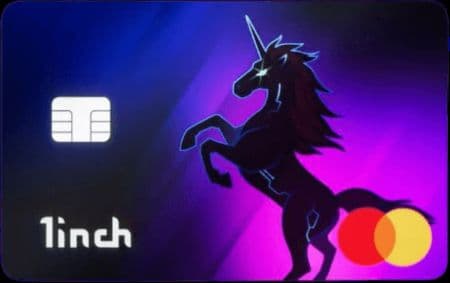 |  |
|---|---|---|
| Max Cashback | 2% | 3%Highest |
| Annual Fee | FreeBest | FreeBest |
| FX Fee | 0% | 1% |
| Custody Model | Custodial | Custodial |
| Network | MASTERCARD | VISA |
| Regions | EEAUK | GLOBALUSUKEEA |
| Supported Assets | 8+ assets 1INCHETHUSDTUSDCBTCLTCXRPBXX | 4+ assets USDCETHeETHweETH |
| Cashback | Yes | Yes |
| Staking | No | Yes |
| Points | No | Yes |
| Airdrops | No | No |
| Lounge access | No | No |
| Subscription rebates | No | No |
| Metal card | No | No |
| Virtual Cards | Yes | Yes |
| Physical Cards | Yes | Yes |
| Visa | No | No |
| Mastercard | No | No |
| Apple Pay | Yes | Yes |
| Google Pay | Yes | Yes |
| Self-custody spend | No | Yes |
| Stablecoin spend | No | Yes |
| No annual fee | Yes | Yes |
| No FX fee | Yes | No |
| ATM free allowance | No | No |
| No KYC | Yes | No |
| Virtual vs Physical | Yes | Yes |
| Debit vs Prepaid | No | No |
| Best For | Best for No FX Fees | Best for Cashback |
Note: All data verified as of February 2026. Rewards and fees may vary based on your spending tier and region. Check each card's detailed page for complete terms.
1inch vs ether.fi: Key Differences
A custodial DEX aggregator card versus a self-custodial credit-line card - two DeFi protocols with opposite approaches to card spending in the same European market. [1inch](/crypto-cards/1inch-card/) is powered by Baanx with up to 2% BXX [cashback](/crypto-cards/cashback/) but a 1.75% crypto conversion fee that erodes nearly all returns. [ether.fi](/crypto-cards/ether-fi-core-card/) lends against liquid-staked ETH with a flat 3% cashback, [staking](/crypto-cards/staking/) yield on collateral, and no conversion fee. Both serve EEA and UK, but ether.fi also serves the US and global markets - and the custody, tax, and yield differences make this one of the most lopsided comparisons on SpendNode.
The right choice depends on your priorities: cashback rates, regional availability, custody model, and which ecosystem you already use. Below, we break down who should choose each card.
Custody Architecture: Self-Custodial Credit vs Custodial Debit
Despite both being DeFi-native protocols, these cards have architecturally opposite custody and spending models.
1inch is custodial and debit. Powered by Baanx, your funds are deposited into Baanx's infrastructure. They manage conversion and settlement. Your private keys do not control the card balance once loaded. Every transaction sells crypto at point of sale, creating a taxable disposal. If Baanx experiences a security incident or insolvency, your loaded funds are at risk - the same counterparty model that failed FTX users.
ether.fi is self-custodial and credit. You collateralize eETH or weETH in your own wallet and borrow against it. Your collateral stays under your control, simultaneously earning Ethereum staking yield (approximately 4% APY), EigenLayer restaking rewards, and ETHFI Membership Points. No crypto is sold at point of sale - you spend borrowed value. The collateral remains yours throughout.
The custody difference matters most in crisis scenarios. A Baanx security breach puts every 1inch cardholder's loaded balance at risk. An ether.fi infrastructure issue does not affect your collateral - it remains in your personal wallet. For users who chose DeFi tools specifically to avoid centralized custody, ether.fi's model is philosophically aligned. 1inch the protocol is decentralized; 1inch the card is not.
ether.fi offers four tiers: Core (free, 3% cashback, 3 virtual cards), Luxe (metal card, conference lounges, 65% hotel discounts), Pinnacle (10 virtual cards, $200K limits), and VIP (invite-only, 0% FX). All tiers share the same flat 3% cashback. 1inch offers a single tier with no staking requirement - simpler to understand, but with no upgrade path.
Net Returns After All Fees
1inch's 1.75% crypto conversion fee applies to every crypto-funded transaction. ether.fi charges 0% conversion at point of sale but 1% FX on cross-currency spending. Both charge 2% ATM fees.
| Scenario | ether.fi (3%, same-currency) | ether.fi (3%, cross-currency, after 1% FX) | 1inch (2% BXX, after 1.75% fee) | 1inch (1% BTC, after 1.75% fee) |
|---|---|---|---|---|
| Casual ($1,000/mo) | $30 | $20 | $3 (0.25% net) | -$8 (-0.75% net loss) |
| Active ($2,000/mo) | $60 | $40 | $5 | -$15 (net loss) |
| Power ($3,000/mo) | $90 | $60 | $8 | -$23 (net loss) |
| Annual ($3,000/mo) | $1,080 | $720 | $90 | -$270 (net loss) |
On $3,000/month same-currency spending, ether.fi earns $1,080/year versus 1inch's $90 - a 12x advantage. Even on cross-currency spending where ether.fi pays 1% FX, the $720/year still exceeds 1inch's best case by 8x.
Choosing BTC or USDT rewards on 1inch (1%) minus the 1.75% conversion fee means losing money on every transaction. A user spending $3,000/month with BTC rewards loses $270/year by using the card. Only the 2% BXX tier stays positive - barely - at 0.25% net, and BXX (Baanx's ecosystem token) carries significantly more liquidity risk than ether.fi's direct cashback.
The cross-currency paradox: 1inch advertises 0% FX while ether.fi charges 1% FX. But 1inch's 1.75% conversion fee applies to every transaction regardless of currency. Total cost per cross-currency transaction: ether.fi = 1% (FX only), 1inch = 1.75% (conversion only). Even on international spending where 1inch's 0% FX should be an advantage, ether.fi's total cost is lower.
Tax treatment creates an additional gap. ether.fi's credit model borrows against collateral without selling - no taxable disposal in most jurisdictions. Every 1inch transaction sells crypto at point of sale, triggering capital gains tax on appreciated assets. For a European holder with $40,000 in appreciated crypto (50% unrealized gains) spending $3,000/month at a 20% capital gains rate, Wirex-style debit spending creates approximately $3,600/year in tax liability. 1inch's debit model creates the same exposure. ether.fi's credit model creates $0. The tax savings alone ($3,600) exceed 1inch's total annual cashback ($90) by 40x.
Yield Stacking: ether.fi's Triple-Income Model
ether.fi's credit architecture creates passive income that no debit card can match:
- Card cashback: 3% on all spending ($1,080/year at $3,000/month)
- ETH staking yield: approximately 4% APY on collateral (eETH/weETH)
- EigenLayer restaking rewards: additional variable yield on the same collateral
Combined annual returns for a user with $20,000 ETH collateral spending $3,000/month:
- ether.fi: $1,080 cashback + $800 staking yield + variable restaking = approximately $1,880+/year
- 1inch: $90 cashback (2% BXX, after conversion fee) + $0 yield on deposited balance = $90/year
The gap is 20x. ether.fi's $20,000 collateral earns $800/year passively while simultaneously backing your spending. 1inch's deposited balance sits in Baanx's custodial wallet earning nothing. Even if you only consider the staking yield ($800) and ignore cashback entirely, ether.fi's collateral alone earns nearly 9x what 1inch's card returns in cashback.
The trade-off is liquidation risk. ether.fi's credit model carries the risk that a significant ETH price decline could trigger collateral liquidation. 1inch's debit model has zero liquidation risk - you spend your loaded balance directly. For risk-averse users who want to avoid any exposure to collateral calls, 1inch's simpler debit model eliminates this concern. But the financial cost of that simplicity ($1,790+ per year in foregone returns) is substantial.
Asset Support and Geographic Reach
1inch's asset breadth is its single genuine advantage.
1inch supports 8 assets (1INCH, ETH, USDT, USDC, BTC, LTC, XRP, BXX). For holders of BTC, LTC, or XRP, 1inch is the only option between these two for direct card spending. The integrated DEX aggregation engine finds optimal swap routes when converting assets, potentially saving on conversion spreads - though the 1.75% flat conversion fee applies regardless of the route.
ether.fi supports 4 assets (USDC, ETH, eETH, weETH). The focus is narrower but purpose-built for the ETH staking ecosystem. Users who already hold eETH or weETH can collateralize immediately without additional swaps.
Geographic coverage favors ether.fi significantly. ether.fi serves the US, UK, EEA, and global markets - rare for any crypto card. 1inch serves only EEA and UK via Baanx. For US users, LATAM users, or APAC users, 1inch is unavailable. ether.fi's global reach makes it accessible to users who have no access to 1inch.
Spending limits: 1inch caps at $8,000/day. ether.fi scales by tier: Core has standard limits, Pinnacle reaches $200,000, VIP is uncapped. For high-volume spenders, ether.fi's tier system accommodates significantly larger spending.
ATM access: Both charge 2% ATM fees. 1inch: $500/day limit. ether.fi: varies by tier, with higher tiers offering increased limits. Neither is ideal for regular cash access.
Both support Apple Pay. 1inch operates on Mastercard; ether.fi on Visa. 1inch offers low-KYC onboarding via Baanx for users who prefer minimal identity verification.
Common Mistakes When Choosing
Using the 1inch card for ETH spending when ether.fi eliminates the conversion fee entirely. A user holding ETH who spends through 1inch pays 1.75% on every transaction (after converting ETH to fiat via Baanx). The same ETH held as eETH on ether.fi backs a credit line with 0% conversion fee and 3% cashback. On $2,000/month ETH spending, 1inch returns $5/month (0.25% net) while ether.fi returns $60/month (3% net) - a $660/year swing. Add the staking yield on the ETH collateral (approximately 4% APY), and the total gap exceeds $1,000/year even on modest holdings. How to avoid it: If your primary holding is ETH, ether.fi is purpose-built for your use case. The only scenario where 1inch makes sense for ETH spending is if you specifically want custodial simplicity with no liquidation risk and accept the 0.25% net return as the cost of that simplicity.
Assuming 1inch is self-custodial because 1inch is a DEX aggregator. The 1inch protocol is fully decentralized - one of the most used DEX aggregators in DeFi. The 1inch card is not. It is powered by Baanx with custodial fund management. Your deposited crypto is held by Baanx, not in your personal wallet. ether.fi's card spends from a credit line backed by collateral in your own wallet - genuine self-custody throughout. This distinction matters beyond philosophy: in a Baanx security incident, 1inch card balances are at risk. In an ether.fi infrastructure issue, your collateral (eETH/weETH) remains in your personal wallet. How to avoid it: Verify the custody model independently of the brand. "DeFi protocol" does not equal "self-custodial card." Among DeFi-native cards, ether.fi, Gnosis Pay, MetaMask, and Solflare offer genuine self-custody. 1inch does not.
Decision Shortcut
For ETH holders wanting maximum value: ether.fi Core at 3% cashback with staking yield and no conversion fee. Total returns (cashback + yield) can exceed $1,880/year on $3,000/month spending with $20,000 collateral. Self-custodial, global availability, no token commitment required.
For users needing multi-asset spending (BTC, LTC, XRP): 1inch is the only option between these two, but the 1.75% conversion fee limits net returns to 0.25% at the BXX tier. Consider MetaMask (9 assets, 1% cashback, 0% fees, self-custodial) as a better multi-asset alternative.
For US users: ether.fi is the only option (1inch serves EEA/UK only).
For premium travelers: ether.fi Luxe adds conference lounges and 65% hotel discounts on top of the 3% cashback. No 1inch tier offers lifestyle perks.
For risk-averse users avoiding liquidation: 1inch's debit model has zero liquidation risk, but the $1,790+/year value gap versus ether.fi is a high price for that peace of mind.
Outlook: ether.fi's four-tier expansion and credit-line model position it as the leading DeFi-native card globally. 1inch's competitiveness depends entirely on reducing or eliminating the 1.75% conversion fee - at 0% conversion, the comparison would shift dramatically. Without a fee reduction, 1inch remains a niche product for Baanx ecosystem participants and multi-asset holders who specifically need BTC/LTC/XRP spending. Watch for ether.fi VIP tier availability expanding (currently invite-only with 0% FX), which would eliminate its only fee disadvantage against 1inch's 0% FX.
Fee Breakdown
| Fee | 1inch | ether.fi |
|---|---|---|
| FX Fee | 0% | 1% |
| Annual Fee | Free | Free |
| ATM Fee | 2% | 2% |
Fees pulled from issuer documentation. Verify on the official site before applying.
Who Should Choose 1inch
The 1inch Mastercard is best suited for users who:
- Want up to 2% cashback on spending
- Need zero FX fees for international transactions
- Prefer a card with no annual fee
- Are based in EEA, UK
Who Should Choose ether.fi
The ether.fi Core Card is best suited for users who:
- Want up to 3% cashback on spending
- Prefer a card with no annual fee
- Are based in GLOBAL, US, UK, EEA
Our Verdict
**ether.fi wins this comparison by every meaningful metric except multi-asset convenience.** On net cashback alone, ether.fi's 3% with zero conversion fee delivers 12x more than 1inch's best case (0.25% net after 1.75% fee) - $1,080/year versus $90 on $3,000/month spending. Choosing BTC or USDT rewards on 1inch (1%) minus the 1.75% conversion fee produces a -0.75% net loss ($270/year lost). Add ether.fi's self-custody (your collateral stays in your wallet), credit-line tax advantage (no disposal at point of sale), and staking yield on collateral (approximately 4% APY on ETH), and the total value gap exceeds $2,000/year for ETH holders. 1inch's only practical advantages are broader asset support (8 tokens versus 4) and 0% FX on cross-currency spending - but ether.fi's 1% FX is still cheaper than 1inch's 1.75% conversion fee, so even the FX advantage is theoretical.
Frequently Asked Questions
Which has better cashback, 1inch or ether.fi?
ether.fi offers up to 3% cashback compared to 1inch's 2%. Actual rates depend on your spending tier and card variant.
Which card has lower fees?
1inch charges 0% FX fee vs ether.fi's 1%. Neither charges an annual fee.
Is 1inch or ether.fi better for self-custody?
Both use custodial models. If self-custody is important, consider providers like Gnosis Pay or ether.fi.
Which card is available in more regions?
ether.fi is available in 4 regions (GLOBAL, US, UK, EEA) compared to 1inch's 2 regions (EEA, UK). Always verify eligibility on the issuer's website.