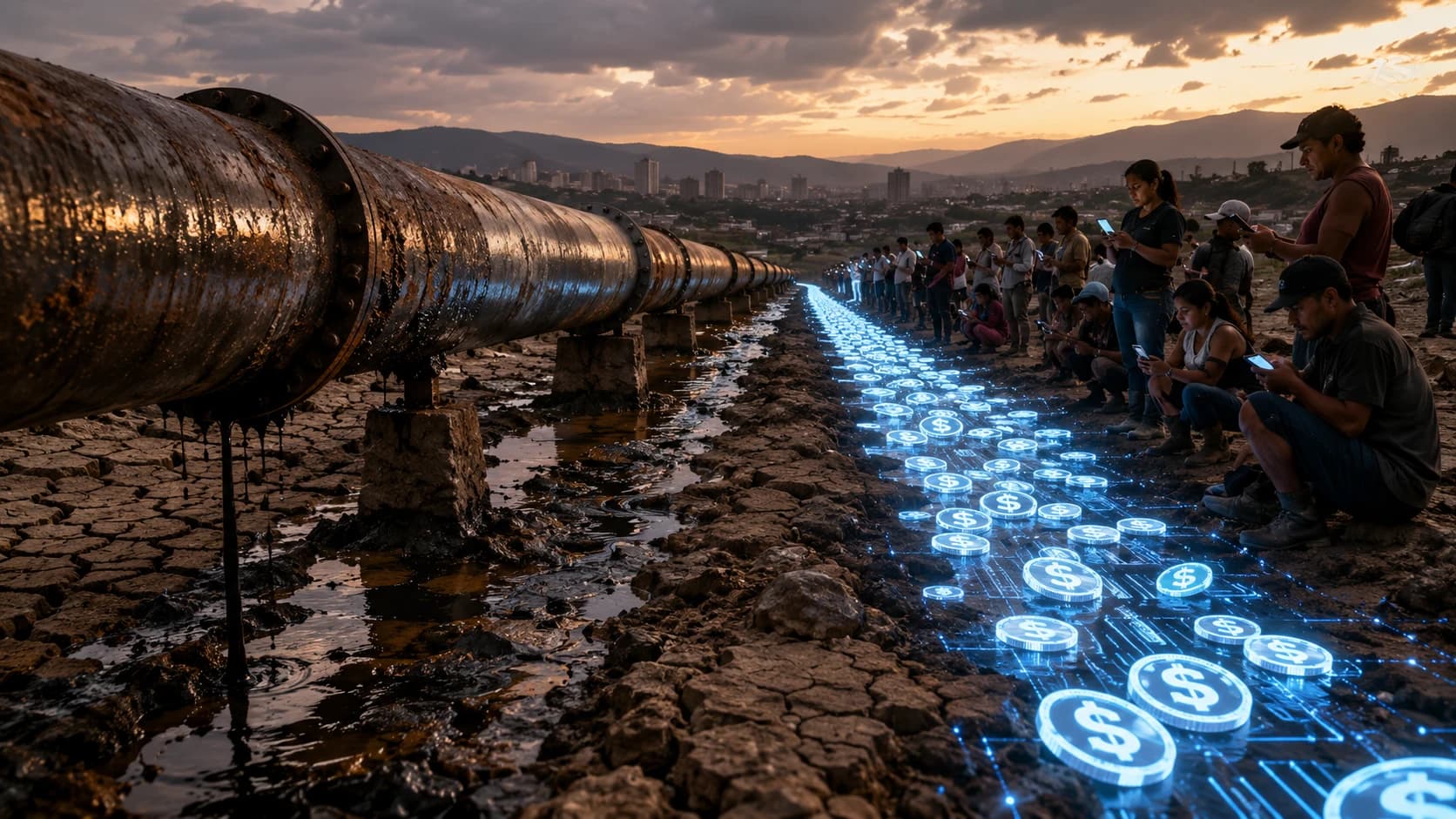
Stablecoin activity in Venezuela has reached a scale that is hard to dismiss as a niche crypto story. A report published by WuBlockchain on July 17, 2026 estimates that USDT trading in the country over a roughly one-month window, from June 11 to July 13, approached the value of Venezuela's oil exports for a comparable period. The claim is based on the report's own dataset, and it captures a shift that Venezuelans have lived through for years: the dollar, in tokenized form, is doing the work the bolivar no longer can.
Oil is the reference point for a reason. Crude has been the backbone of Venezuela's economy and its main source of hard currency for decades. For stablecoin flows to sit anywhere near that number says less about crypto speculation and more about a population routing everyday value through whatever holds its worth overnight.
Dollar demand outrunning the official system
Venezuela's bolivar has been eroded by years of hyperinflation, and access to physical US dollars is uneven and often expensive. Tether's USDT fills that gap. It is priced in dollars, it settles in minutes, and it does not require a bank branch to be open or a customs officer to approve a shipment of banknotes.
The report frames the trading figure as a monthly snapshot rather than a permanent state, and that caveat matters. A single window can be inflated by remittances, by traders arbitraging local exchange rates, or by businesses settling imports. Even with those qualifiers, the direction is consistent with what on-the-ground reporting has described for some time. When people lose faith in a local currency, they do not wait for a regulator to bless an alternative. They adopt the one that already works.
That behavior is not unique to Venezuela. Similar patterns show up wherever inflation runs hot and capital controls bite, which is why central banks elsewhere are watching stablecoin volumes closely. Thailand's central bank, for instance, has begun auditing high-volume USDT transactions as the asset moves further into everyday commerce.
The oil comparison in proportion
Comparing a stablecoin trading figure to oil exports is a rhetorical device, and it is worth being precise about what it does and does not prove. Trading volume is not the same as net wealth created. A dollar of USDT can change hands many times in a month, so gross volume overstates the "size" of the flow relative to oil revenue, which is measured as sales.
The comparison still carries weight because it reframes where economic gravity now sits. Oil requires infrastructure, buyers, shipping, and a state apparatus to extract value. USDT requires a phone and an internet connection. One of these has been degrading under sanctions and mismanagement. The other has been growing from the bottom up, transaction by transaction, with no central planner directing it.
For readers outside the country, the takeaway is not that Venezuela has "gone crypto." It is that a hard-currency substitute can scale to macroeconomic relevance without any official endorsement, purely because it solves a problem the formal system cannot.
The custody question underneath the headline
The part the volume figure hides is how Venezuelans actually hold that USDT. Much of it sits inside centralized exchange accounts and custodial apps, which reintroduces exactly the counterparty risk the dollar peg is supposed to avoid. A frozen account or an insolvent platform can wipe out a balance that felt as safe as cash. That is the same lesson traders elsewhere learned from earlier exchange failures.
The alternative is holding stablecoins in a wallet the user controls and spending directly from it. Non-custodial spending options and cards that draw from a self-held balance reduce the risk that a third party freezes funds, though they shift the burden of key management onto the user. In a country where the banking system is unreliable, that tradeoff often favors self-custody, but it is a real tradeoff, not a free upgrade.
Stablecoin-linked cards add another layer, letting a USDT balance become spendable at ordinary merchants. That utility comes with its own costs: network spreads, conversion fees at the point of sale, and the reality that many providers do not serve sanctioned or high-risk markets at all. Availability, not just economics, is the binding constraint in a place like Venezuela.
The signal for the rest of the market
Governments building stablecoin rules are, in effect, legislating for scenarios like this one. The US and UK recently published a 10-point roadmap to align stablecoin regulation, and Japan has moved to formalize stablecoin lending and payment products. Those efforts are aimed at orderly, licensed markets. Venezuela shows the other end of the spectrum, where adoption happens first and rules, if they come at all, arrive late.
The number to watch is not this month's headline figure but whether the trend holds across the second half of 2026. A single month rivaling oil exports could be a spike. Several consecutive months at that level would mark a durable shift in how an entire economy stores and moves value.
Overview
A WuBlockchain report dated July 17, 2026 estimates that USDT trading in Venezuela from June 11 to July 13 approached the value of the country's oil exports. Gross trading volume overstates net economic size, so the comparison is directional rather than exact, but it reflects a real substitution of tokenized dollars for a collapsed local currency. The bigger open question is custody: much of that volume sits on centralized platforms, carrying the same counterparty risk the dollar peg is meant to avoid. This is speculative analysis of a fast-moving situation, not financial advice.