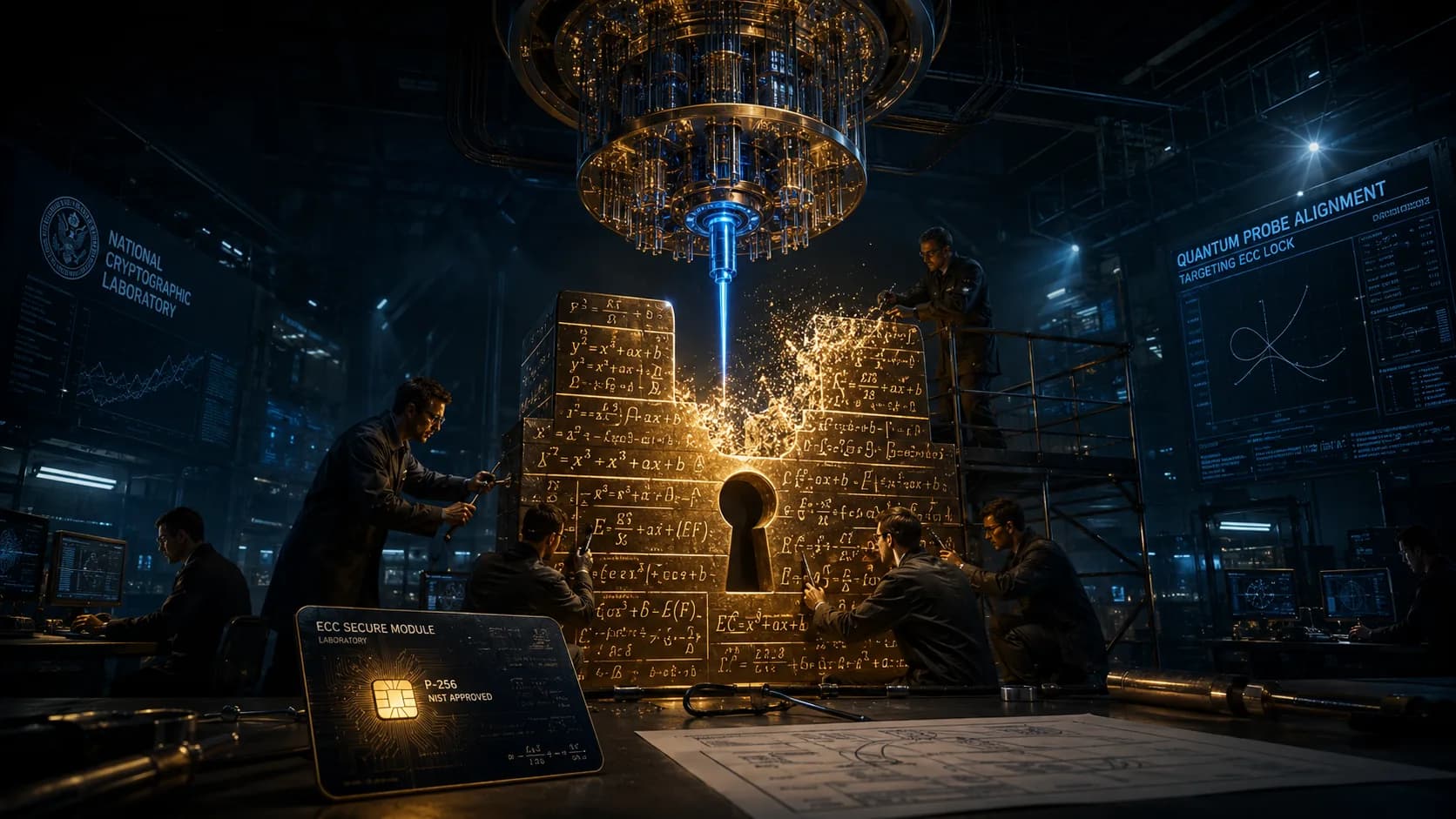
Trump signed executive orders calling for a powerful quantum computer, with a target of 2028, Reuters reported early on June 23, 2026. The orders direct a coordinated national effort to build the kind of machine that has sat at the center of long-range computing strategy for a decade. For crypto holders, the relevant detail is not the politics. It is the cryptography.
The math that protects a Bitcoin private key, an Ethereum wallet, and the signing keys behind a self-custody crypto card is the same family of math a large fault-tolerant quantum computer is theorized to break. A government-funded deadline does not change the physics, but it does compress the planning window for everyone who custodies digital assets.
The 2028 target is a goal, not a guarantee
A directive to build something by a date is not the same as building it. Quantum computers that exist today are noisy, error-prone, and far short of the scale needed to run Shor's algorithm against real-world keys. Estimates for a "cryptographically relevant" machine, one that could derive a private key from a public key, have consistently sat years beyond whatever the current frontier is. A 2028 target accelerates funding and coordination. It does not collapse the gap to zero.
The honest framing is that the United States is putting state resources behind a problem that was previously led by a handful of labs and large technology firms. That raises the odds of faster progress. It also raises the odds that post-quantum standards get adopted before any machine can threaten live funds, because the same urgency that funds the attack funds the defense.
Bitcoin's cryptography sits in the blast radius
Two cryptographic primitives matter for crypto. The first is the elliptic-curve signature scheme (ECDSA on secp256k1) that Bitcoin and most chains use to prove ownership of funds. The second is SHA-256, the hash function behind Bitcoin mining and address generation. A sufficiently large quantum computer running Shor's algorithm threatens the first by recovering a private key from an exposed public key. Grover's algorithm weakens the second, but only by roughly halving its effective strength, which a parameter change can offset.
The practical risk is narrower than headlines suggest. A Bitcoin address only exposes its public key once it has been spent from. Funds sitting in unspent, never-reused addresses are protected by an additional hash layer. Reused addresses and any chain that exposes public keys by default are the soft targets. That distinction is why the migration conversation centers on signature schemes first.
Custody and card providers are the first movers
The companies that hold or help secure keys carry the earliest planning burden. Hardware wallet makers such as Ledger ship secure elements and firmware that would need to support post-quantum signature schemes once standards settle. Custodial exchanges and the issuers behind crypto cards face the same migration on their internal key management, where a single compromised signing key can affect many users at once.
This is where the counterparty question returns. With a custodial provider, you are trusting that its security roadmap, including any future post-quantum upgrade, is competent and funded. With a self-custody setup, the upgrade path is yours to manage, but so is the exposure if you delay. Neither model is automatically safer here. Both depend on adopting standardized post-quantum cryptography on a sane timeline, and the US standards body has already published initial post-quantum algorithms for exactly this purpose.
The migration window, not the panic button
For a reader holding crypto today, nothing about June 23 requires action. No machine capable of breaking secp256k1 exists, and the assets most at risk, reused or public-key-exposed addresses, are a known and fixable category. The reasonable posture is to track how the wallets and platforms you use talk about post-quantum readiness over the next few years, and to avoid address reuse as basic hygiene.
The larger signal is institutional. A national government putting a date on quantum hardware tells custodians, chains, and card issuers that the abstract "someday" threat now has a clock attached. That tends to move roadmaps. The same applies in the United States specifically, where federal agencies often set the procurement standards that private security vendors follow.
Overview
Trump signed executive orders directing a US push for a powerful quantum computer targeting 2028, per Reuters on June 23, 2026. The crypto stakes sit in the elliptic-curve signatures and hashing that secure wallets and card keys. A machine capable of breaking them does not exist yet, and never-reused addresses carry an extra hash layer of protection. The actionable takeaway is unglamorous: avoid address reuse, and watch whether your wallet, exchange, and card issuer commit to post-quantum standards as the timeline tightens. Crypto markets reflected the non-urgency, with BTC at $64,036 (+0.4% on the day) and the Fear and Greed index at 22 as of June 23, 2026.