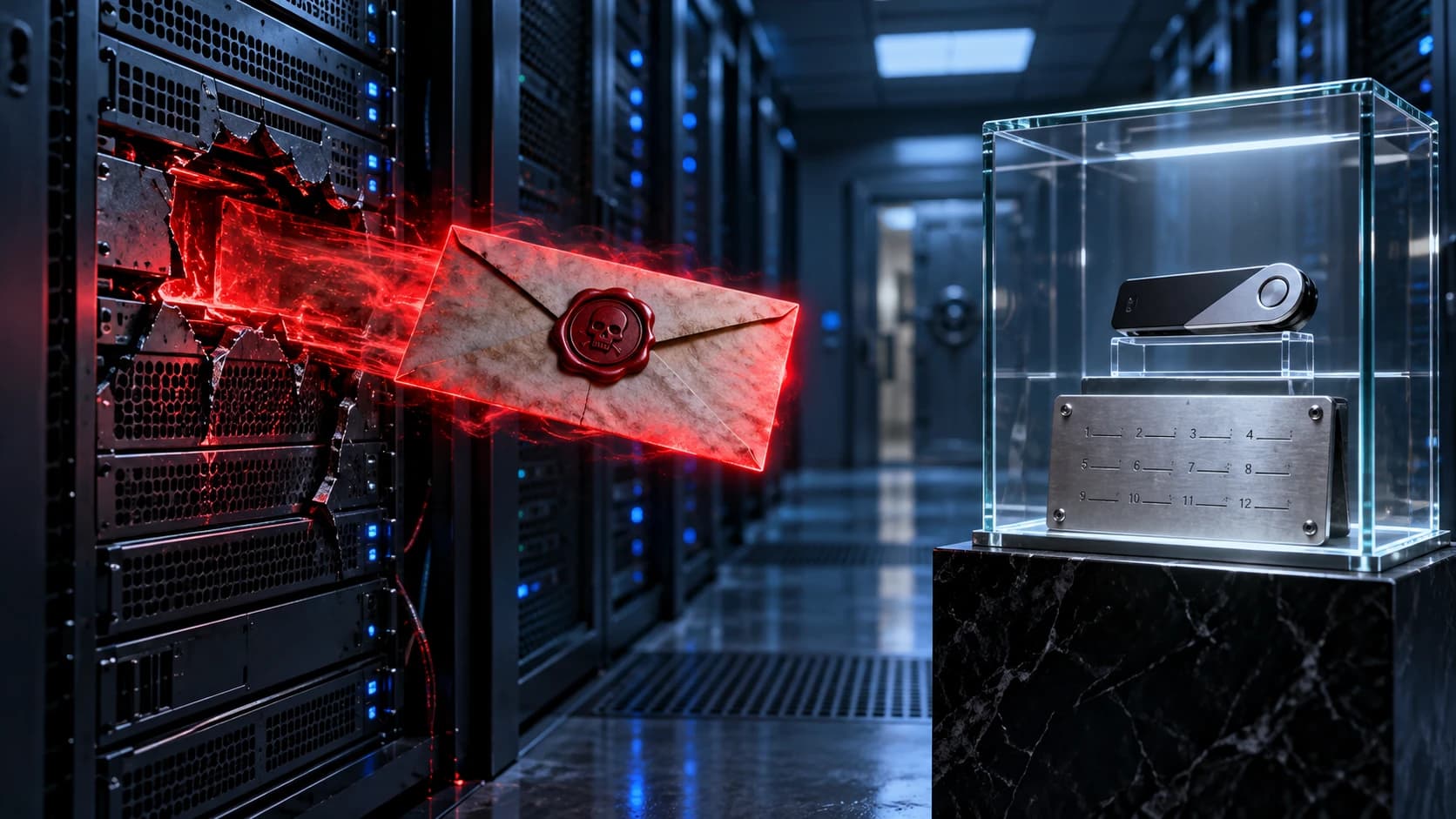
Trezor disclosed that a third-party email provider it relies on was breached, and it is telling customers to ignore phishing emails carrying a fake "Critical Security Alert" subject line. The company said it is still investigating and has not confirmed the full scope. The warning was shared publicly on September 10, 2026, and reported by Cointelegraph.
The pattern is familiar for hardware wallet makers. When an attacker gets access to a customer email list or the systems that send email on a brand's behalf, the payoff is not the email addresses themselves. It is the trust those addresses carry. A message that appears to come from Trezor, landing in the inbox of someone who owns a Trezor device, clears the hardest hurdle a scammer normally faces: getting the target to believe the sender is real.
The breach is at a vendor, not the device
The important distinction in this incident is where the failure sits. Trezor's disclosure points to a third-party email provider, not to the security element inside its wallets or to the recovery seed that protects funds. A hardware wallet keeps private keys offline on the device. An email vendor breach does not change that. No amount of access to a mailing system lets an attacker sign a transaction or extract a seed phrase that never leaves the hardware.
What the breach does hand attackers is a high-quality target list and a plausible reason to make contact. That is why the phishing wave uses urgency. A "Critical Security Alert" subject line is engineered to make a reader act before thinking, click a link, land on a cloned site, and type in the one thing that would actually drain their wallet: the 12 or 24 recovery words.
Trezor's guidance here is the same it has repeated after previous incidents. The company does not ask for your recovery seed by email, by web form, or through any support channel. Any message that requests it, or links to a page that requests it, is fraudulent regardless of how convincing the branding looks.
Repeated vendor exposure is the real story
This is not the first time Trezor's external partners have been the weak point. The company has dealt with support-tool abuse and a separate incident tied to a fulfillment vendor that exposed customer records. Each event followed the same shape: the core product held, but a connected service that touched customer data did not.
For anyone weighing where their crypto risk actually lives, that is the useful takeaway. The threat model for a hardware wallet owner has shifted away from someone cracking the device and toward someone impersonating the brand after harvesting contact details from a softer target in the supply chain. The device can be near-flawless and the owner can still lose everything to a well-timed email.
Verification habits that survive a breach
The defense does not depend on trusting any single email again. It depends on treating unsolicited security messages as untrusted by default and verifying through a channel you already control.
- Never enter your recovery seed anywhere except directly on the Trezor device screen during setup or recovery. No legitimate prompt asks for it in a browser or email.
- Do not click links in security emails. Type the official domain yourself or use a bookmark you saved earlier.
- Check the sender address closely, but do not rely on it. Display names and even some header details can be spoofed.
- Treat urgency as a warning sign. Real security notices rarely demand that you act within minutes through a link.
- If a message references your account or a supposed compromise, confirm through the official support page rather than replying.
These habits matter beyond hardware wallets. The same logic applies to anyone holding funds on an exchange or spending from a self-custody wallet, where a card or app links directly to on-chain balances. The authentication question is always the same: are you responding to a message, or are you reaching the service through a path you chose and trust?
The cost sits with users, not the vendor
An email provider breach carries little direct cost for the brand whose name gets abused. The losses land on individuals who click. That asymmetry is why these campaigns keep running and why they follow major disclosures within hours. Attackers know a fresh, real breach gives their fake alerts a veneer of legitimacy, and they move while the news is still circulating.
Trezor has not published a customer count or a timeline for its investigation as of September 10, 2026. Until it does, the safe assumption is that any Trezor-branded email demanding urgent action or referencing a security problem should be ignored and verified independently. The recovery seed stays on the device and in your head, and nothing that arrives in an inbox has any claim to it.
Overview
Trezor confirmed a breach at a third-party email provider and warned users about fake "Critical Security Alert" phishing emails while its investigation continues. The device and recovery seed are not compromised by an email vendor breach, but the stolen trust makes phishing more convincing. The durable defense is procedural: never enter a seed anywhere but the device, never click links in security emails, and verify through channels you already control.