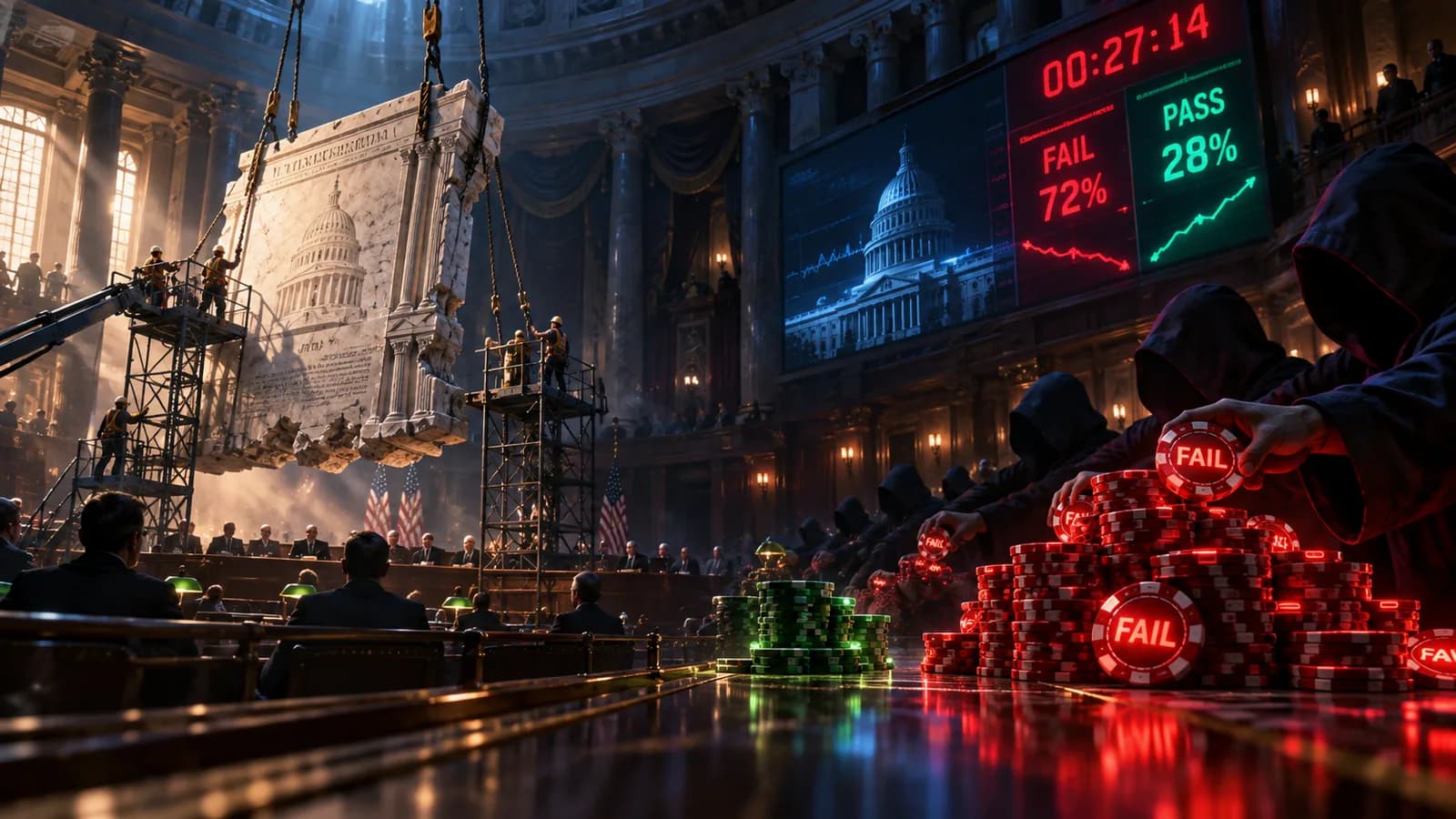
Anonymous traders have placed more than $1 million in wagers that the CLARITY Act, the market-structure bill widely seen as crypto's most consequential US legislation this cycle, will fail its upcoming vote. The bet surfaced days before what backers have framed as a make-or-break moment, and it puts a hard dollar figure on skepticism that had mostly lived in commentary and headline anxiety. The claim comes from a Sept. 6, 2026 post by Coin Bureau on X.
Prediction-market money is a different signal from a poll or a pundit quote. Someone has to be willing to lose the stake. When over $1 million lines up on the "fail" side of a binary question, it means at least one set of participants is confident enough in a negative outcome to hold that position through the vote. That does not make the bill's defeat likely on its own, but it does show the market is not treating passage as a formality.
The size of the bet against passage
A seven-figure position on a single legislative outcome is unusual for a bill that supporters have repeatedly described as having momentum. It reflects genuine uncertainty about the vote count, the calendar, or both. Prediction markets tend to compress rumor, whip counts, and procedural risk into one number, and right now that number is skewed enough toward failure to attract real capital.
This is speculative positioning, not a forecast of the result, and it is not financial advice. Wagers can be wrong, thin markets can be moved by a few large players, and anonymous traders may hold information advantages or simply strong convictions that do not pan out. The signal worth taking from it is that informed money sees a live path to the bill stalling.
A bill that keeps hitting the calendar
The CLARITY Act would divide oversight of digital assets between US regulators and set clearer rules for when a token is treated as a security versus a commodity. That framework matters to exchanges, token issuers, and any product that touches US users, because the current ambiguity shapes what can list, what gets delisted, and where companies choose to operate.
Timing has been the recurring obstacle. When a legislative session slips or floor time gets reallocated, a bill with cross-chamber steps to complete can lose its window fast. Traders betting against passage may be pricing in exactly that kind of procedural risk rather than a hardened opposition to the policy itself. A vote that keeps getting described as "make-or-break" is, by definition, one where the downside is real.
The read for crypto users
Market-structure rules feed directly into where crypto cards, exchanges, and stablecoin products can operate and how aggressively they expand in the US. Clear categories would make it easier for regulated issuers to launch consumer products with confidence. Continued limbo keeps some launches offshore and pushes US users toward platforms and cards domiciled elsewhere. That is why the outcome matters beyond trading desks, and why comparing options across different jurisdictions stays relevant while the rules remain unsettled.
For anyone tracking the vote, the useful move is to watch the odds alongside the whip count rather than reacting to either alone. Prediction markets have front-run legislative outcomes before, and they have also been wrong when a late procedural maneuver changed the math overnight. A million dollars of "fail" money is a data point, not a verdict.
Overview
Anonymous traders have wagered over $1 million that the CLARITY Act will fail its upcoming vote, according to a Sept. 6, 2026 post from Coin Bureau. The position puts a concrete price on doubt that had been largely rhetorical, and it points to procedural and calendar risk as much as policy opposition. The bill would set clearer US rules on how digital assets are classified and regulated, with direct consequences for exchanges, issuers, and consumer products. The bet is a market signal of live uncertainty, not a prediction of the result, and it is not financial advice.