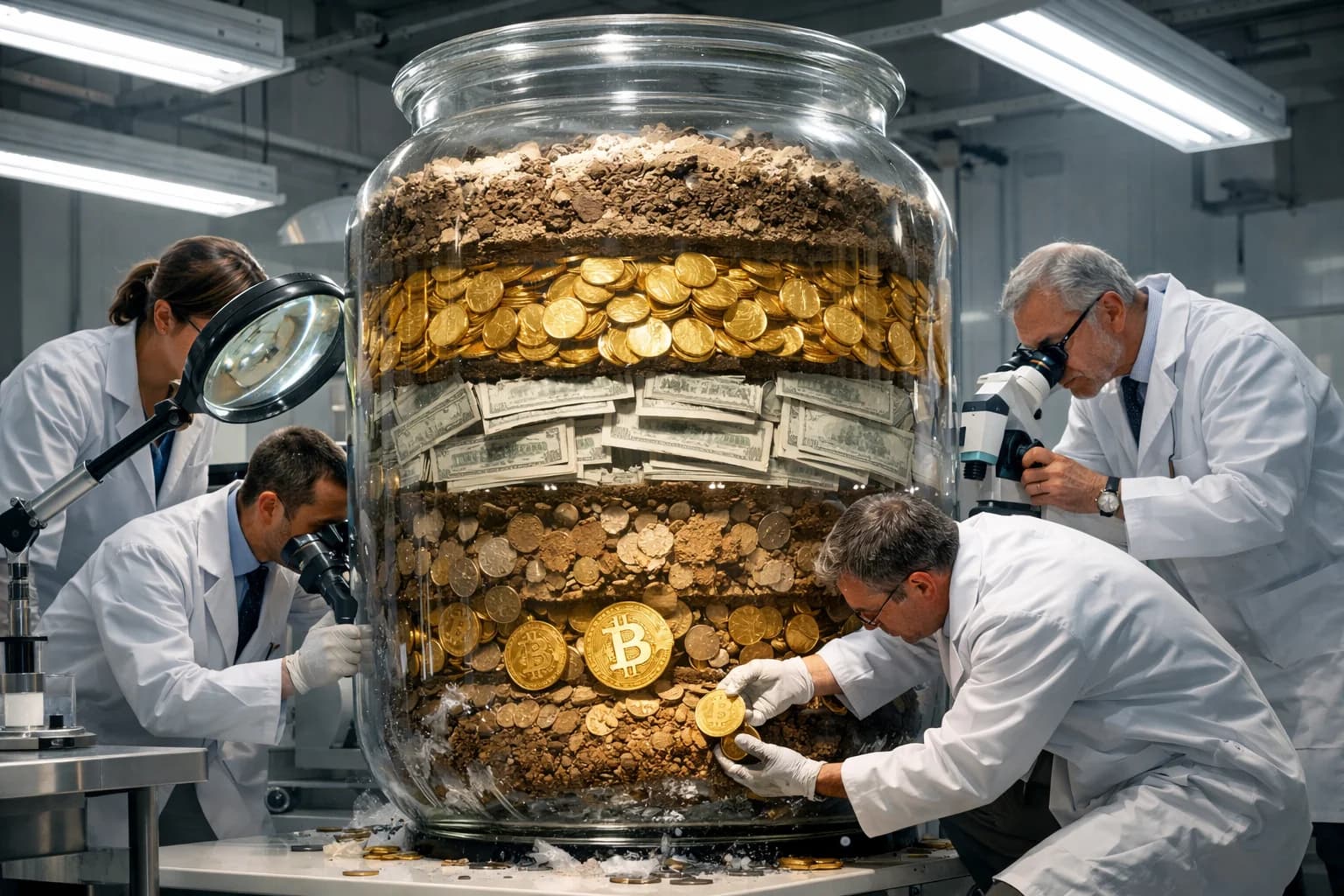
Tether aims to complete a full audit of its operations by the end of 2026, Bloomberg reported on March 13. If the company follows through, it will mark the first time the issuer of the world's largest stablecoin has submitted to a comprehensive financial examination in its more than ten-year history.
USDT's market cap sits near $189 billion as of March 2026, backing roughly 70% of all stablecoin liquidity in crypto. The reserves behind that figure have never been fully audited. Tether has published quarterly attestation reports, point-in-time snapshots that confirm reserve balances on a given date, but an attestation is not an audit. It does not examine internal controls, verify the flow of funds over time, or test whether the accounting policies themselves are sound.
From Attestation to Audit: What Changed
The timeline shifted in March 2025, when Tether hired Simon McWilliams as CFO. McWilliams, a finance executive with over two decades of experience including stints at LetterOne and Quantmetrics Capital Management, replaced Giancarlo Devasini, who moved to Chairman. CEO Paolo Ardoino told Reuters at the time that a full audit by a Big Four firm was a "top priority" and that the company was actively in talks with Deloitte, EY, PwC, or KPMG.
Then came the first concrete result. On March 2, 2026, Deloitte signed off on the reserve report for USAT, Tether's new US-regulated stablecoin launched in January through a partnership with Anchorage Digital. The report confirmed $17.6 million in reserve assets backing 17.5 million USAT tokens, composed of $3.65 million in cash and $13.95 million in reverse repurchase agreements backed by US Treasuries.
$17.6 million is a rounding error next to $189 billion. But the Deloitte sign-off on USAT was the first time any Big Four firm put its name on a Tether-affiliated product. It established a working relationship and, more importantly, a precedent.
What $189 Billion Actually Looks Like
Tether's most recent attestation, covering reserves as of December 31, 2025, shows $192.878 billion in total assets against $186.540 billion in total liabilities, leaving a $6.338 billion equity cushion. The asset composition breaks down into US Treasury bills and reverse repos (the bulk), $17.45 billion in precious metals, $8.43 billion in Bitcoin, $2.76 billion in other investments, and $17.04 billion in secured loans.
That secured loan portfolio, along with the precious metals and Bitcoin holdings, is exactly where a full audit would differ from a quarterly snapshot. An attestation confirms that on December 31, those numbers existed. An audit would trace how those loans were originated, whether the collateral is sufficient, how the Bitcoin is valued under stress conditions, and whether the internal controls governing $192 billion in assets meet professional standards.
No stablecoin issuer of this size has undergone that level of scrutiny. Circle, which issues USDC (approximately $59 billion in circulation), publishes monthly attestation reports through Grant Thornton, but has not completed a full audit either, though it filed for an IPO in April 2025 that would subject it to SEC audit requirements.
The Genius Act Forces the Issue
Tether's audit push does not exist in a vacuum. The Genius Act, passed last summer, limits the types of assets that can back stablecoins and requires larger issuers to move under federal oversight. USAT was designed specifically to comply with these rules, and Deloitte's involvement signals that Tether is building the accounting infrastructure the law demands.
For USDT specifically, which operates primarily offshore, the path is less clear. Tether is incorporated in the British Virgin Islands with operational ties to Hong Kong and El Salvador. A Big Four firm auditing the full entity would need to verify counterparties across multiple jurisdictions, examine the lending book, and sign off on the precious metals holdings reportedly stored in Swiss vaults.
The Genius Act does not directly mandate that offshore stablecoins like USDT get audited. But the competitive pressure is real. If USDC gains ground partly because it is perceived as more transparent, and if banks begin issuing their own stablecoins under stricter regulatory frameworks, USDT's market dominance depends on clearing the audit bar.
A Decade of Promises
Tether has said it would get audited before. In 2017, the company hired Friedman LLP, which departed before completing the work. In 2018 and 2021, Tether promised audits that never materialized. The company settled with the New York Attorney General in 2021 for $18.5 million over misleading statements about its reserves. In 2022, it began publishing quarterly attestations through BDO Italia, a step up from nothing but still short of the audit that critics and regulators wanted.
The difference this time: a Big Four firm has already agreed to work with a Tether product, a dedicated CFO was hired specifically to oversee the process, and US legislation now creates a regulatory framework where an unaudited stablecoin faces structural disadvantages.
Whether Tether actually delivers the audit by December 31, 2026, is a different question. Big Four audits of financial institutions of this complexity typically take 12 to 18 months from engagement to final report. If the engagement started in early 2026, a year-end delivery is ambitious but not impossible.
What Holders Should Watch
For anyone holding or transacting in stablecoins, the audit's outcome matters more than the promise. The key variables: which firm takes the engagement (Deloitte is the frontrunner given the USAT relationship), whether the audit covers the full Tether entity or only specific subsidiaries, and whether the results are made public in full or only summarized.
BTC traded at $72,522 (+3.0% in 24 hours) and ETH at $2,128 (+2.6%) as of March 13, 2026. The Fear and Greed Index sat at 34 (Fear). Markets are pricing in macro uncertainty, not stablecoin risk, but a failed or delayed audit would change that calculus quickly.
Overview
Tether told Bloomberg it aims to complete a full audit by the end of 2026, which would be the first in the company's history. The commitment follows Deloitte's March 2 sign-off on the $17.6 million USAT reserve report and the March 2025 CFO hire of Simon McWilliams. USDT's $189 billion in reserves has never been fully audited despite quarterly attestation reports. The Genius Act and competitive pressure from USDC and bank-issued stablecoins create real incentives for Tether to follow through, but the company has a documented history of audit promises that went unfulfilled.