SWI Group has raised 800 million euros to invest in data centers that serve artificial intelligence companies, according to a report shared by Cointelegraph on October 12, 2026. The capital pool is anchored by Genesis Digital Assets, a Bitcoin mining operation that SWI Group took control of in the wake of the FTX collapse.
The move turns one of the more visible remnants of the FTX era into infrastructure for the AI buildout. Rather than being wound down or sold off piecemeal, Genesis Digital Assets becomes the operational core of a fund aimed squarely at the compute shortage that AI firms keep complaining about.
A mining estate repurposed for compute
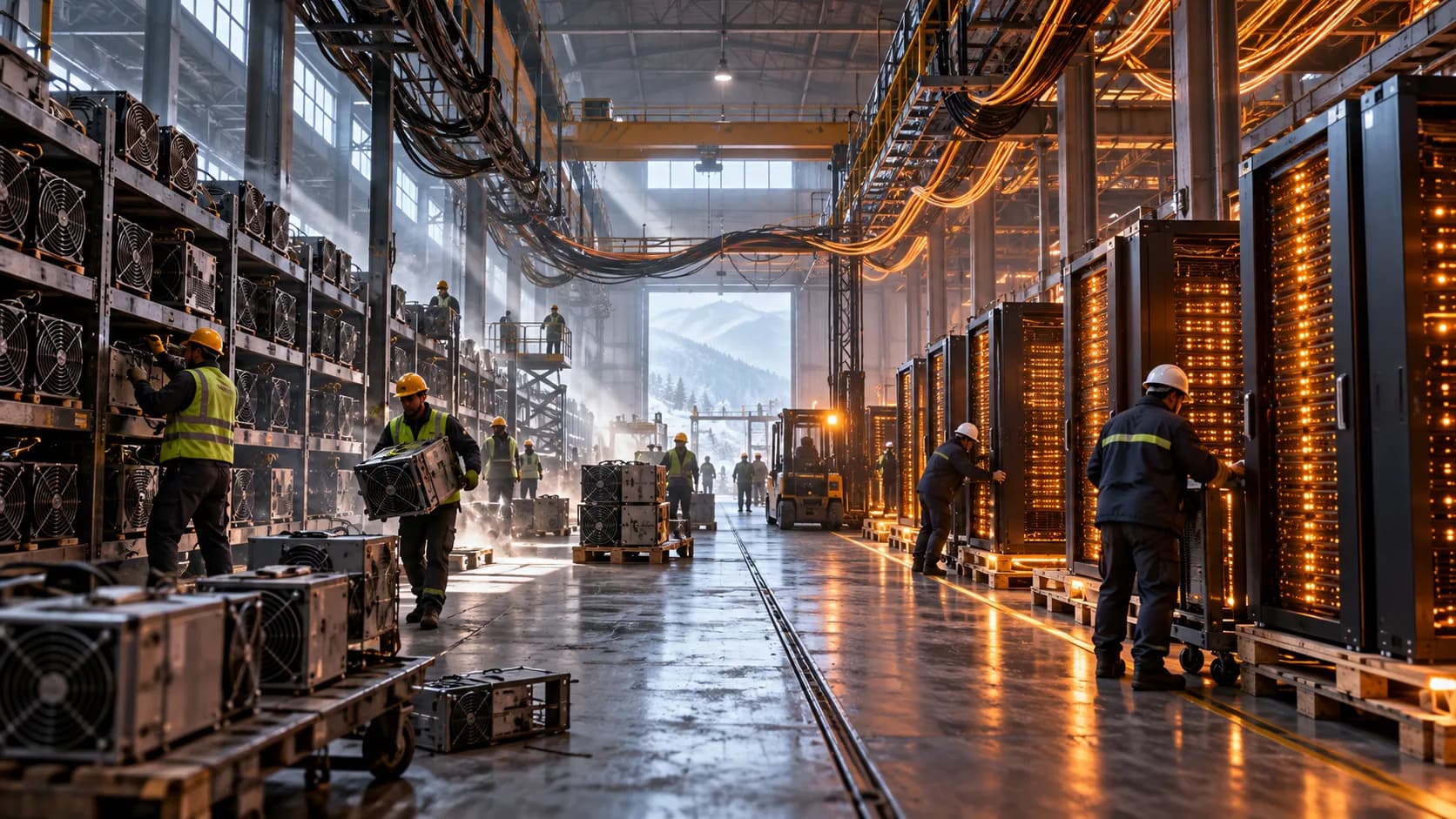
Genesis Digital Assets built its business around industrial-scale Bitcoin mining, which means large sites, high-density power contracts, and the physical plumbing to run thousands of machines around the clock. Those are the same ingredients AI data centers need. Power access and ready-to-use sites, not chips alone, are usually the bottleneck for new compute capacity, so an existing mining estate is a shortcut past the slowest part of the build.
SWI Group raising 800 million euros against that base reads as a bet that the assets are worth more pointed at AI workloads than at hashing blocks. Mining margins swing with the Bitcoin price and the network's difficulty, while AI compute demand has been climbing on a steadier curve. Reallocating power and floor space toward AI is a way to lock in revenue that does not depend on where Bitcoin trades.
As of October 12, 2026, Bitcoin sat at roughly 83,647 dollars, down about 2.2 percent over the prior week. At that level, mining economics stay tight for operators without cheap power, which makes the case for repointing capacity toward customers who will pay for every watt regardless of the token's direction.
The FTX estate keeps producing deals
Genesis Digital Assets was one of the larger holdings connected to the FTX and Alameda orbit, and its path from that wreckage into a new owner's hands fits a pattern. Assets caught in the 2022 collapse have spent years being untangled, revalued, and moved to operators who can run them. The destination this time is AI infrastructure rather than a crypto exchange or trading desk.
This is analysis rather than a claim from the source, but the direction is hard to miss: capital that first chased crypto exposure is increasingly chasing the picks-and-shovels layer underneath both crypto and AI. Data centers, power purchase agreements, and server capacity are the assets that hold value whether the hype cycle is about tokens or large language models. An 800 million euro raise built on a former mining company is a concrete version of that shift.
Miners and AI data centers are close cousins
Bitcoin miners and AI data centers are close cousins. Both chase low-cost electricity, both run hot and need heavy cooling, and both sign multi-year power deals that are hard for newcomers to replicate. Several large mining firms have already leased or converted capacity for AI tenants because the per-megawatt economics of serving an AI customer can beat mining outright when the Bitcoin price is soft.
SWI Group is effectively institutionalizing that trade at fund scale. Instead of a single miner flipping one site, an 800 million euro vehicle is set up to acquire and convert capacity as a strategy. The size of the raise signals that backers see the demand lasting long enough to justify committing real money to physical buildout, not just a short-term arbitrage while Bitcoin is cheap.
For the broader crypto economy, the read-through is mixed. Capacity that leaves mining tightens the network's industrial base, which can firm up hashing economics for the operators that stay. It also shows that the most durable value from the last cycle's crypto infrastructure may end up serving AI rather than crypto itself.
Overview
SWI Group raised 800 million euros to build AI data centers, with Genesis Digital Assets, a Bitcoin mining business inherited from the FTX collapse, as the anchor asset. The deal converts industrial mining capacity, power contracts, and sites into infrastructure for AI compute, a crossover that keeps recurring as miners find AI tenants more profitable than hashing when Bitcoin trades soft. It is also another sign that assets stranded by FTX are being recycled into whatever the market values most, which right now is compute.