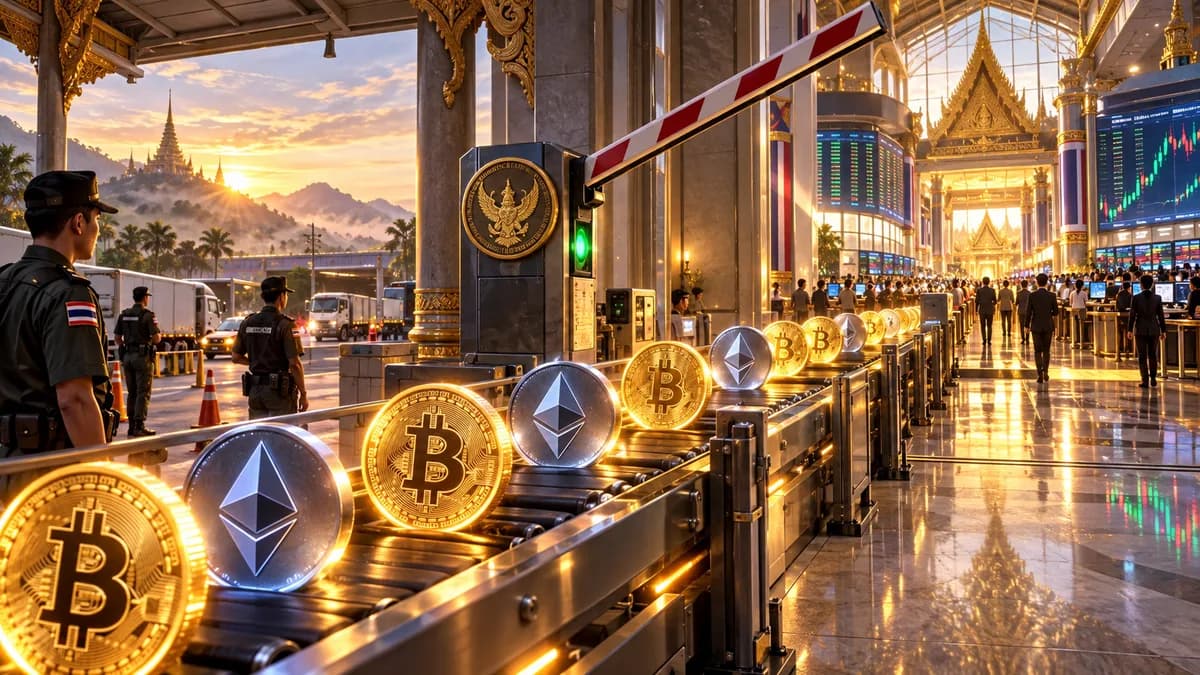
South Korean crypto trading has shrunk to roughly 10% of the volume changing hands on the country's stock market, according to a WuBlockchain post citing Digital Asset on May 27, 2026. That ratio is a striking reversal for a market that, during the 2021 bull run, regularly traded more crypto by dollar value than Korean equities and at times outpaced major US venues.
The shift matters because South Korea has long been treated as a leading indicator for retail crypto appetite. When the "kimchi premium" widened, traders worldwide took it as a sign of overheated demand. A market that small relative to local stocks tells a different story: retail capital has rotated out, regulation has thickened, and the equity tape has been competitive enough to keep money at home.
A market that once led global retail flow
At various points in 2017, 2021, and early 2024, Korean won pairs accounted for more daily crypto turnover than any other fiat outside the US dollar. Upbit alone has historically ranked among the top three spot venues by volume. Bithumb, Coinone, and Korbit added more depth on top.
That dominance has been fading throughout the current cycle. Bitcoin sits at $75,793, down 1.2% on the day, with the broader market under pressure: ETH at $2,083, SOL at $84, and XRP at $1.33 as of May 27, 2026. The CMC Fear & Greed index reads 37 (Fear). Soft prices alone do not explain the drop in Korean activity, though. Korea's earlier cycles saw volume rise into selloffs as retail bought the dip. This time, the dip is being met with silence.
Regulation tightened the funnel
Korea's Virtual Asset User Protection Act took effect in July 2024 and pushed exchanges toward bank-grade custody, reserve audits, and stricter listing reviews. The Financial Services Commission has spent the past year forcing delistings of low-liquidity tokens and tightening real-name banking partnerships. Each step trimmed the surface area where casual traders used to play.
Recent enforcement has gone further. Earlier this week, prosecutors filed Korea's first criminal case for a DEX rug pull, signaling that on-chain activity is now squarely within regulatory reach. A retail base that once treated crypto as a fast lane to speculative gains is being told, repeatedly, that the lane is being narrowed.
KOSPI gave traders somewhere else to be
The other half of the story is equities. The KOSPI has been on a multi-month rally driven by chip exporters, AI hardware demand, and a weaker won that flatters Korean revenue from overseas. Samsung's pay deal noted in Reuters reporting on the same day signals that domestic equity narratives still command attention, even when management challenges remain.
When local stocks pay off, the case for chasing volatile altcoins thins. Retail flow follows the easier trade. With KOSPI returns competitive against many large-cap crypto positions through this cycle, the rotation back into equities has had a real opportunity cost case behind it, not just a fatigue narrative.
Spending and card design implications
Korean crypto card uptake has always been muted by the same rails that limit on-exchange activity. Real-name banking rules mean most cards routed through global issuers cannot easily pull won-denominated balances from a domestic Korean account. Users wanting to spend crypto-funded balances generally rely on offshore-issued options.
That has kept Korean users disproportionately reliant on self-custody card products and stablecoin-funded cards, where the funding step happens entirely on chain rather than through a Korean bank. If the domestic trading base continues to shrink, expect the spending side to skew further toward self-custodial options rather than exchange-tied debit products, because the exchange leg is exactly what regulation has been squeezing.
For comparison, the broader global picture remains expansionary on the payments side, with stablecoin supply hitting a record $322 billion the same week. The contrast is sharp: stablecoins are growing as global settlement rails while one of crypto's most active retail markets is contracting.
The signal in the ratio
A 10% ratio is not zero. Korea remains an active market by any reasonable measure, and exchanges like Upbit still post daily volume comfortably in the billions. The story is the gap between what Korea once was and what it now is relative to its own stocks.
For traders watching for sentiment turns, that ratio is worth tracking. A bounce back toward 30% or 40% would suggest retail conviction is rebuilding. A continued slide toward single digits would suggest the structural shift is hardening, with implications for global spot liquidity, listing momentum on Korean venues, and the won-pair premium that historically front-ran rallies.
Overview
South Korea's crypto trading volume now sits at roughly one-tenth of its stock market activity, a sharp reversal for a market that has spent most of the past decade punching far above its weight in global crypto flow. Tighter rules under the Virtual Asset User Protection Act, ongoing enforcement against rug pulls and low-quality listings, and a competitive KOSPI have all pulled retail capital toward equities and away from speculative crypto pairs. The structural shift is real, and it most likely benefits self-custodial and stablecoin-funded spending products over the exchange-tied debit card model that Korean rails now make harder.