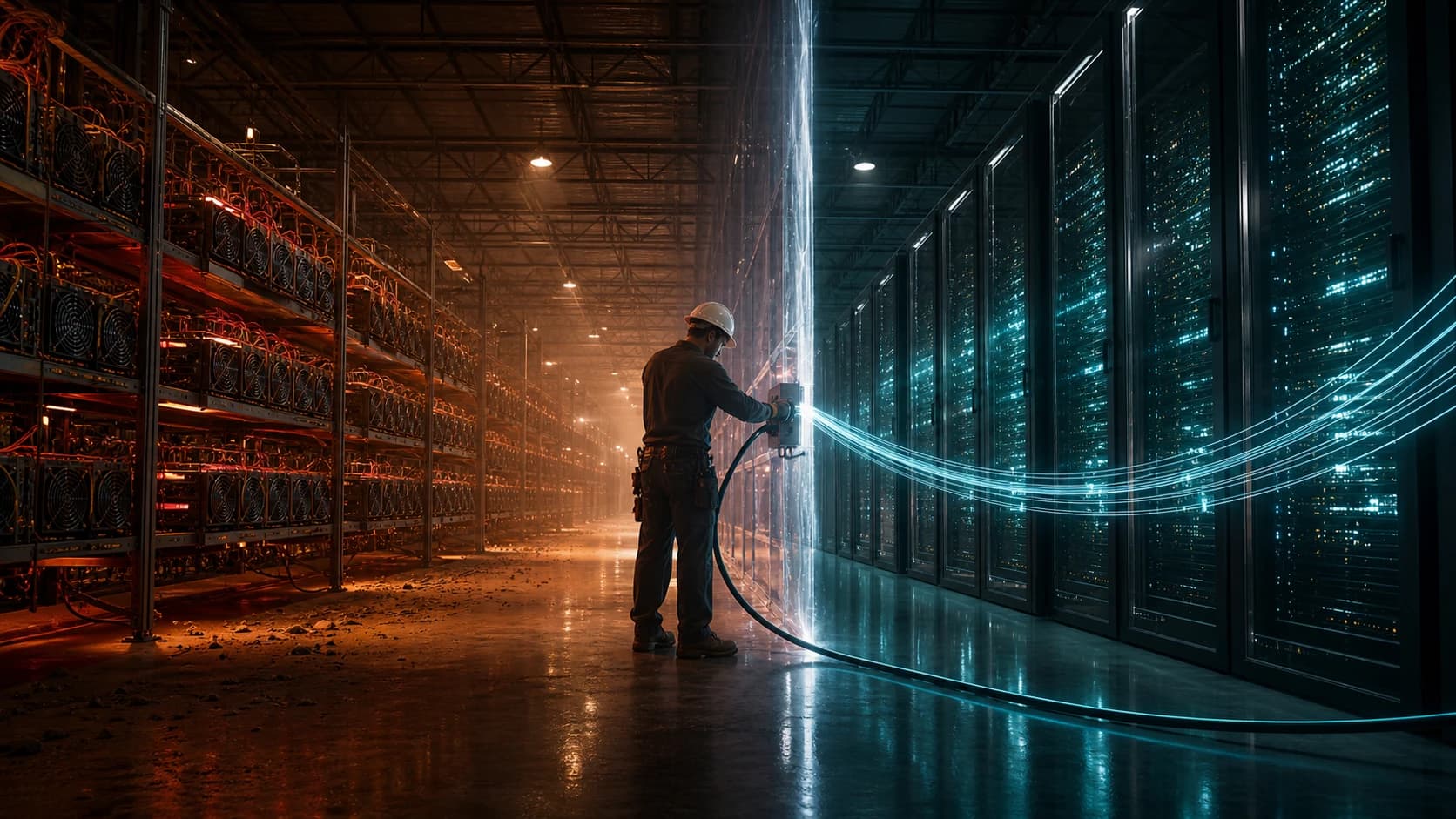
Bitcoin miner Riot Platforms recorded its first data center revenue from AI infrastructure hosting after AMD expanded capacity at the company's Texas operations, Decrypt reported on May 2, 2026. The number itself is small relative to Riot's mining business, but it is the first time the line item shows up at all, and it lands while Bitcoin trades at $78,215 (+1.6% on the day) with a Fear & Greed reading of 45.
Riot has been telegraphing a hybrid pivot for over a year. The thesis: turn megawatts of cheap, interruptible Texas power, originally bought to mine bitcoin, into colocation revenue for AI training and inference workloads. Today's signal is the first concrete sign that the thesis is starting to pay.
Riot is the landlord, AMD runs the silicon
The expansion involves AMD scaling up the GPU capacity it hosts inside Riot's facilities, not Riot buying chips itself. That distinction matters for how to read the revenue. Riot is acting as the landlord and power-and-cooling provider; AMD or AMD's customers run the silicon.
For Riot, that means the revenue carries a lower gross margin than mining when bitcoin is strong, but it is far more stable. Hosting contracts pay regardless of hashprice, and they let Riot keep its grid economics intact during demand-response curtailment, which is when miners get paid to turn off during Texas grid stress.
AI tenants are not as easy to switch off, so the hybrid setup forces some operational rework. Riot will have to carve sites or substations into AI-priority and miner-priority zones, otherwise an AI customer cannot rely on uptime that a curtailment-friendly miner is happy to give up.
Two distinct templates: own the plant or lease the rack
Riot's announcement comes a few days after rival miner MARA Holdings agreed to acquire Long Ridge Energy in a $1.5 billion AI data center pivot. The two stories rhyme but are structurally different.
MARA bought a power plant. Riot is leasing rack space. MARA is building generation capacity it will own outright. Riot is reselling capacity it already has, with AMD or AMD's customers as the operator. The MARA approach is heavier capex with potentially higher long-term margins. The Riot approach turns existing infrastructure into cash sooner, with less balance-sheet risk.
Investors who have been watching the public miner cohort for an "AI optionality" trade now have two distinct templates. Both depend on the same underlying bet: that bitcoin mining alone, at a 3.125 BTC block subsidy and post-2028 halving, may not justify the megawatts that miners have already locked in.
The Bigger Picture for Listed Miners
The next bitcoin halving in 2028 will cut the block subsidy to 1.5625 BTC. At anything close to today's prices and difficulty, marginal miners will be squeezed. Public miners that own megawatts and substations have two ways out: scale to dominate hashprice, or repurpose the megawatts.
Today's number from Riot is small. The signaling is not. If the AMD partnership keeps adding capacity, AI hosting could become a meaningful percentage of Riot's revenue mix within a few quarters. That changes how the equity is valued, since AI hosting trades at higher multiples than mining cash flows.
It also widens the gap between miners that own land, power contracts, and grid interconnects (Riot, MARA, CleanSpark, Core Scientific) and miners that only own machines. Asset-light operators have nothing to repurpose.
The disclosures that will confirm this is a real pivot
Three things will tell us if this is a real pivot or a press release. First, Riot's next quarterly filing should disclose the AI hosting revenue as a separate line, with megawatts dedicated and contract length. Second, AMD's own commentary on its Q2 earnings call will indicate whether the Texas capacity is for AMD's own internal model training or for third-party tenants. Third, any new disclosure on whether Riot is signing long-term hosting contracts (typical AI colos run 5-10 years) or short-term capacity deals.
For crypto users, the second-order effect is that the strongest miners are pivoting away from being pure bitcoin price proxies. That changes the correlation between miner equities and BTC, and over the next two years it will probably reduce miner share-price beta to bitcoin meaningfully.
Overview
Riot Platforms reported its first AI data center revenue after AMD expanded GPU hosting capacity at the miner's Texas sites. The dollar amount is modest, but it confirms that Riot's hybrid bitcoin-plus-AI thesis is producing real income, not just slide decks. With BTC at $78,215 and the next halving roughly two years out, the public miner cohort is splitting into operators that can repurpose megawatts and operators that cannot. Riot just put itself firmly in the first camp, alongside MARA's heavier Long Ridge bet.