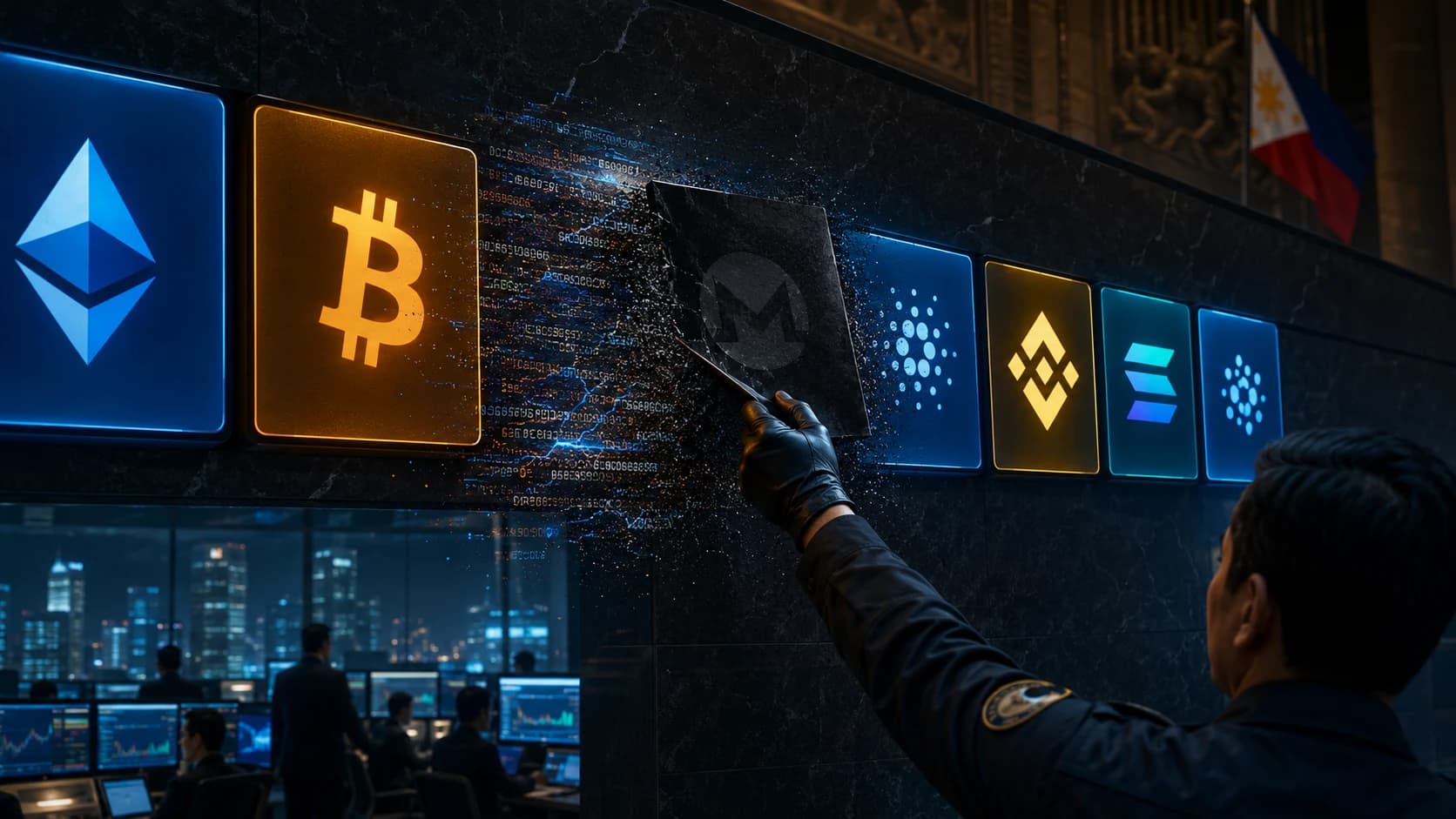
The Bangko Sentral ng Pilipinas (BSP) has directed every registered virtual asset service provider in the country to stop listing privacy-enhancing virtual assets, the class of coins built to obscure who sent funds to whom. The directive was reported by Philippine press and circulated on June 14, 2026. It names the category rather than a single ticker, but the practical targets are well known: Monero, Zcash, Dash, and similar assets that route transactions through shielding or ring-signature designs.
The order lands as the central bank tightens its grip on the local crypto market under its VASP licensing regime. The Philippines has built one of the larger retail crypto user bases in Southeast Asia, and the BSP has spent the past few years pulling exchanges, remittance apps, and wallet services under formal registration. Privacy coins sit awkwardly inside that framework.
The travel rule is the real trigger
At the center of the ban is the Financial Action Task Force travel rule, the standard that requires regulated crypto firms to collect and pass along identifying information about the sender and receiver on transfers above a set threshold. A compliant VASP has to know who is on both ends of a transaction and be ready to hand that data to authorities.
Privacy coins are engineered to make exactly that impossible. Monero hides amounts and addresses by default. Zcash offers shielded transactions that strip transaction detail from the public ledger. For a licensed firm, holding and settling those assets means it cannot produce the records its license now obliges it to keep. The BSP's move reads as a clean resolution of that conflict: if a coin cannot be made travel-rule compliant, a regulated venue should not list it.
This is not a Philippine invention. Exchanges in Japan, South Korea, and across the European Union have delisted privacy coins over the past several years for the same reason, and major global platforms quietly dropped them from regulated markets well before that. The Philippines is following a path that is already worn, not breaking new ground.
Filipino holders face a conversion deadline
For users, the immediate question is access. People who hold privacy coins on a Philippine-licensed platform will likely face delisting notices that give them a window to either withdraw the assets to a self-custodial wallet or convert them into something the venue will still support. Anyone who misses that window risks frozen or force-converted balances, the usual outcome when a regulated exchange exits a token.
There is a self-custody angle here that matters for spenders. Privacy coins do not plug into mainstream card rails to begin with, so a Filipino who wanted to spend Monero was already converting it to a stablecoin or fiat at some point in the chain. The ban removes the regulated on-ramp and off-ramp, not the coin itself. Holders who spend from their own wallet keep the asset, but lose the easy local exit. Those who relied on a licensed exchange to cash out now have fewer doors.
It also feeds the broader verification tightening that has reshaped onboarding across the region. Card and exchange users in the Philippines have watched KYC requirements climb in step with the BSP's VASP build-out. A privacy-coin ban is the same impulse aimed at the asset layer rather than the account layer: regulators want every leg of a transaction legible.
Privacy advocates versus the compliance line
Privacy coins draw a sharper reaction than most delisting stories because the debate underneath is unresolved. Supporters argue financial privacy is a legitimate right and that shielding transaction data is no different in principle from keeping a bank balance off a public ledger. Regulators counter that the same opacity is what makes these assets attractive for sanctions evasion and laundering, and that a licensed firm cannot be in the business of moving funds it cannot trace.
The BSP has come down firmly on the compliance side, and the directive gives local firms no discretion. That is the part likely to provoke takes: this is a hard line, not a risk-based one. A venue cannot keep a privacy coin listed by adding extra monitoring, because the asset's design defeats the monitoring itself.
Against the wider market backdrop, the news is a regulatory data point rather than a price mover. As of June 14, 2026, Bitcoin trades near $64,304, up 0.9 percent on the day, with the Fear and Greed Index at 21, firmly in Fear. Privacy-coin liquidity is a small slice of that picture, and the ban is unlikely to register on the majors. The signal is in the direction of travel, not the size of the asset class affected.
For stablecoin-based spenders, the move is mostly affirming. Dollar-pegged tokens such as USDC and USDT carry transparent, auditable ledgers that satisfy the travel rule by default, which is part of why stablecoin spending keeps absorbing share from more exotic assets in regulated markets. The coins built to hide are the ones getting pushed out; the coins built to be tracked are the ones staying on the menu.
Overview
The BSP has ordered Philippine VASPs to stop listing privacy-enhancing coins, citing the FATF travel rule those assets cannot satisfy. Targets include Monero, Zcash, and Dash. Local holders will likely get a delisting window to withdraw or convert, and the rule extends a multi-year regional pattern of regulated venues dropping privacy assets. The practical effect is fewer compliant on-ramps and off-ramps in one of Southeast Asia's biggest crypto markets, not a price event for the majors.