On This Page
- What changed on May 21, 2026
- How Season 1 was originally structured (reference)
- Inside the weekly Terminal points formula
- Sizing the 2.5% allocation against realistic outcomes
- Featured this week
- What changed in Wave 3 (May 7, 2026)
- The apps that should anchor your weekly selection
- The booster lockout
- Inside the clan reward mechanics
- Risks
On May 21, 2026, MegaETH announced it would conclude Terminal Season 1 early. Week 3 was the final regular points distribution. The season, originally scheduled to run through June 23 across eight weeks, will not continue. Eligible participants instead receive a share of a rewards pool in USDm, the chain's USD-pegged stablecoin, based on points accumulated to date plus activity that supported the Mega ecosystem.
The early conclusion arrives alongside a broader product reset. Terminal's main features are being merged into Rabbithole into "one unified chain experience." The team is preparing to launch the MOSS SDK, a self-custody wallet with smart-approvals security building on Ithaca's Porto. The full M(OS)S product, positioned as a financial OS for an internet-native generation, is targeted for Q3 2026.
This guide now serves two purposes: the original farming playbook stays below as a complete reference to how Season 1 was structured, and the section immediately following covers the sunset announcement and what participants need to do to claim the USDm distribution.
What changed on May 21, 2026
The supplemental USDm distribution goes out next week. MegaETH will open a place on Terminal during the same window for one week, so participants can designate a wallet address to receive their share. Three things to watch for if you farmed Terminal:
- Designate your wallet inside the one-week window. Miss it and the claim mechanic for late participants has not been described.
- Expect USDm, not $MEGA. The original 2.5%-of-supply, $37-$42 million framing positioned Season 1 as a token-airdrop pool. The actual distribution is in USD-pegged stablecoin instead. Boosted rewards are referenced in the announcement but the exact multiplier was not published.
- The snapshot is closed. A snapshot was taken at the point of the announcement, with Week 3 distribution already paid out as normal. Activity after this date does not feed into Season 1 rewards.
Founder Shuyao framed the decision around audience fit rather than program failure. Terminal opened MegaETH up to crypto-native users who already understood how to farm points, bridge ETH, and rotate through featured apps. Shuyao writes that the team now believes the program "has run its course" and that the next phase needs to target users beyond crypto-native farmers.
The technical case behind the pivot rests on numbers the team has been citing for months. The MegaEVM execution environment passed an 11 billion-transaction stress test on mainnet production, averaging 40,000 TPS with fees consistently lower than competing L2s. A collaboration with Chainlink is underway on what the team calls the first real-time oracle, targeting DeFi applications that need sub-second price feeds.
The MOSS SDK: a self-custody wallet with smart approvals
The MOSS SDK is the near-term product launching out of the Terminal sunset. MegaETH describes it as a self-custody wallet that unifies liquidity across applications while maintaining "top in class security through smart approvals." It builds on the foundational work of Porto by Ithaca, the smart-account framework that has been quietly shipping inside several wallets over the past year.
The pitch on the SDK is to solve the embedded-wallet versus generalized-wallet split that has been an open problem in crypto UX for years. An embedded wallet (the kind apps create on signup) gives a clean first-time experience but locks the user into one application. A generalized wallet (MetaMask, Rabby, Phantom) works everywhere but adds friction and security risk through repeated approvals. The MOSS SDK aims to deliver one unified account across all integrating apps while preserving granular per-app security controls.
For readers running self-custody crypto cards, the SDK is worth tracking. Cards like Tria, Gnosis Pay, Ledger CL, and MetaMask Metal all sit somewhere on the embedded-vs-generalized spectrum. If MOSS delivers what the description promises, it changes the wallet layer underneath the card stack, not the cards themselves.
What this means for the airdrop landscape
Terminal Season 1 was one of the cleaner mainnet farming pools open in May 2026: real token at TGE, no second-chance gates, a published eight-week window. Its early conclusion sends a signal that points programs tied to crypto-native farmers may not be the structure other L2s lean on going forward. MegaETH's pivot to direct GTM, embedded wallets, and a consumer-finance product framing is closer to what apps with mass-market ambitions have been doing.
The supplemental USDm payout also means Season 1 farmers receive predictable dollar value rather than speculation on $MEGA token price. For the farming subset that prefers stable payouts, this is a friendlier outcome than a low-trading-volume token drop. For users who farmed expecting concentrated $MEGA exposure, the math is different.
How Season 1 was originally structured (reference)
MegaETH ran its token generation event on April 30, 2026, and the chain went straight into Season 1 of its Terminal points program the same week. About 2.5% of $MEGA supply, roughly 250 million tokens worth $37 to $42 million at TGE-era prices, was set to be paid out to wallets that interact with featured ecosystem apps before the season closed on June 23. That window was eight weeks. There was no second-chance round announced. The early sunset on May 21 closed the program at the end of Week 3.
The chain has institutional credibility. Backers include Vitalik Buterin, ConsenSys founder Joseph Lubin, and EigenLayer founder Sreeram Kannan. Mainnet has been live since February 9, three full months before the TGE actually happened, so the chain accumulated real activity rather than launching a token into a vacuum.
The 2.5% allocation was one of the cleaner mainnet farming pools open at the time. There was no token already trading that you needed to buy first and no whitelist gate. You bridged ETH, connected to Terminal, and used apps. The gating was on activity weight, not access.
Before going further: this was a points program with no guarantee of a token drop. MegaETH's documentation called the rewards "subject to eligibility" and noted that KYC and sanctions screening "may apply" at distribution. The actual outcome on May 21 was a USDm payout rather than a $MEGA airdrop, which lines up with the eligibility caveat.
| TGE | April 30, 2026 |
| Season 1 window | Apr 28 to May 21, 2026 (concluded after Week 3) |
| Originally scheduled to close | Jun 23, 2026 (cancelled May 21) |
| Original pool size | 2.5% of supply, ~$37 to $42 million (positioned as $MEGA airdrop) |
| Actual payout currency | USDm, with boosted multiplier referenced but not quantified |
| Total supply | 10 billion MEGA |
| Final snapshot | May 21, 2026 (taken at announcement) |
| Claim window | One week, opening early week of May 25 on Terminal for wallet designation |
| KYC at claim | May apply per Terminal docs |
| Wave 3 status | Live May 7 - May 21, 2026 (5 new partner apps: Offshore Protocol, Stomp, Ave Forge, Pump Party, gTrade by Gains Network) |
| Wave 4 | Not opened. Five queued partner apps (Sir Trading, Canonic, Ferdy, SectorOne, Beefy) remain in the Rabbithole catalog as ecosystem apps but no further wave rotation will occur. |
| Next on the roadmap | MOSS SDK self-custody wallet (launching imminently); M(OS)S full product Q3 2026 |
Inside the weekly Terminal points formula
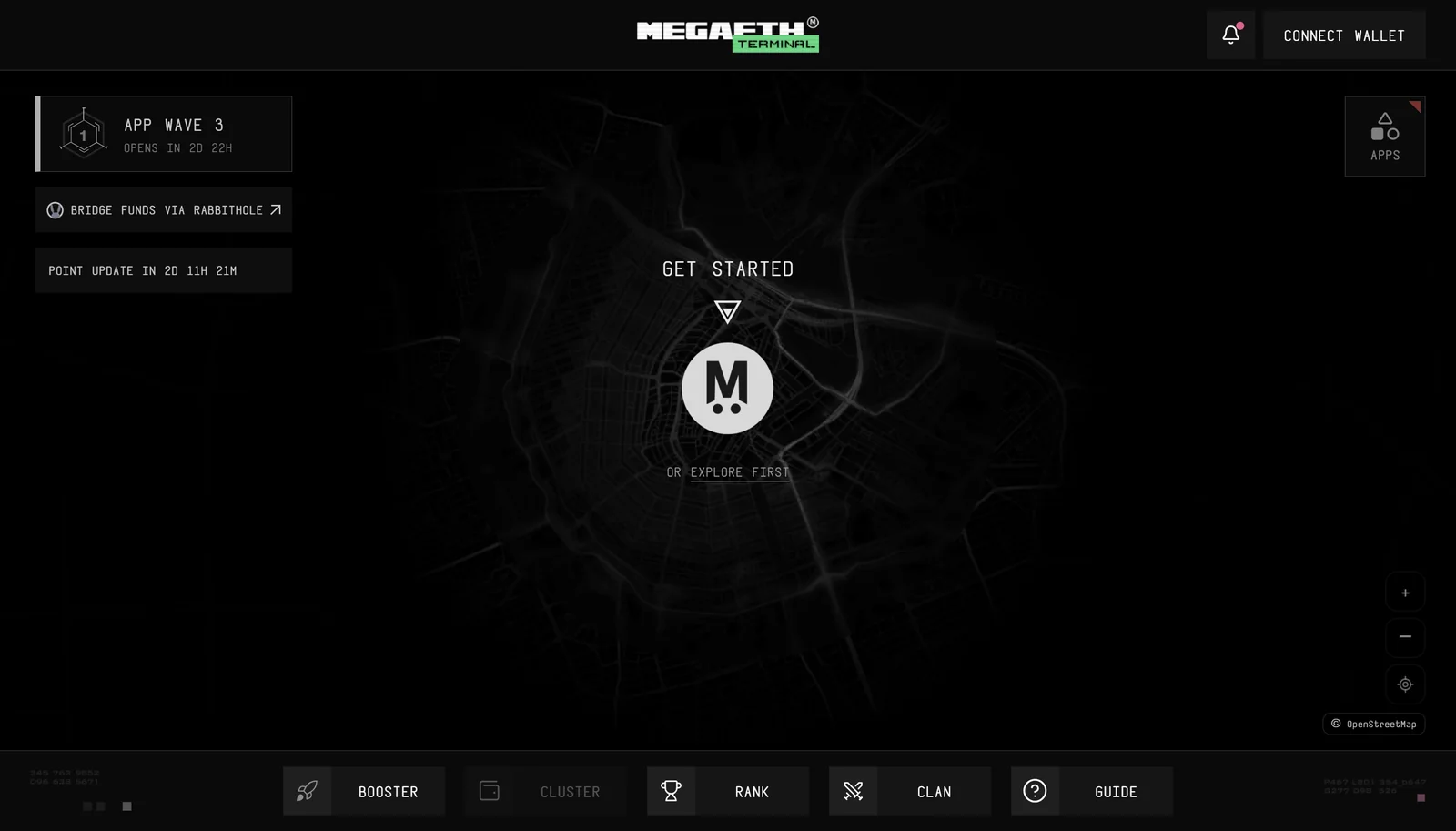
Terminal awards points weekly based on three inputs: which apps you used during that week, the boosters tied to your wallet cluster, and the (up to) three apps you selected for the week's multiplier. The exact formula is not published. The cadence is fixed: snapshots fire every Tuesday at 00:00 UTC, balances drop on Wednesday, and clan and app selections reset on the same Tuesday clock.
Three pieces of that flow matter more than the others.
- The booster multiplier only applies to your three selected apps. Activity on anything else earns at the base rate. If you use Hit.One, Kumbaya, and Brix in a week but only select two of them, the third earns flat. If you select an app you do not actually touch that week, the multiplier sits unused. Pick the three apps you will actually use, not the three that look highest-value on paper.
- Wallet clustering is the way to scale. The first wallet you connect to Terminal becomes your Main Wallet. Additional addresses linked to the same profile become sub wallets, and boosters and weekly selections apply across the entire cluster. Activity on any wallet in the cluster counts under the same profile. The catch: a single wallet can only belong to one profile at a time, and deleting a profile permanently zeros its points. So cluster strategically and do not delete in haste.
- Every app you use needs its own Terminal connection. This is the easiest step to miss. Most apps surface it as a "Connect to Terminal" button in their profile or settings section, sometimes as a banner at the top once you sign in. Until you click it, activity in that app earns at base rate to a disconnected wallet and does not roll up under your profile, which means your boosters and weekly selections do not apply. Do this once per app the first time you sign in. Re-check after each app update; some apps disconnect on session expiry.
One quirk to note: at each new wave launch, Terminal opens a one-time booster reset window so users can re-allocate their three weekly selections to the new app group. MegaETH confirmed this when Wave 2 went live ("We've also allowed users to reset their boosted apps if they wish to re-allocate to the new group") and the pattern has held through Wave 3.
If you want to swap selections after a wave launches, do it within that window. Outside the reset window, weekly selections still rotate on Tuesday at 00:00 UTC like normal, but the team's wave-launch reset is the cleanest moment to rebalance.
Points themselves are non-transferable and not a token. They are the leaderboard signal that determines your share of the eventual distribution. Whether the conversion ratio is generous or stingy is the variable nobody can price right now, which is part of why this is optionality rather than a sure thing.
Sizing the 2.5% allocation against realistic outcomes
MegaETH's total supply is 10 billion $MEGA. At the public reference price of $0.15 right after TGE, that puts fully diluted valuation at $1.5 billion. Circulating supply at TGE was roughly 1.1 billion tokens, or 11% of the total, with the rest unlocking through various vesting schedules.
The 2.5% mainnet activity allocation works out to 250 million $MEGA. At spot, that is around $37.5 million. As $MEGA price moves, so does the dollar value of the pool. Some farmers have quoted higher numbers like $42 million, which simply reflects a slightly higher reference price at the time they wrote.
What that 2.5% does not include is the rest of the community pool. The full community allocation is 15% of supply, split four ways:
| Bucket | % of supply | Status |
|---|---|---|
| Echo private sale | 5% | Closed. 1y cliff, 3y vest. |
| Fluffle NFT holders | 5% | Closed. 50% at TGE, rest over 6mo. |
| Sonar public sale | 2.5% | Closed. 100% at TGE or 1y lockup option. |
| Bonus Campaign (mainnet activity) | 2.5% | Active. The pool this guide covers. |
One detail in the Bonus Campaign to flag. Per coverage of the original tokenomics, the top 5,000 mainnet participants can earn up to 2x their original Sonar allocation. A non-trivial slice of the 2.5% may be reserved for existing Sonar buyers who farm aggressively, not freely competed for by every new wallet. MegaETH has not published the exact split. Expect to compete with both new entrants and a layer of pre-existing token holders running their boosters at full stack.
Featured this week
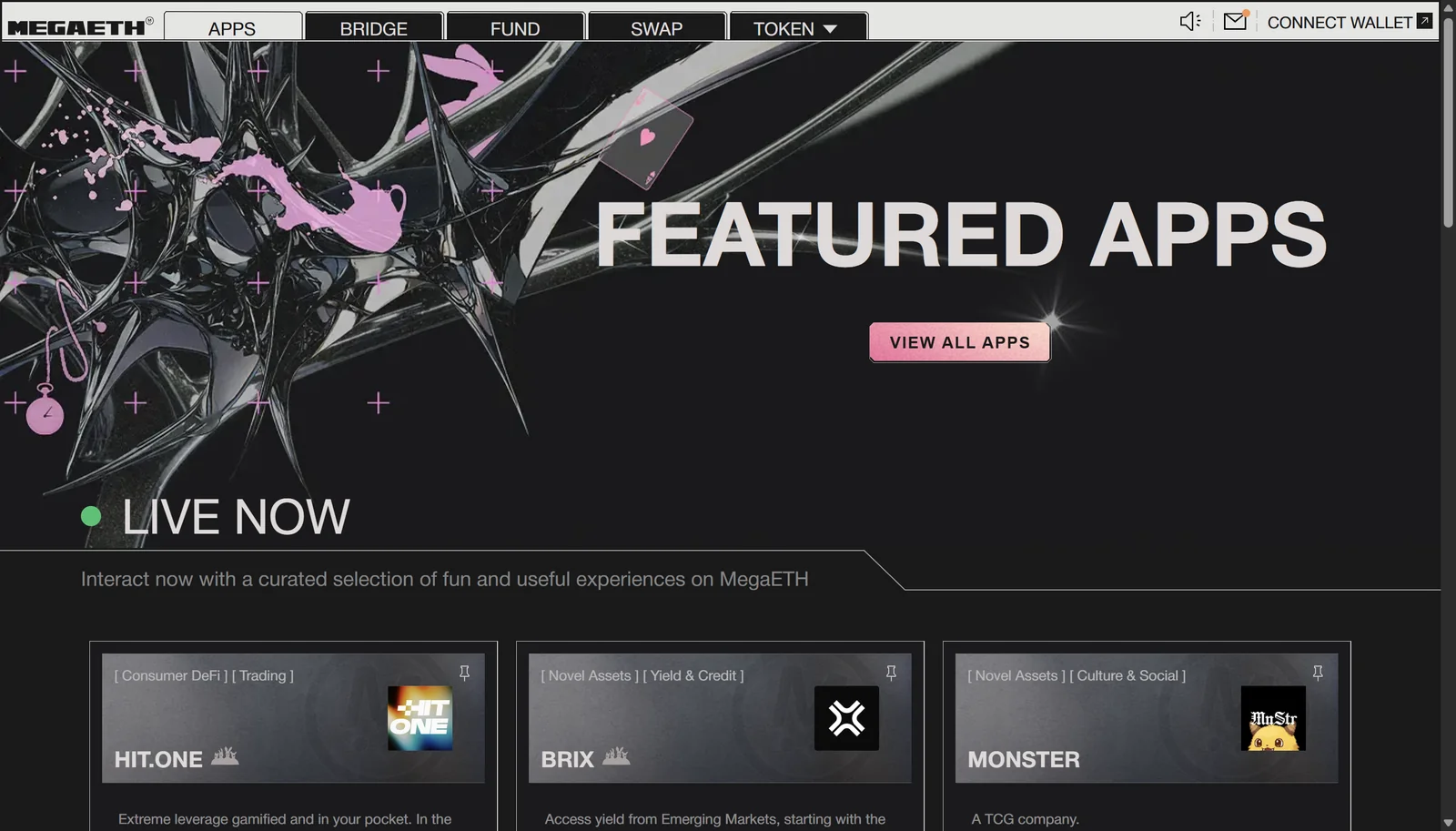
We are currently in Wave 3, which went live on May 7, 2026. MegaETH announced 5 new partner apps under a "Wave 4" label on May 12-13 (Sir Trading, Canonic, Ferdy, SectorOne, and Beefy), but the Rabbithole featured-apps rotation had not actually moved as of May 13.
The 5 new apps are live in the broader Rabbithole catalog and on the chain, but the team had not yet promoted them into the Live Now slot on the Featured Apps page. The grid below hydrates from MegaETH's live feed, so the moment the rotation does flip, the listing reflects that automatically.
These are the apps the team is spotlighting for the current wave, and they are the obvious picks for your three weekly selections since that is where the booster multiplier earns the most.
Currently featured on Terminal
Synced from MegaETH Rabbithole

Hit.One
MafiaConsumer DeFi · Trading
Extreme leverage gamified and in your pocket. In the backend it might be a 666x ETH Long, on your screen you're just trying to Hit One. Currently invite-only beta.


Euphoria
MafiaConsumer DeFi · Trading · Gaming
Discover Tap Trading - a mobile interface where you tap squares on a grid based on where you think the price goes in extremely fast timeframes.

Brix
MafiaNovel Assets · Yield & Credit
Access yield from Emerging Markets, starting with the Turkish Lira - enabled by DeFi Legos (tokenized MMFs, custodied real-world assets and staking).

Kumbaya
MafiaTrading · Culture & Social · Novel Assets
Swap with deep liquidity on ecosystem tokens and native launches around die-hard cults. Get rewarded for creating content for these cults.

Stomp
MafiaGaming
Engage in fully onchain, endless PvP showdowns with monsters that you collect, evolve and use in battle to stomp opponents.
Coming next: Rocket, MNX, Dorado.
If your booster multiplier is base rate (i.e. no retroactive boosters from Echo, Fluffle, or prior Rabbithole activity), the difference between selecting featured apps and non-featured ones is mostly about where the team is concentrating attention and points emissions. Featured does not mean "only place that earns." It means "place where the team's active weighting is pointed this week."
What changed in Wave 3 (May 7, 2026)
Wave 3 went live on May 7 with five new partner apps added to the Terminal roster: Offshore Protocol, Stomp, Ave Forge, Pump Party, and gTrade by Gains Network. The Wave 3 thread also re-highlighted Brix because its iTRY product (synthetic Turkish lira backed by Turkish sovereign money market funds) is now live and bridged into World Markets.
The pattern across the five additions is heavier on gaming and PvP this time around. Three of the five (Stomp, Ave Forge, Pump Party) are real-time PvP titles. Offshore is an idle simulator. gTrade is the only pure trading addition, and it is the most operationally mature: Gains Network has run a perp DEX on Polygon and Arbitrum for years, so MegaETH's deployment is an established protocol porting to a faster chain rather than a new product launching from zero.
The five new apps slot into weekly selection like any others. If you want to lean into Wave 3, pick three of them as your weekly selections (within the wave-launch reset window) and the booster multiplier follows.
The apps that should anchor your weekly selection
The MegaETH ecosystem currently lists 113 apps in the Rabbithole catalog. Most are not relevant for points farming. The ones below are the apps we have either used directly or expect to see in featured rotations through Season 1, with an honest read on what each is for and whether it deserves one of your three weekly slots.
Hit.One
Extreme leverage gamified into a phone app. Sign up with email, deposit USDm to your in-app wallet, then connect the app to your Terminal profile from the wallet section. Pick a wager between $1 and $50 and the app opens a high-leverage long or short for you. The marketing references positions up to 1000x. Most rounds resolve quickly. There is a profit guard toggle that protects against total losses on most outcomes, and we recommend leaving it on.
The honest read: this is a points-buying mechanism dressed as a trading app. The expected value of any 666x random position is negative once you include slippage. Spin a few small rounds, register the activity, move on. Do not size it like a trade.
Open Hit.OneKumbaya
The native DEX on MegaETH and the recommended USDm liquidity pair for the season. Kumbaya supports basic swaps and concentrated liquidity provision on the USDm/USDT0 pool, plus a launchpad for ecosystem token launches. Kumbaya creates a sub wallet for you at signup, so the connect-to-Terminal button (top of the page) is what links that sub wallet to your profile and gets your activity credited.
Kumbaya day-1 fee incident. Kumbaya launched on April 30 with an undocumented 50% protocol fee on LP earnings. Independent reporting from Protos quantified the impact at over $375,000 in protocol revenue between April 30 and May 1, taken from LPs without prior disclosure. The team reversed within 24 hours, matched Uniswap fees on all pools, and announced refunds for affected LPs. Kumbaya is still the recommended USDm pair for farming, but the early-ecosystem fee transparency is a real risk variable to factor in before parking serious liquidity.
For LP exposure, the USDm/USDT0 pair has limited impermanent loss in normal conditions because both sides are dollar-pegged. The non-trivial risk is a USDm depeg. USDm is MegaETH's native stablecoin and not yet battle-tested at scale. Treat any LP position as an exposure to USDm holding its peg through the season, not as a passive cash farm.
Open KumbayaMonster
A tokenized trading card game. Sign in with X or wallet, fund the in-app wallet with USDm, then go to the MegaETH section in the app and connect to your Terminal profile (this step is what credits the points; skipping it leaves your activity orphaned). Buy booster packs priced from $50 up to $1,250, open them, and either keep the cards or instant-sell back to the protocol. Expected loss per pack is roughly 20% on average, per third-party reports, before any price changes on cards held.
Like Hit.One, this is points fuel in collector's clothing. One mid-sized pack registers the activity. Opening packs in series hoping for a card hit is a slot machine with cosmetic upside.
Open MonsterPrism
The widest product surface in the MegaETH catalog. Prism combines spot DEX, perpetuals, lending, and on-chain prediction markets into a single onboarding flow. They partnered with Swapper Finance for direct deposits from card, CEX, or wallet, which lowers the friction of getting capital onto MegaETH compared to pure-bridge flows.
Prism is not in the current featured set as of Wave 3, but it has appeared in earlier waves and will likely return given the team's connection to the Bad Bunnz NFT clan and the ecosystem more broadly. When it is featured, the per-action weight is high. A few swaps and one or two small prediction-market positions cover most of the activity surface.
Open PrismITS
A booster-pack TCG with dynamic pricing. Pack prices move with demand, so early purchases are cheaper than late ones. Packs cost roughly $6 to $10 at launch and have moved up since. Lower entry cost than Monster, similar mechanic.
Open ITSWorld Markets
A unified-margin trading app that runs spot, perps, and credit loops against a single collateral pool. The current points farm vector is a spot swap into iTRY (synthetic Turkish lira) and holding it, which dual-farms World Markets and Brix simultaneously. As of Wave 3, iTRY is live and properly bridged through World Markets per MegaETH's own announcement.
This one rewards capital efficiency more than transaction count. One larger spot position you are willing to leave for the season earns more than dozens of small swaps.
Open World MarketsBrix
Emerging-markets yield through tokenized money market funds, real-world assets, and staking primitives. Initial focus is the Turkish lira. Returns are quoted in local currency, so the headline yield is high but the FX exposure is real. Keep position size modest unless you have a view on TRY.
Open BrixTopStrike
Sportfun-style fantasy football where you trade and hold real footballer "shares" through tournament cycles. Engagement is recurring through the season. A few player positions held into tournaments covers the activity. Fits readers who already follow football and would enjoy this independently of farming.
Open TopStrikeRockSolid
A one-click USDm vault. Deposit USDC on Ethereum mainnet, the protocol bridges and routes into MegaETH ecosystem yield, and you hold a vault token. Closest thing in the ecosystem to a passive set-and-forget farming primitive. Lower active points than other apps, but no manual upkeep.
Open RockSolidCap
A stablecoin protocol that issues cUSD, a yield-bearing dollar generated through covered credit and on-chain financial guarantees. Not in the current featured rotation but has counted for points in earlier waves. Mechanically similar to RockSolid with different yield sourcing.
Open CapOffshore Protocol
Wave 3 addition. Idle simulator built around a money-laundering theme. The marketing tagline from MegaETH's own thread: "Build an international money laundering empire on MegaETH." Mechanics flow USDm → Influence → Offshore ops → Build assets and enterprises → send proceeds to a Swiss Vault. Failed hustles fund the shared pool. There was a presale on day 1 of MegaETH mainnet, so some early holders already have positioned exposure.
In practice, idle simulators are points-fuel by design. Engagement is recurring (open the app, click through a few ops, close it) rather than capital-intensive. Best fit if you want a low-effort daily action that registers under your Terminal profile without parking serious funds.
Open Offshore ProtocolStomp
Wave 3 addition. Fully onchain 1v1 turn-based monster PvP. MegaETH's intro thread called the vibe "Pokémon + Smash Bros energy." You build a squad, battle friends or CPU, instant settlement on each move. Free to play in the current state, which makes it the lowest-friction Wave 3 app to test for points.
The honest read: free-to-play also means the per-action points weight is likely lower than apps that ask you to deposit USDm. If you enjoy the gameplay it is the best leisure-track Wave 3 option. If you are pure-farming, Offshore or Pump Party will likely outweigh it on points per hour of effort.
Open StompAve Forge
Wave 3 addition. Fast-paced mech PvP. Upgrade your mech, enter arenas, wager, climb the ladder. Skill-based duels with real onchain consequences (your stake is at risk in each match). Got the strongest community pickup in the Wave 3 announcement thread, with multiple commenters calling it the standout of the new batch.
What you are paying for: wager-based PvP means the points fuel comes with real downside if you are not good at the mechanic. Small-stake wagers cover the activity registration. Climbing the ladder requires either skill or patience to lose-and-rebuy. Treat the wager as the price of points.
Open Ave ForgePump Party
Wave 3 addition. Onchain game studio. The flagship title, Super Bunny Cannon, is a real-time intuition shooter with 100 chances to win per second and instant settlement. More titles flagged as coming. Marketing positions it on speed (the same MegaETH performance pitch the chain itself uses).
The honest read: 100 chances per second is the gimmick. It leans into MegaETH's real-time block production as a gameplay feature, not just infrastructure. Like Hit.One and Monster, this is a negative-expected-value pure points-buying mechanism for the median user. Size accordingly.
Open Pump PartygTrade by Gains Network
Wave 3 addition. Onchain perpetual DEX for crypto and RWAs. Stocks, commodities, forex, and crypto with up to 1000x leverage, collateralized in USDm. 280+ markets live across the listed asset classes. This is the most operationally mature Wave 3 addition. Gains Network has been running gTrade on Polygon and Arbitrum since 2022 with proven settlement infrastructure, so MegaETH is a chain expansion rather than a new protocol.
For farming purposes, a small perpetual position with conservative leverage covers the activity registration with much less random downside than 1000x slot-spinning. The platform's deeper liquidity also means tighter execution if you actually use the position rather than just opening and closing for points.
Open gTradeSir Trading
May 12-13 partner addition under MegaETH's "Wave 4" label. A leverage primitive aimed at long-term holders: you open a leveraged long with a one-time fee, and there are no liquidations and no funding payments. The trade-off is that you pay upfront in exchange for convex upside without the death-by-funding-rate that erodes long-held perp positions. LPs on the other side earn the fee stream plus MegaSIR, the protocol's native token, which pays ETH dividends.
The structural angle: Sir is one of the more interesting designs in the Wave 4 batch because it targets a real gap (perp funding rates) rather than just shipping another leverage venue. For points farming, a small upfront-fee position covers the activity.
The downside is bounded by what you paid upfront, which makes sizing cleaner than 1000x slot-spinning apps. Live in the catalog but not in the featured rotation yet, so weekly-selection points multiplier does not apply on Sir unless the rotation moves.
Open Sir TradingCanonic
May 12-13 partner addition. A fully onchain spot order book with what the team calls a Midpoint-Anchored Order Book (MAOB) design: zero maker fees, oracle-anchored pricing, midpoint-anchored execution, and passive LP vaults. The flagship pair is MEGA/USDm, traded with real-time execution and tight spreads.
The honest read: MAOB is a niche order-book design that tries to give CEX-tight execution with onchain settlement. For farming purposes, a small MEGA/USDm swap covers the activity. If you LP into a Canonic vault you take MEGA price exposure plus market-making risk, which is a different return profile from passive Kumbaya LP. As with Sir, the weekly-selection multiplier does not apply until the featured rotation moves.
Open CanonicFerdy
May 12-13 partner addition. Provably fair onchain casino: dice, Plinko, roulette, coin flip, and other classic casino mechanics, all settled instantly onchain with verifiable randomness. No trust required because the house edge math is transparent.
The honest read: this is the highest-house-edge category on the Wave 4 list. Expected value is negative for the user by design, like all casinos. Treat any wager as the price of points. Small bets register the activity. Do not chase losses. The "provably fair" label means the house edge is honest, not that the house edge is zero.
Open FerdySectorOne
May 12-13 partner addition. Native DLMM DEX on MegaETH (Dynamic Liquidity Market Maker). LPs shape ranges, adjust bins, and set fees in real time, or park capital in passive DLMM vaults. Marketing pitches it as max yield for providers and tightest execution for traders.
The honest read: DLMM is a mature design pattern (Trader Joe pioneered it on Avalanche) and porting it to MegaETH's faster block time is a legitimate UX upgrade for active LPs. For pure farming, a small swap covers the activity. For LPs willing to actively manage ranges, DLMM offers higher fee capture than v2-style AMMs at the cost of more attention. Passive DLMM vault is the easier path. Same featured-rotation caveat as the other Wave 4 entries.
Open SectorOneBeefy
May 12-13 partner addition and the most established protocol in the Wave 4 batch. Beefy has been running auto-compounding yield vaults across 20+ chains since 2020 with a strong audit history. The MegaETH deployment offers auto-compounding vaults for MEGA-USDm, USDm pools, and other ecosystem yield sources.
Why this matters: Beefy is the cleanest passive farm in the Wave 4 group. Deposit once, Beefy handles the harvest-and-recompound mechanics, you collect the higher net APY. Comparable to RockSolid in spirit but Beefy has a longer multi-chain track record. For points farming, the vault deposit registers the activity and the compounding runs in the background. If the featured rotation flips and selects Beefy, the weekly-selection multiplier becomes meaningful.
Open BeefyShowdown, Chisino, Smasher, and the rest
Smaller gaming and consumer apps. Each generates points if used, but the points-per-dollar-of-effort math is worse than the larger apps unless you actually enjoy the gameplay. Pick one if you want a leisure track inside your weekly selection. Otherwise treat them as base-rate filler.
The booster lockout
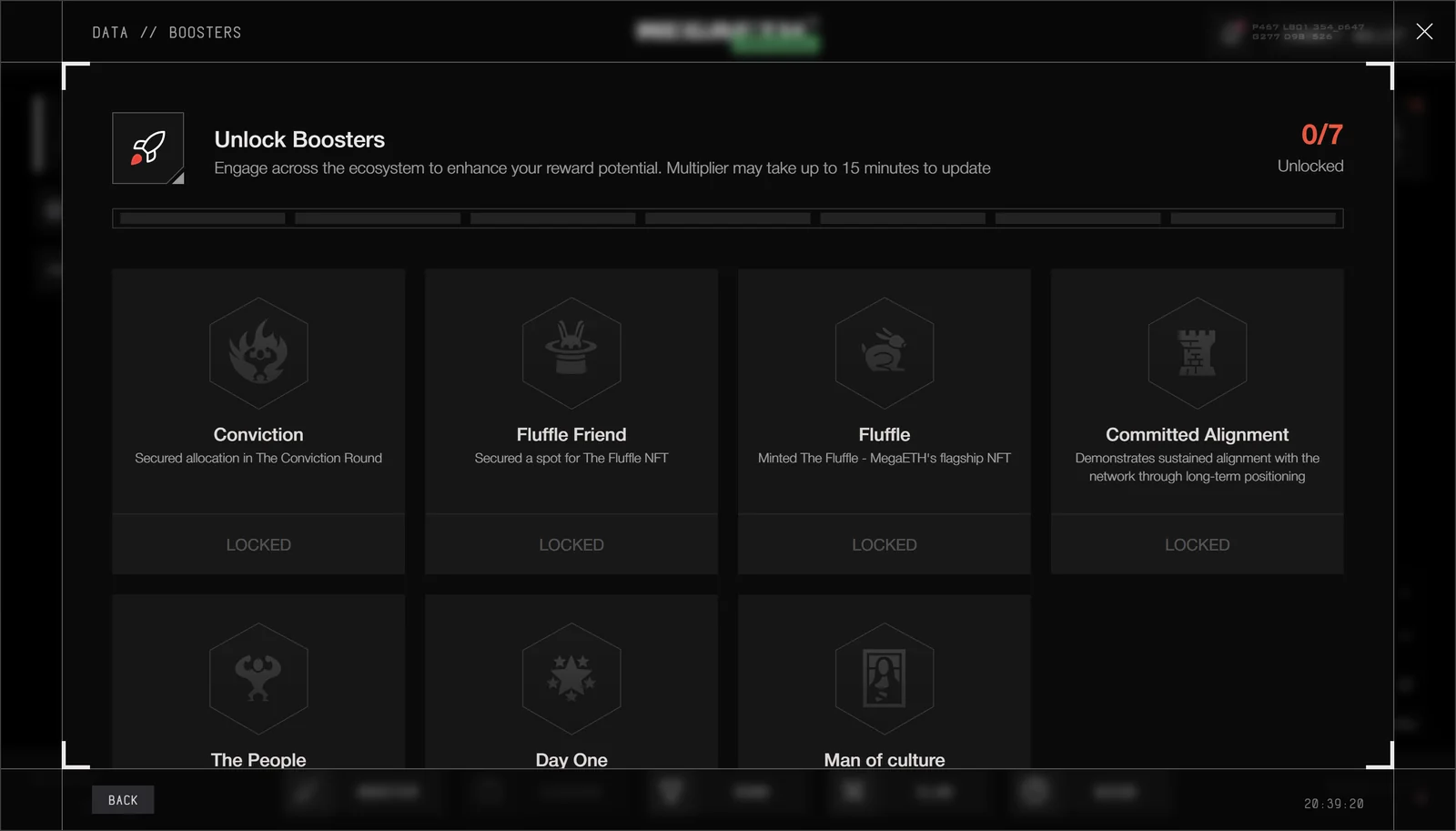
Terminal has seven booster types. They stack into a single multiplier that applies only to your three weekly selected apps. All of them are retroactive, awarded for past actions rather than something you can grind into now.
| Booster | How you would have unlocked it | Open today? |
|---|---|---|
| Conviction | Allocation in the Echo Conviction Round | Closed |
| Fluffle Friend | Secured a Fluffle NFT spot | Closed |
| Fluffle | Minted a Fluffle (the flagship NFT) | Closed |
| Committed Alignment | Long-term positioning across the ecosystem | Closed |
| The People | Participated in Echo's People's Round | Closed |
| Day One | Explored Rabbithole before Terminal launched | Closed |
| Man of Culture | Holding "culturally significant onchain collections" | Possibly via clan NFTs |
The only one a participant joining in May 2026 has any path to is Man of Culture, and even that depends on what MegaETH counts as "culturally significant onchain collections," a definition the team has not formalized. The clan NFTs (Bad Bunnz, WCNetizens, meganacci, Megalio, MINIMINDS, Legend of Breadio) are the most plausible candidates.
The honest implication: if you did not buy into Echo, did not mint a Fluffle, and were not on Rabbithole pre-Terminal, your booster stack is base rate or close to it. Your three weekly selections still benefit from the multiplier, but the multiplier itself is small or absent. You compete against farmers who carry one or more of the closed boosters at full stack.
The one lever new participants do have is the clan system, which interacts with Man of Culture and standalone clan boosts. That gets its own section below.
Inside the clan reward mechanics
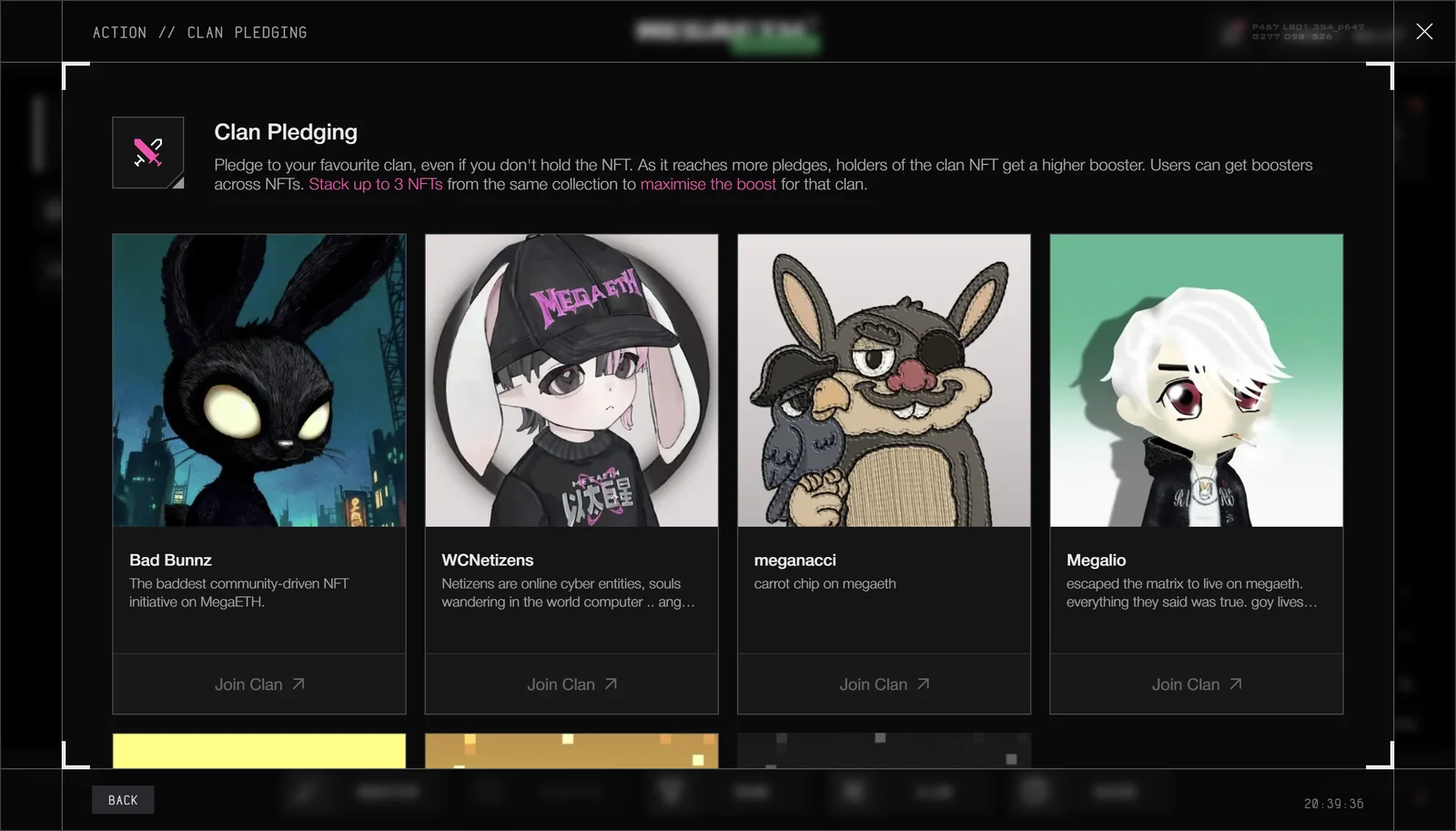
Six clans are live: Bad Bunnz, WCNetizens, meganacci, Megalio, MINIMINDS, and Legend of Breadio. Anyone can pledge to a clan each week. Pledges that pass anti-sybil filters count toward clan milestones. As a clan reaches more milestones, holders of that clan's NFT get a higher booster.
Two stacking rules matter. You can hold up to 3 NFTs from the same collection to maximize that single clan's boost. You can also hold NFTs across multiple clans, which gives you boosters across each one. The booster only flows to NFT holders, though. Pledging without holding feeds the milestone but does not give you the multiplier.
Is buying clan NFTs worth it? A single clan NFT at floor is roughly the price of one large Monster pack, and the boost stacks for the rest of the season (about seven weeks remaining as of mid-May).
If your weekly farming generates around 100 base points and the clan boost is 1.2x to 1.5x at full milestone count, that is 20 to 50 extra points per week, or 140 to 350 extra points across the remaining season. Whether that translates into more $MEGA than the NFT cost is unknowable until distribution.
Our read: one clan NFT is reasonable optionality if the floor is below $200 equivalent. Stacking three from the same collection to maximize a single clan is harder to justify unless you already plan to hold the NFT for collection reasons. Buying across multiple clans is even more speculative.
Wave history
The featured set rotates every five days or so. The list below shows which apps were featured in each wave so you can see how the team's focus has shifted. Reconstructed entries (where we did not directly capture the wave's API state) are flagged.
App list reconstructed from public threads, not directly observed via the MegaETH API.
Eight-week plans by bankroll
Three sample plans. None of them are advice; they are starting points to adapt. The rule that holds at every size: do not size positions you would not be comfortable holding for the full eight weeks at zero airdrop value.
$200 starter
Bridge $150, leave $50 for gas and small interactions. Allocate roughly $50 to a Kumbaya USDm/USDT0 LP position as your passive farm. Use the remaining $100 across Hit.One (small wagers), Monster (one $50 pack), and one ITS pack. Pick Hit.One, Kumbaya, and one of the others as your weekly three. Pledge to a clan but skip the NFT at this size.
$1,000 active
Bridge $800. Allocate $400 to the Kumbaya USDm pool, $200 to a RockSolid vault deposit (passive yield), and $200 across Hit.One, Monster, and one of TopStrike or Showdown. Pick Kumbaya, Hit.One, and one rotating featured app as your weekly three. One clan NFT becomes reasonable if the floor is approachable. Pledge weekly. Cluster a second wallet under the same Terminal profile to extend boosters across activity.
$5,000 aggressive
Bridge $4,000. Run a full Kumbaya LP position around $1,500, a $1,000 RockSolid deposit, $500 in Brix wiTRY (accept the FX risk), and the remaining $1,000 split across active apps including Prism when it returns to featured. Buy one or two clan NFTs depending on floor and your own NFT preference. Cluster two or three wallets under one profile and rotate weekly selections so different wallets cover different featured apps.
Risks
USDm depeg. If you LP USDm/USDT0 on Kumbaya, you are taking on USDm-holds-its-peg risk for the full season. USDm is the chain's native dollar and is not yet stress-tested at scale. A depeg event would impair the LP value regardless of points farmed. Treat the position as exposure, not as cash.
Impermanent loss on volatile pairs. The USDm/USDT0 LP has minimal IL in normal conditions because both sides are stables. If you LP into anything paired with ETH or a volatile token, IL becomes a real cost. Stick to stablecoin pairs unless you have a directional view.
Smart contract risk. Every protocol on the chain carries it, and the newer Mafia accelerator apps (most of the featured set) do not have third-party audit history. Bigger names that ship on MegaETH (Aave, Lido, GMX, Stargate) bring their existing audit track record with them, but most points farming routes through newer code.
The Kumbaya fee precedent. A flagship app shipped with undocumented fee logic and was caught within 24 hours. Other apps in the ecosystem may have similar gaps that have not surfaced yet. Read the docs on any app before depositing meaningful capital.
KYC at distribution. Terminal documentation says KYC and sanctions screening "may apply." For wallets in the United States, China, or other restricted jurisdictions, treat KYC as probable. Wallets that cannot pass KYC may forfeit their share.
Sybil filtering. Cluster wallets carefully. One Main Wallet plus thoughtful sub wallets is fine. A spray of fresh disconnected addresses gets filtered out.
Negative-EV apps. Hit.One and Monster are designed to take money from the median user in exchange for points. Size them like points purchases, not investments.
Bottom line
Season 1 is a real $37 to $42 million distribution open to most wallets willing to spend a few hours a week through June 23. Two things matter most. Pick three featured apps to receive your weekly multiplier, and cluster wallets under one Main profile to share boosters across activity. Then accept that all seven retroactive booster types are closed if you did not have early access. New participants run at base or near-base multipliers and compete against farmers who do not.
The honest framing is cheap optionality, not a guaranteed payday. Median outcomes will be modest. Aggressive farmers with retroactive boosters and large capital will capture an outsized share. For everyone else, the right approach is to size positions you are happy to hold at zero airdrop value, focus weekly selections on apps you will actually use, and pledge to a clan even without owning the NFT.
Bridge ETH via Rabbithole, open Terminal, pledge a clan, and select three featured apps from the grid above. As you sign up for each app, click its "Connect to Terminal" button before you start using it. Without that link the activity does not credit to your profile. The next snapshot is Tuesday at 00:00 UTC.