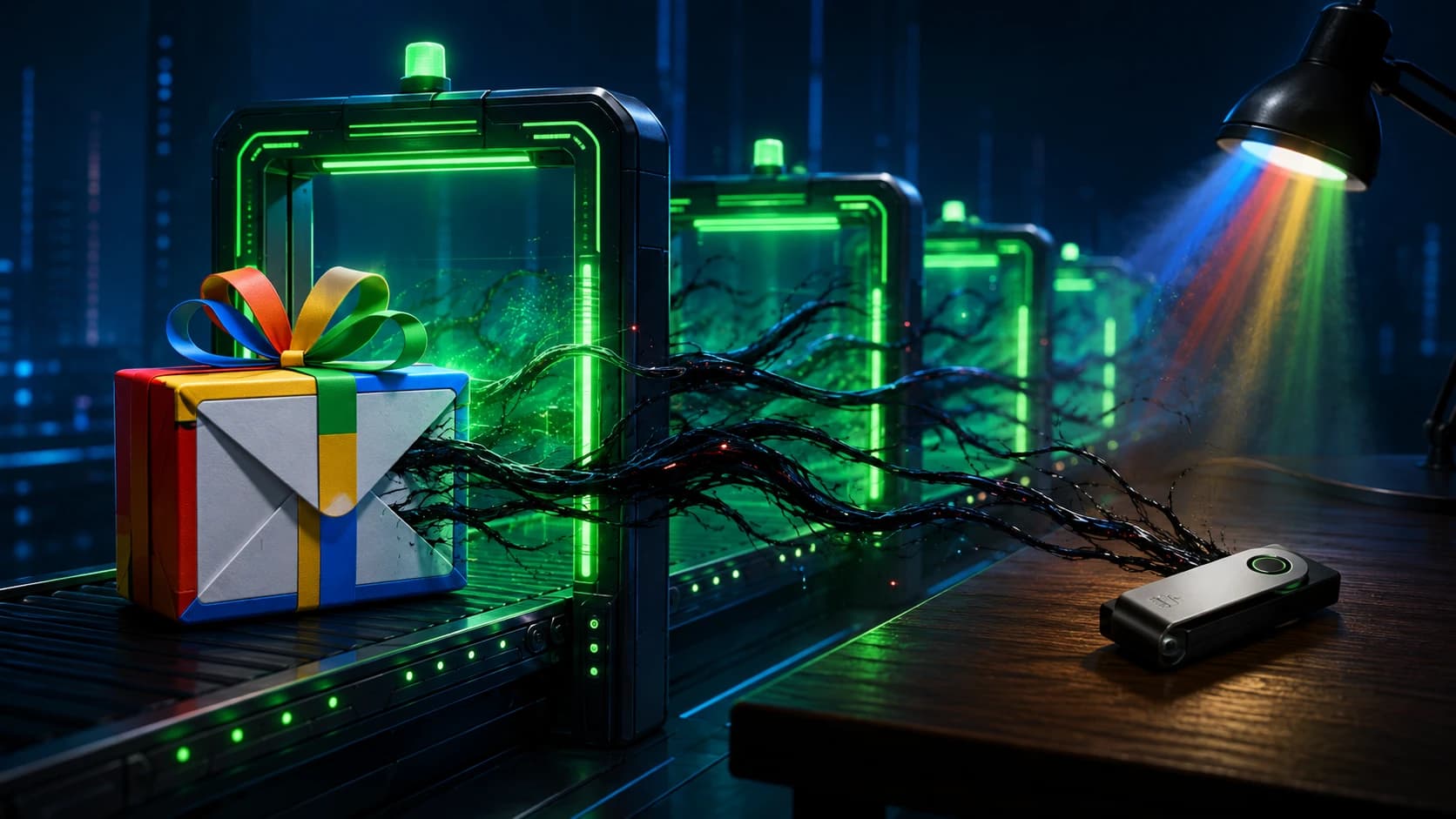
Jameson Lopp, the Casa co-founder and one of the most vocal voices on Bitcoin self-custody security, is pressing crypto holders to assume every inbound message is hostile after researchers flagged a phishing scheme that abuses legitimate Google infrastructure to bypass standard email security filters. CoinDesk surfaced the warning on May 18, citing Lopp's call for a "zero trust" posture toward incoming communications.
The advisory matters because it inverts the usual mental model. For years, the default heuristic for inbox safety has leaned on platform reputation: if the email is delivered through Gmail, signed by Google, and not flagged by spam filters, it is probably fine. The attack Lopp is reacting to defeats that heuristic directly. Because the phishing path runs through real Google services, the cryptographic signatures and sender reputation that filters check actually validate, and the malicious payload arrives looking clean.
A trust shortcut that no longer works
Most consumer email security relies on a stack of signals: SPF, DKIM, DMARC, sender reputation, link reputation, and behavioral filtering. The reason mainstream providers can route billions of messages a day is that this stack catches the obvious noise. Sophisticated phishers have spent years finding ways to make malicious messages clear those checks. Borrowing the host's own infrastructure is the most efficient version of that play, because the message is technically authentic at every layer the filter inspects.
That is the framing Lopp is pushing back on. Holders cannot outsource judgement to the filter when the filter is the thing being exploited. A message that arrives signed, in-thread, and from a familiar-looking sender still needs to be treated as suspicious until verified through a separate channel.
Zero trust in practice for a holder
"Zero trust" is a security industry term that gets thrown around loosely, so it helps to ground it in concrete habits a crypto holder can actually run.
Verify out of band. If a message claims to come from an exchange, a wallet vendor, or a tax service, do not click anything in the email. Open a fresh browser tab, type the address manually, and check the account dashboard or the official support channel directly.
Never approve anything in a rush. Phishing campaigns work because urgency suppresses pattern recognition. A message claiming an account will be locked in 24 hours, a withdrawal needs urgent confirmation, or an airdrop is about to expire is doing the same thing as a fake IRS phone call. The fix is procedural, not emotional: any message that demands action inside a short window gets cooled off until verified independently.
Treat seed phrases and signing requests as the only assets that matter. Cards, exchange logins, and even wallet UIs can be replaced if compromised. Seed phrases and on-chain signatures cannot. A self-custody holder who never types their seed into anything connected to a browser, and who reads every signing prompt in full, removes the two paths that drain wallets in the worst cases.
Card users are inside the target pool
Crypto card users are sometimes treated as a separate population from cold-storage holders, but for phishing purposes they sit on the same target list. Anyone whose email is tied to an exchange account, a custodial wallet, or a card issuer is a candidate, because credentials to any of those accounts can be drained or used as the staging ground for a follow-on social engineering attempt.
The practical risk for card users is twofold. First, a phishing email impersonating a card issuer can harvest login credentials and one-time codes, which is enough to move balances or initiate a card reissue with the attacker's address. Second, even where the card is non-custodial and tied to a self-custody wallet, the attached browser or mobile session can still be the weak link if the holder is conditioned to trust messages from the issuer's domain.
Holders who use exchange-issued cards should treat the email tied to that exchange account as a high-value asset. A dedicated address used only for the card account, paired with hardware-key two-factor authentication and a separate password manager entry, raises the cost of attack significantly without changing the user experience much.
The bigger pattern Lopp is naming
The Casa CTO has been making a version of this argument for years, but the specific attack vector keeps shifting. In 2022 and 2023 it was SMS-based SIM swap attacks tied to exchange recovery flows. In 2024 it was malicious browser extensions. The current cycle is infrastructure abuse, where phishing payloads ride inside services that holders and filters already trust. The constant across these waves is that the attacker keeps moving the entry point closer to the user's default trust surface.
Treating every inbox message as hostile until proven otherwise is not paranoid in that context. It is the only posture that holds up when the attacker can rent the same infrastructure as the defender.
Overview
Lopp's advisory is a reminder that the bar for crypto holder security keeps rising with the sophistication of phishing campaigns. A "zero trust" approach to inbound communications, verifying through separate channels, refusing urgency, and treating seed phrases and signing prompts as the only real attack surface, is the practical floor. Card users sit firmly inside the target pool and should harden the email accounts tied to their card programs before, not after, a campaign hits.