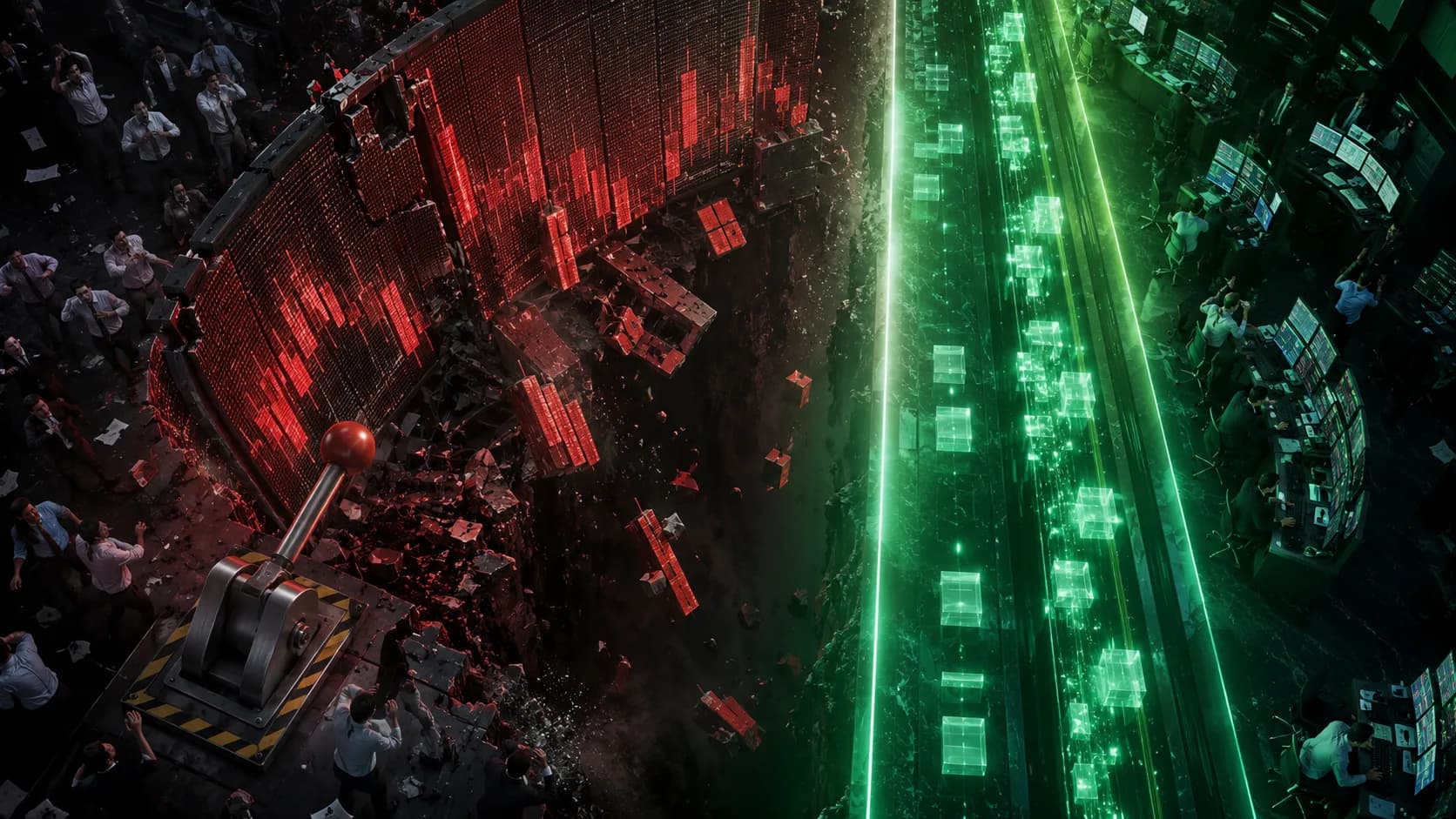
South Korea's benchmark KOSPI index fell more than 8% on Monday and triggered circuit-breaker trading halts, according to a CoinMarketCap market update. Bitcoin moved the other way. It rebounded above $63,000 after a sharp weekly drop, and the rest of the major tokens followed it higher.
As of June 8, 2026, Bitcoin trades at $63,675, up 3.1% on the day. Ether is at $1,684 (+4.0%), Solana at $66.76 (+3.8%), XRP at $1.16 (+3.6%) and BNB at $600.34 (+2.0%). For one session, crypto and a major Asian equity market pointed in opposite directions.
A circuit breaker in Seoul, green candles everywhere else
The KOSPI's 8% slide is the kind of move that forces an exchange to stop trading. Circuit breakers are designed to halt panic selling when an index drops past set thresholds, giving the market a forced pause. Hitting them is rare and signals a genuine equity-market shock in one of Asia's largest economies.
Crypto did not flinch in the same direction. Bitcoin had spent the prior week sliding, down 11% over seven days, so part of Monday's move is a bounce off a low rather than fresh conviction. Still, the timing matters. On a day when Korean stocks were falling hard enough to stop the tape, Bitcoin and the large-cap tokens were the assets adding value.
This is the decoupling argument that crypto holders reach for in moments like this. For most of the past two years, Bitcoin has traded as a risk asset, rising and falling with equities. A session where stocks crater and Bitcoin climbs is the exception, not the rule, and it is exactly the kind of divergence that gets quote-tweeted as proof the correlation is breaking.
One session is not a trend
The harder read is that this is a single day, and the broader mood is still grim. CoinMarketCap's Fear and Greed index sits at 15, deep in Extreme fear territory. A bounce off oversold levels during a panic is common, and it does not require any structural decoupling from stocks to explain it. Traders who were heavily short into the weekend cover positions, oversold tokens snap back, and the tape turns green for a few hours.
The seven-day picture keeps that caution honest. Bitcoin is still down 11% on the week, Ether down 14%, and Solana down 16%. Monday's gains recover a slice of that, not all of it. A green day inside a red week is a rebound, not a reversal, until it holds.
There is also a cleaner explanation than decoupling for why Korean stocks and crypto split on the day. They trade on different clocks and different catalysts. The KOSPI was reacting to whatever drove its own selloff during Asian hours; crypto trades 24/7 and was already working through its own oversold weekend. Two markets moving apart for one session can be coincidence as easily as a regime change.
The Korea angle for crypto users
South Korea is one of the most active retail crypto markets in the world, and a violent equity selloff there is not just a stock story. A sharp drop in domestic risk appetite tends to spill into the won and into local trading volumes, and any stress in Korean financial plumbing touches the on-ramps and off-ramps that South Korean users rely on to move between cash and crypto.
For anyone holding stablecoins or crypto as a spending balance rather than a trade, the practical takeaway is the same as it has been all week. Extreme fear readings mean thin liquidity and fast moves in both directions. A token balance that funds a card can swing in fiat value between the moment you load it and the moment you spend it, which is the same volatility risk that makes stablecoin-funded spending the steadier option when the broader crypto market is whipsawing this hard.
Overview
The KOSPI fell more than 8% on Monday and hit trading halts while Bitcoin rebounded above $63,000 and the major tokens turned green, a one-session split between a crashing Asian equity index and a recovering crypto market. The decoupling read is tempting, but the Fear and Greed index at 15 and Bitcoin still down 11% on the week argue this is an oversold bounce inside a downtrend, not a confirmed break from equities. The next few sessions, not this one, will show whether the divergence holds.