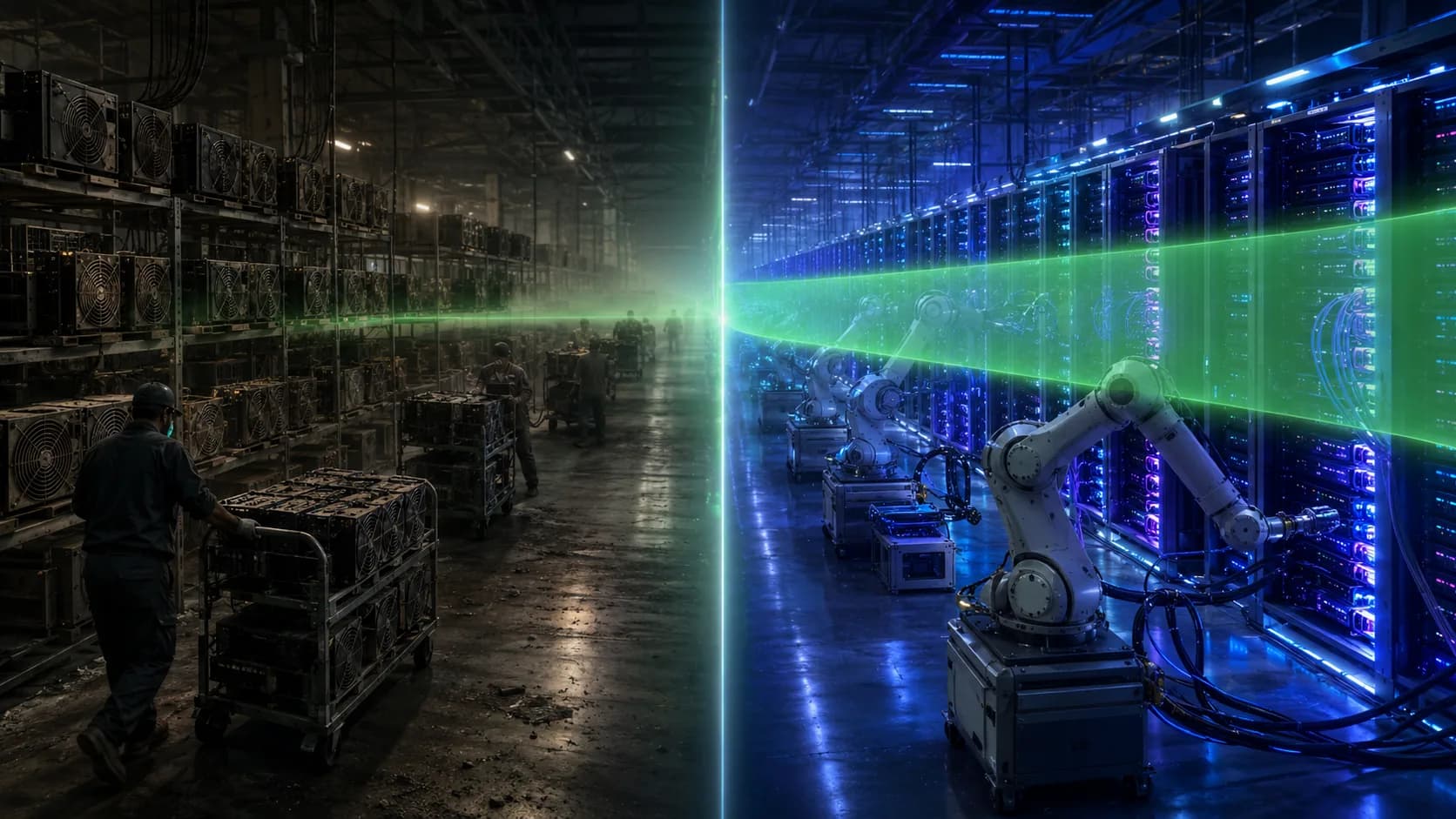
IREN reported fiscal fourth-quarter results on August 28, 2026, and one line crossed a threshold the company has been building toward for two years. AI cloud services brought in $70.5 million for the quarter ended June 30, ahead of the $66.7 million from Bitcoin mining. It is the first time the compute business has outrun the mining business that IREN was built on. AI now accounts for 51.4% of quarterly revenue, per figures the company shared alongside the report.
The market did not read it as a victory lap. IREN shares fell 8.2% in after-hours trading on Thursday to $37.19, after closing the regular session at $40.53. A $70.5 million AI number that beat mining still sat inside a quarter with a $684 million net loss and a revenue miss.
The number that flipped, and the one that hurt
AI cloud revenue more than doubled quarter over quarter, from $33.6 million to $70.5 million. Bitcoin mining held roughly flat at $66.7 million. That is the crossover: two revenue lines that traded places in a single three-month window.
Total revenue told a harsher story. IREN booked $137.2 million for the quarter, down about 5% from the prior period and short of the $142.32 million analysts expected. Adjusted EBITDA fell 68% to $19.2 million as employee costs and pre-ramp spending climbed ahead of the AI buildout. Growth in one segment did not cover the drag from the transition around it.
The $684 million net loss was driven mostly by a $450.4 million non-cash impairment, tied largely to decommissioning Bitcoin mining hardware. That charge is the accounting version of the strategy: writing down the rigs that made the old business work in order to make room for the new one. It is not cash out the door this quarter, but it marks how much of the mining base IREN is prepared to retire.
A pivot priced in contracts, not yet in power
IREN put its contracted annualized run-rate revenue at $4 billion. Only about $1 billion of that is currently operational. The gap between signed and switched-on is the whole risk of the moment: the company has demand on paper that depends on data centers, GPUs, and power capacity coming online on schedule and on budget.
That framing explains the share-price reaction better than the crossover headline does. Investors already understood the direction. The quarter's job was to show the transition happening without the mining cash engine sputtering faster than the AI engine ramps. On revenue and EBITDA, it did not quite clear that bar.
For the broader mining sector, IREN is now a test case that others are watching closely. Firms that spent the last cycle buying rigs and chasing hashrate are being pushed, by GPU demand and by post-halving mining economics, to ask whether their real asset is the mining machine or the powered, cooled building it sits in. IREN is answering that the building and the power contract are the durable asset, and the mining rig is the part you write down.
Reading past the crossover
The 51.4% split is a clean headline, but it sits on top of a quarter that missed on the top line and lost money on the bottom. Both things are true. IREN has proven AI cloud can become its largest segment. It has not yet proven the switch pays for itself while it is underway, and the $450.4 million impairment plus the 68% EBITDA drop are the price tag on that uncertainty.
The next few quarters turn on execution, not narrative. If the operational slice of that $4 billion run-rate climbs from roughly $1 billion toward the contracted figure, the crossover reported this week will look like the start of a re-rating. If the buildout slips, the same numbers will read as an expensive company writing off its old business before the new one can carry the load. This is a report on a transition in motion, not a finished one, and it is not investment advice.
Overview
IREN's fiscal Q4 2026 results, released August 28, 2026, show AI cloud revenue of $70.5 million passing Bitcoin mining revenue of $66.7 million for the first time, making AI 51.4% of the top line. The same quarter carried a $684 million net loss, a $450.4 million impairment mostly from decommissioned mining hardware, a 68% drop in adjusted EBITDA to $19.2 million, and a revenue miss at $137.2 million. Shares fell 8.2% after hours. Contracted run-rate revenue stands at $4 billion, with about $1 billion operational.