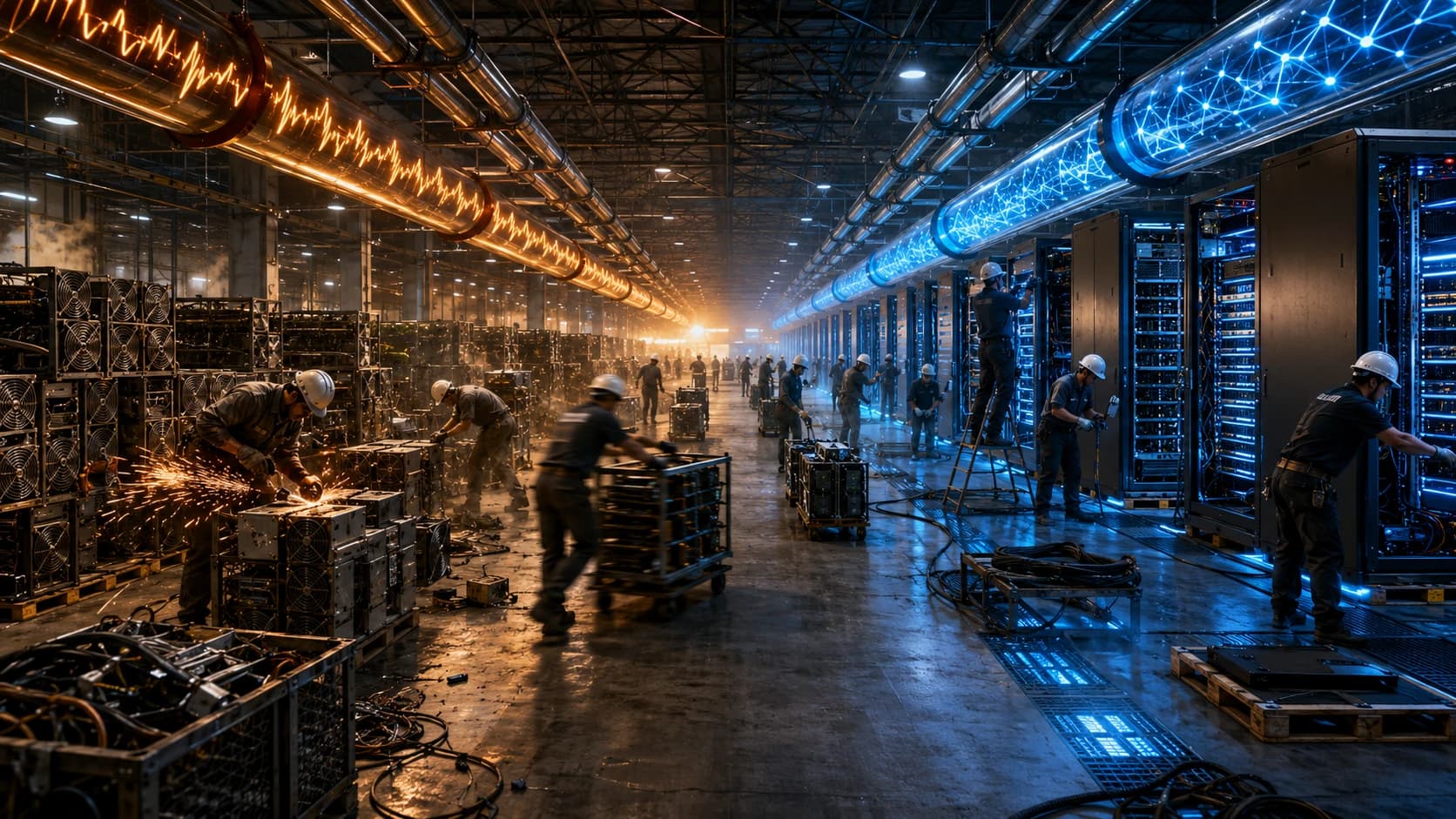
Bitcoin miner IREN has signed a $3.4 billion infrastructure agreement with Nvidia, with the chipmaker receiving rights to invest up to $2.1 billion in IREN shares as part of the arrangement. Decrypt reported the deal on May 8, 2026, citing terms that tie one of the largest publicly traded miners to the dominant AI silicon vendor.
The headline number puts IREN among the most aggressive miner-to-AI converters in the listed mining cohort. At the time of writing, BTC trades at $79,776, down 0.1% on the day, with the Fear & Greed index sitting at 47 (Neutral). For a miner whose revenue line moves with that price, locking in multi-year GPU hosting contracts is a way to cut beta to bitcoin.
The structure of the deal
Two pieces sit inside the $3.4 billion figure. The first is the underlying compute and infrastructure agreement that puts Nvidia hardware into IREN's data centres, with the miner providing power, cooling, and operations. The second is a financial sweetener: an option for Nvidia to take an equity stake of up to $2.1 billion in IREN itself.
That second piece is the one to watch. Nvidia rarely takes large positions in its customers. When it does, as with CoreWeave and a handful of other GPU cloud names, the market has read it as a signal that the customer is locked into Nvidia's stack and queue position for chip allocations. For IREN, a publicly listed miner, having Nvidia on the cap table changes how lenders and equity holders price the business.
The mining-to-AI rotation
The mining-to-AI thesis is now familiar. Hyperscalers are short on power-ready data centre capacity. Miners spent the last cycle building exactly that: high-density power, industrial cooling, and grid interconnects in remote locations. GPU hosting offers contracted, dollar-denominated revenue with margins that do not collapse when bitcoin halves cut block rewards.
CoreScientific, Hut 8, Cipher, TeraWulf, and now IREN have all moved in this direction at different scales. The trade-off is capital intensity: liquid cooling and the power envelopes for H100, H200, and Blackwell-class clusters are a different build than ASIC sheds. The $3.4 billion price tag reflects that.
Implications for IREN's balance sheet
A $2.1 billion share option from Nvidia, if exercised in full, would be one of the largest single equity injections into a listed miner. It also raises a dilution question that IREN shareholders will price in. The structure suggests the option is conditional on milestones tied to the broader compute agreement, though the full terms have not been disclosed publicly as of writing.
For Nvidia, the bet is operational rather than financial. Power-ready capacity is the constraint on AI build-out in 2026. Backing a miner that already controls grid contracts in Texas, British Columbia, and Australia is faster than waiting for greenfield hyperscale builds.
The bitcoin question
IREN has not signalled an exit from mining. Its hash rate guidance still puts it among the top public miners by deployed capacity. The question for bitcoin investors is how much of that capacity stays pointed at the network as GPU revenue scales. Every megawatt redirected to AI is a megawatt not securing the chain or competing for block rewards.
Network difficulty has continued to climb through 2026 even as several large public miners reallocate. That suggests private operators and overseas farms are absorbing the slack. The longer-term question, which the IREN deal sharpens, is whether listed miners end the cycle as bitcoin businesses with AI sidelines, or AI hosting businesses with legacy mining rigs.
Overview
IREN's agreement with Nvidia is the largest single announcement yet in the miner-to-AI rotation. The $2.1 billion share option, if exercised, would tie one of crypto's largest listed mining companies to Nvidia at the equity level, not just as a customer. For the wider sector, it sets a new ceiling on how big these pivots can get and how aggressively chip vendors are willing to underwrite them.