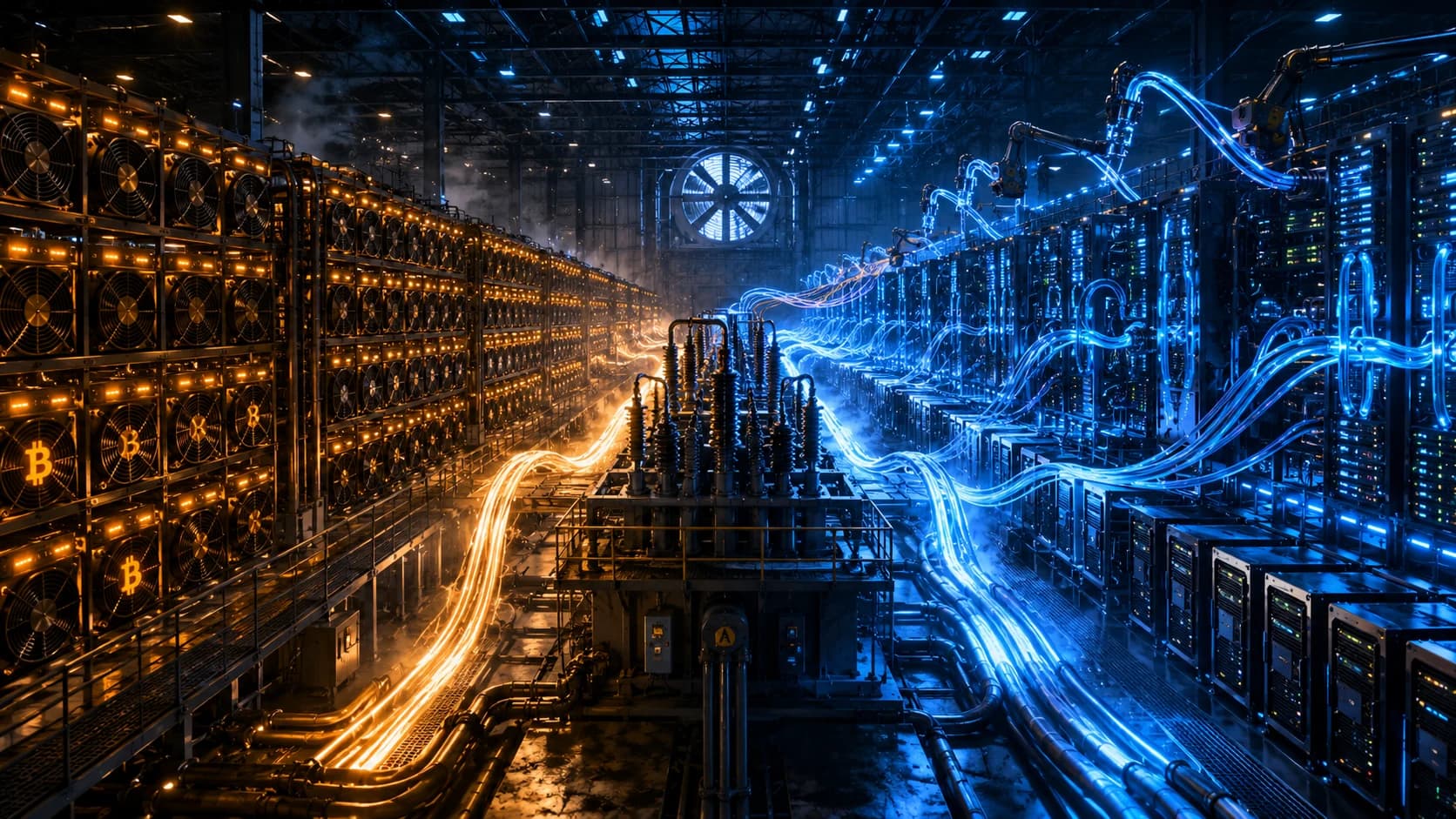
IREN shares rose about 16% on Monday, July 20, 2026, after the Bitcoin miner said it had signed $2.8 billion in new multi-year AI cloud contracts and raised its year-end revenue target above $4 billion. The company disclosed the figures in a filing with the US Securities and Exchange Commission and a customer update the same day.
The move continues a trend that has redrawn what a "Bitcoin miner" actually does. IREN still mines, but the growth story is now the data center power it can point at renting GPUs to AI companies. The market read the announcement as confirmation that the pivot is working: the stock's 16% jump came on the contract news, not on anything related to the price of Bitcoin, which sat at $66,001 as of July 21, 2026, up 3% on the day.
Contracts worth $2.8 billion reset the target
IREN lifted its year-end AI Cloud annualized run-rate revenue target from $3.7 billion to more than $4 billion. About 85% of that figure is now under signed contract, the company said, following new multi-year cloud services agreements representing $2.8 billion in total contract value.
The customer list is the part that drew attention. IREN named Microsoft, NVIDIA, Perplexity, Figure AI, Together AI, Fluidstack, Fireworks AI, Fal AI and Hume AI, plus one additional leading AI developer it did not name. That is a roster of buyers spanning chipmakers, model labs and applied-AI startups, which suggests demand is not coming from a single customer that could walk away.
Annualized run-rate revenue is a forward figure, not booked revenue. It measures what the current contract base would generate over a full year at present run-rate, so the $4 billion number describes contracted capacity, not cash already collected. The distinction matters for anyone pricing the stock: the target is only as good as the contracts behind it, and IREN is telling investors that 85% of it is now committed on paper.
From 3 megawatts to 480 in a year
Co-CEO Daniel Roberts said IREN plans to deliver 480 megawatts of AI cloud capacity in 2026, up from roughly 3 megawatts a year earlier. The company is targeting 1.2 gigawatts by 2027.
That scale-up is the whole thesis. Bitcoin miners spent years building access to cheap power and the electrical infrastructure to run tens of thousands of machines. The same substations, cooling and land now support racks of AI accelerators, which rent for far more per megawatt than mining hashes earn. A miner that can turn a megawatt of power toward AI inference instead of proof-of-work is trading a volatile, halving-exposed revenue stream for multi-year contracts with named counterparties.
The risk sits in execution. Delivering 480 megawatts this year means procuring GPUs, building out data halls and standing up cooling on a compressed timeline. Any slip on construction or chip delivery pushes the revenue that backs the $4 billion target to the right.
Prepayments cut the capital risk
One detail in the filing softens that risk. IREN said recent customer agreements include prepayments covering about 45% of the associated GPU capital spending, which reduces the funding it has to raise for those deployments.
Prepaid capacity changes the math for a company scaling this fast. GPUs are expensive, and buying enough of them to hit 480 megawatts would normally force heavy borrowing or share sales. Having customers fund nearly half the chip bill upfront lowers the amount IREN needs to finance and signals that buyers are committed enough to pay before delivery. For a business that only recently ran 3 megawatts of AI, that is a meaningful vote of confidence from the demand side.
Miners chase the AI trade
IREN is not alone in this rotation. Several large Bitcoin miners have redirected part of their power and real estate toward AI and high-performance computing over the past year, chasing the premium that GPU rentals command over mining rewards. The pattern has split the mining sector into companies that stayed pure-play on Bitcoin and those repositioning as power-and-compute landlords for the AI buildout.
For crypto investors, the shift complicates a common assumption. Mining stocks were long treated as a leveraged bet on the Bitcoin price. As AI cloud revenue grows into the majority of the business, that correlation weakens. IREN's 16% move on a day of routine Bitcoin trading is a concrete example: the stock now reacts to AI contract news and GPU deliveries more than to the coin its rigs were built to mine.
Overview
IREN raised its year-end AI cloud run-rate revenue target from $3.7 billion to over $4 billion after signing $2.8 billion in new multi-year contracts with customers including Microsoft, NVIDIA and Perplexity, sending shares up about 16% on July 20, 2026. Roughly 85% of the target is under contract, the company plans to deliver 480 megawatts of AI capacity in 2026 versus about 3 megawatts a year earlier, and customer prepayments cover close to 45% of the GPU spend. The announcement is another sign that the largest Bitcoin miners increasingly trade on the AI buildout rather than on the price of Bitcoin.