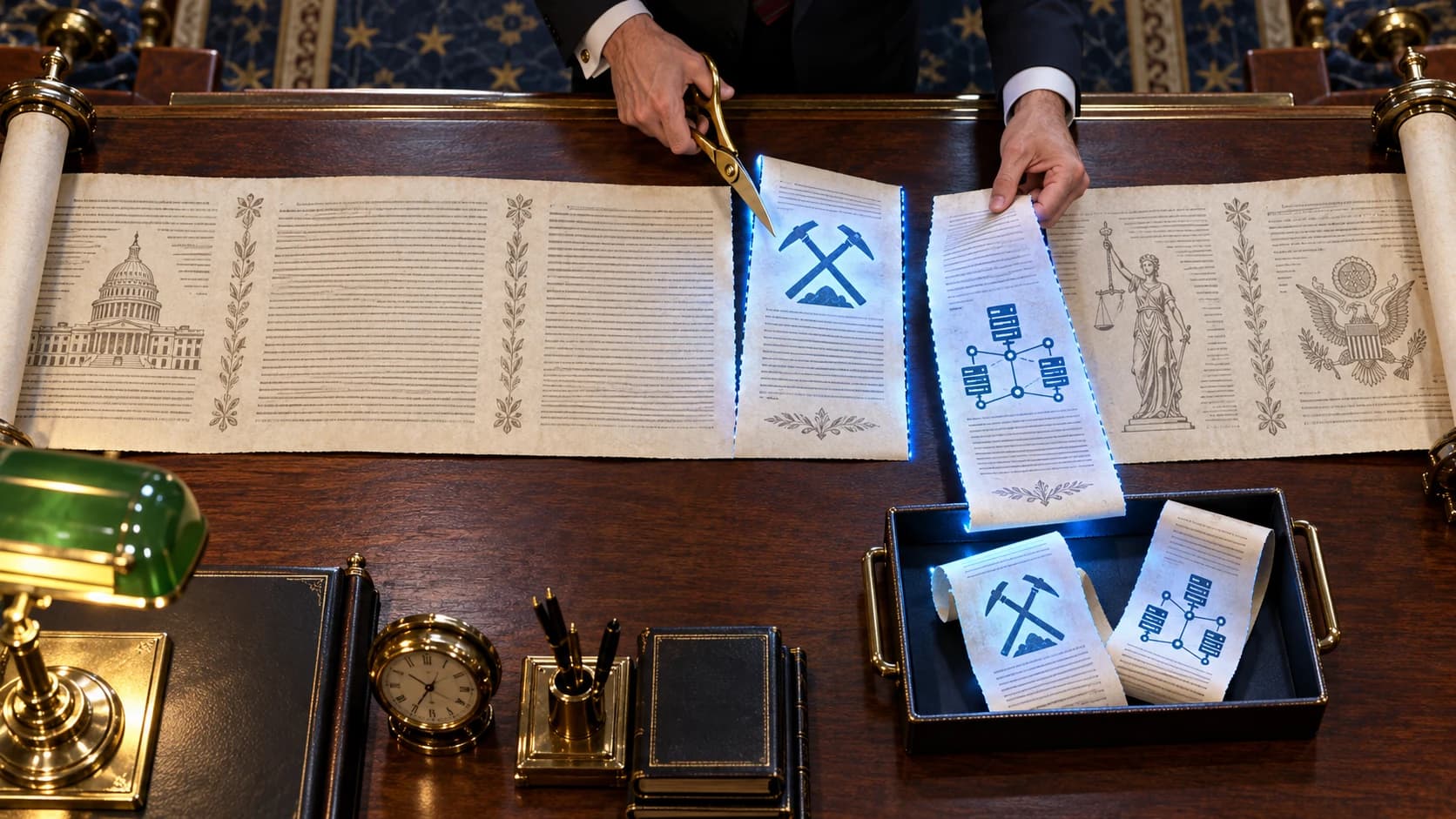
House Ways and Means Committee Republicans are considering whether to remove mining and staking tax provisions from their crypto tax bill before Wednesday's scheduled markup, according to a Punchbowl report shared by Cointelegraph on September 14, 2026. The provisions in question would change how income from proof-of-work mining and proof-of-stake validation is taxed, and their removal would leave a longstanding pain point for US crypto participants unresolved.
A markup is the committee stage where members debate and amend a bill before voting it out to the full chamber. Dropping a section before markup usually signals that the votes or the political appetite are not there to defend it, or that leadership wants a cleaner bill to move faster.
The provisions on the table
The core dispute is about timing. Under current US Internal Revenue Service treatment, block rewards from mining and staking are generally taxed as ordinary income at the moment they are received, based on the token's fair market value that day. Miners and stakers then owe capital gains tax again when they later sell.
The provisions being weighed for removal are widely understood to address that first taxable event, deferring taxation on newly created tokens until they are actually sold rather than the moment they are minted or earned as a reward. That single change would matter to anyone running validators or mining rigs, because it removes the cash-flow problem of owing tax on tokens that were never converted to fiat and may fall in value before they are.
The Cointelegraph post is the primary source here, citing Punchbowl's reporting. As of this writing, the committee has not published a final markup text confirming the cut, so treat the removal as under consideration rather than settled.
A pre-markup cut is a procedural tell
Stripping a provision right before a markup is a procedural tell. It often means the section is either contested within the party, flagged as a revenue problem by scorekeepers, or being held back to avoid slowing the wider bill. None of those reasons requires the underlying policy to be unpopular; sometimes the cleanest path to passing a bill is to shed its most argued-over parts.
For the crypto industry, the mining and staking language has been one of the more concrete asks in tax reform. Losing it before the bill even reaches a committee vote would be a setback, even if the rest of the package advances. It would also mean the current "taxed at receipt" treatment stays in place, keeping the same cash-flow bind that validators and miners have complained about for years.
This lands during a stretch of heavy US crypto legislative activity, with the CLARITY Act moving through the Senate on market-structure questions. Tax treatment is a separate track, but both feed the same broader effort to define how digital assets are handled under US law.
Practical read for miners and stakers
For anyone earning staking yield or mining rewards from the United States, the near-term takeaway is that the tax status quo likely holds. Rewards remain ordinary income at receipt, and the deferral many had hoped for is not guaranteed to be in the bill that gets marked up.
That has direct planning consequences. Validators who receive rewards in a volatile token still face a tax bill based on the value at the moment of receipt, regardless of whether they sell. If the token drops afterward, the tax owed can exceed the eventual sale proceeds. That mismatch is exactly what the deferral provision was meant to fix.
The knock-on effect reaches spending decisions too. Some users route staking yield onto crypto cards that spend staked assets or convert rewards to stablecoins to lock in value and cover tax obligations. If receipt-based taxation stays, the case for converting rewards promptly, rather than holding volatile tokens through a tax year, stays intact. Anyone in this position should confirm their own liability with a qualified tax professional; this is analysis, not tax advice.
The market context is muted. Bitcoin traded at roughly $77,508, up 0.4% on the day, with Ether near $2,511 as of September 14, 2026, and the Fear and Greed Index sitting at 67 ("Greed"). Prices did not react to the report, which fits a story that is procedural and not yet final.
Overview
House Ways and Means Republicans may drop mining and staking tax provisions from their crypto bill ahead of Wednesday's markup, per a Punchbowl report relayed by Cointelegraph on September 14, 2026. The provisions would have addressed the taxation of block rewards at the point of receipt. Their removal would keep the current ordinary-income-at-receipt treatment in place, leaving US miners and stakers with the same cash-flow problem they have raised for years. The cut is not confirmed until the committee publishes its final markup text.