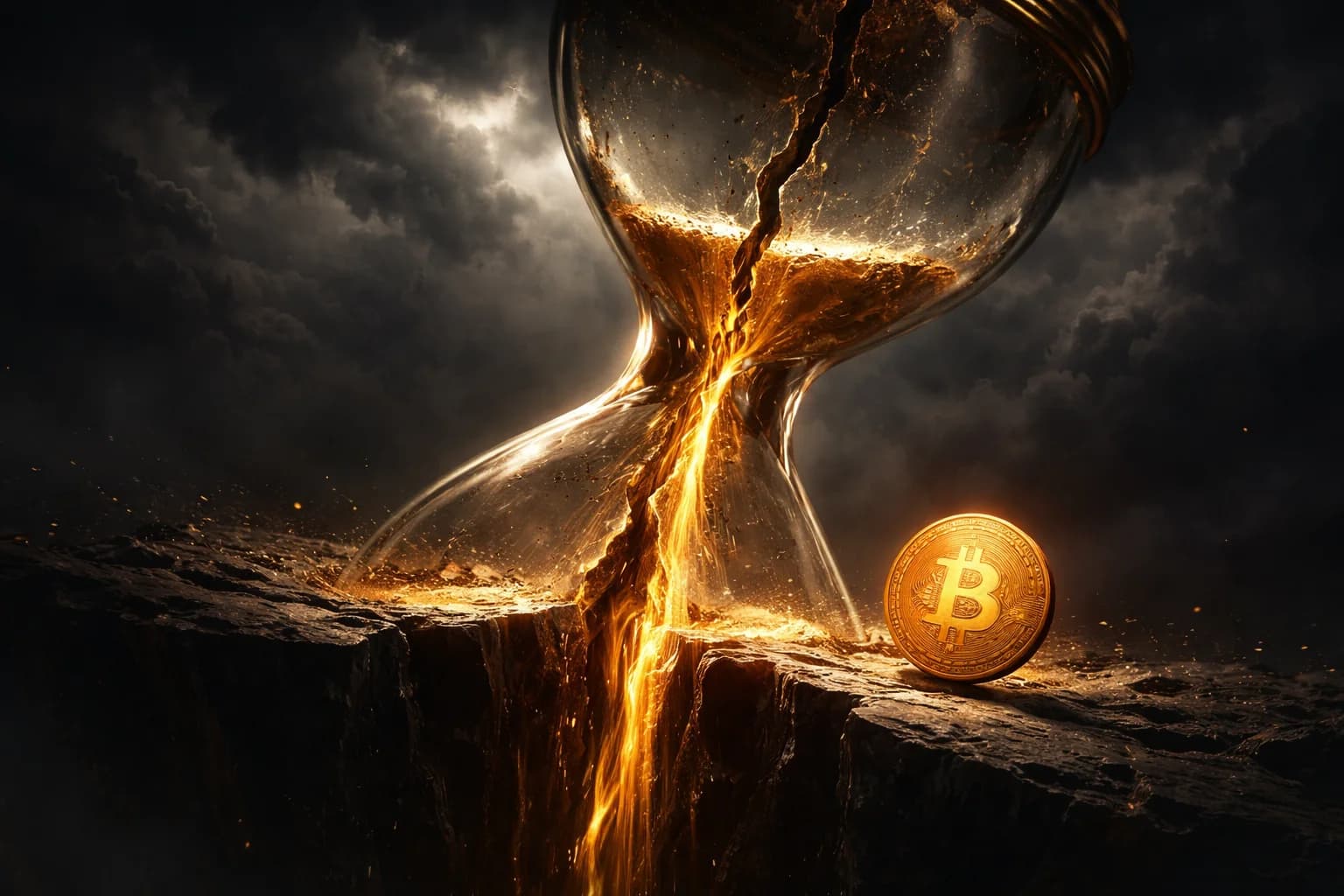
Gold dropped below $4,350 per ounce on March 23, 2026, erasing roughly $1.5 trillion in market value in a single session as futures opened sharply lower. The metal is now down more than 22% from its all-time high of $5,589 set on January 28, and March has been its worst month since 2021. As of the same date, Bitcoin sits at $67,846 with the Crypto Fear & Greed Index at 24, deep in "Fear" territory.
Both assets that claim "store of value" status are bleeding at the same time.
A Seven-Session Losing Streak That Broke Key Levels
Gold's decline is not a single-day anomaly. The metal has now fallen for seven consecutive sessions, the longest losing streak since 2023. The slide began when gold lost the psychologically critical $5,000 level on March 19, then crashed through $4,700, and has now broken below $4,350 on futures.
The speed of the drawdown is historically unusual. Gold lost roughly 6% across just two sessions mid-week, then extended those losses through the weekend futures open. Margin calls on gold futures amplified the selling: exchanges raised margin requirements, forcing leveraged longs to liquidate, which pushed prices further down and triggered more liquidations. The feedback loop is textbook commodity cascade selling.
From its January high of $5,589 to today's $4,350, gold has erased roughly $1.5 trillion in total market capitalization, according to Cointelegraph.
Three Forces Behind the Collapse
Three factors converged to break gold's 2026 rally.
A hawkish Federal Reserve. The Fed trimmed its 2026 rate-cut projections from two cuts to one at its most recent meeting, citing persistent producer inflation driven by elevated oil prices. The 10-year Treasury yield climbed to 4.2%, making non-yielding assets like gold less attractive relative to risk-free government bonds.
A strengthening dollar. The Dollar Index pushed toward 99.9 as capital rotated into USD-denominated assets. A stronger dollar raises the cost of gold for international buyers, historically the largest demand bloc. This is the same dynamic that crushed gold in 2022 when the Fed was hiking aggressively.
Oil shock inflation. Brent crude has surged past $119 per barrel amid conflict-related disruptions in the Strait of Hormuz. Under normal geopolitical stress, gold rises as a flight-to-safety asset. But when the stress itself generates inflation, the Fed response (higher for longer rates) overwhelms the safe-haven bid. Gold is caught between its role as an inflation hedge and its sensitivity to real interest rates, and real rates are winning.
Bitcoin Is Not Picking Up the Slack
The "digital gold" thesis suggests that when physical gold fails, Bitcoin should capture rotating capital. That is not happening.
As of March 23, Bitcoin trades at $67,846, down 1.55% over 24 hours and 6.19% over seven days. Ethereum is at $2,050, down 1.73%. The Fear & Greed Index reads 24, firmly in "Fear" territory. BTC has dropped roughly 46% from its October 2025 all-time high of $126,000.
The correlation data explains why. During stress events in early 2026, the BTC-Nasdaq correlation ran between 0.35 and 0.60, with some analysts measuring it as high as 0.68 during the worst of the January-February selloff. Bitcoin is behaving as a risk asset, not a safe haven. When equities sell off and yields rise, BTC sells off too.
This creates an uncomfortable reality for portfolio construction. Gold is failing as a store of value during an inflationary shock. Bitcoin is failing as an uncorrelated hedge. Both are down double digits from their highs, and neither is absorbing the capital fleeing the other.
Tokenized Gold Adds a Crypto-Specific Wrinkle
The gold crash has a direct crypto footprint through tokenized gold products. PAXG (Paxos Gold) and XAUT (Tether Gold) collectively represent over $6 billion in market cap and track spot gold prices. When gold fell 9% in a single day in February, automated liquidations hit DeFi protocols that accepted PAXG as collateral, mirroring the margin calls in traditional futures markets.
The irony is structural. Tokenized gold was built to give crypto traders access to gold's stability without leaving the blockchain. But when gold itself is unstable, those tokens import traditional market volatility directly into DeFi collateral pools. A PAXG position used as collateral on Aave or MakerDAO carries the same downside as a COMEX futures contract, with the added risk of on-chain liquidation cascades.
Where Analysts See Gold Going
Despite the selloff, major banks have not revised their year-end targets. J.P. Morgan maintains a $6,300 year-end forecast. Deutsche Bank stands behind $6,000. Both banks characterize the current decline as a correction within a secular bull market, driven by short-term liquidity and leverage dynamics rather than fundamental weakness.
If those targets hold, gold at $4,350 represents a 38-45% upside. But the path between here and there depends entirely on the Fed's next move. If oil prices ease and inflation data softens, the Fed could accelerate rate cuts, removing the primary headwind. If oil stays above $110 and inflation persists, gold could test lower levels before any recovery materializes.
For crypto holders, the takeaway is simpler: in a rising-rate, strong-dollar environment, neither gold nor Bitcoin has provided the hedge that their respective communities promised. The only asset class delivering positive real returns right now is short-duration U.S. Treasuries, and you cannot put those on a crypto card.
Overview
Gold crashed below $4,350 per ounce on March 23, erasing $1.5 trillion in a single session and extending a 22% decline from January's all-time high. The selloff is driven by a hawkish Fed, a stronger dollar, and an oil shock that turned inflation into gold's enemy rather than its ally. Bitcoin, trading at $67,846 with the Fear & Greed Index at 24, is not absorbing the rotation. Tokenized gold tokens like PAXG and XAUT are importing the volatility directly into DeFi collateral pools. Major banks maintain year-end targets of $6,000-$6,300, but the path depends on whether oil prices ease enough for the Fed to cut.