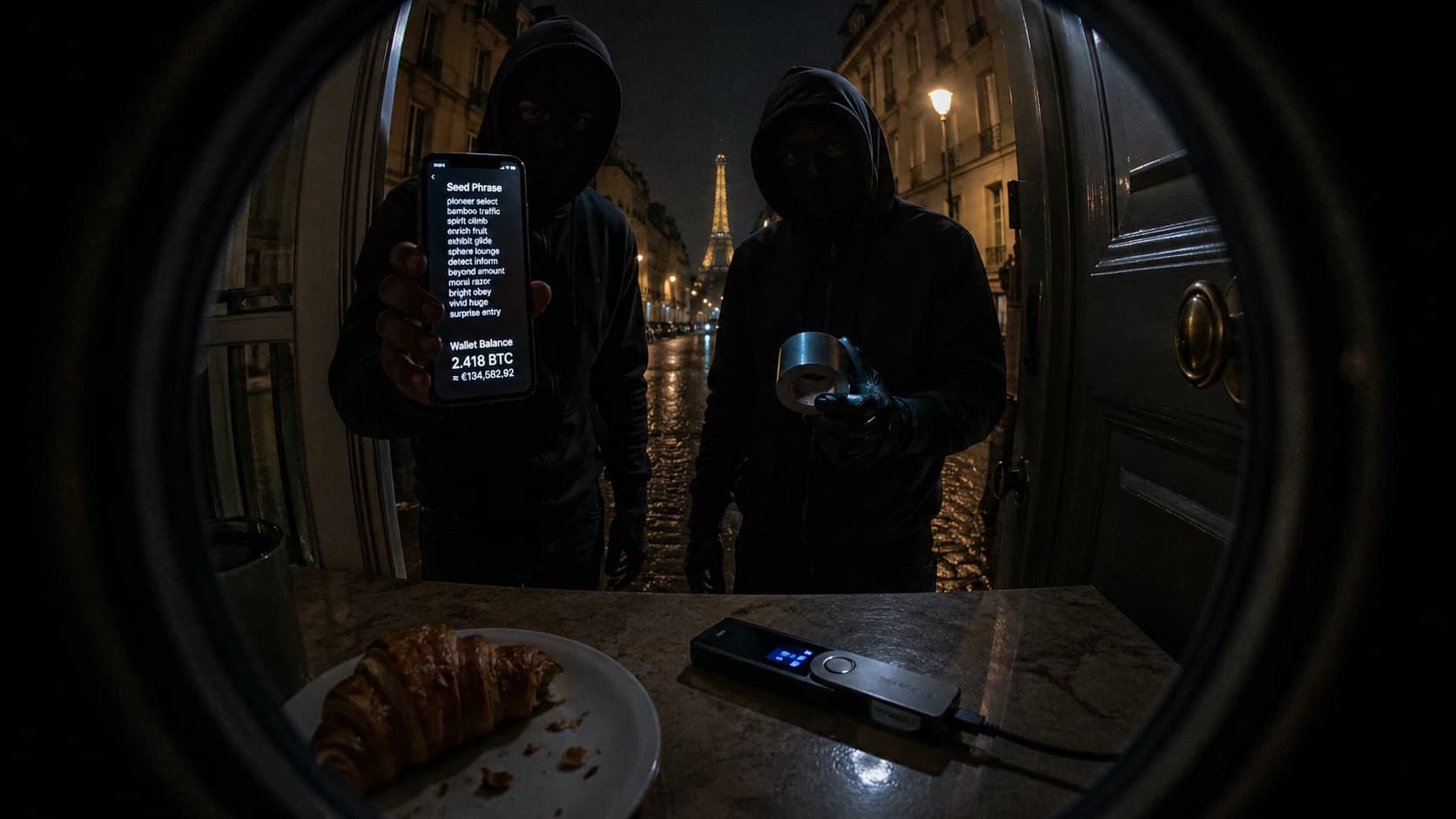
France's national branch for the fight against organized crime has charged 88 people in connection with a surge of crypto-related kidnappings, Le Monde reported on April 25, 2026. The charges cover a string of cases in which victims were abducted, held against their will, and pressured to hand over private keys, seed phrases, or transfers from self-custodial wallets.
The figure was highlighted on April 25 by Wu Blockchain citing the Le Monde investigation. It puts a hard number on a trend French police and prosecutors have been describing in pieces for more than a year: home invasions and street abductions specifically aimed at people known or suspected to hold crypto.
French Cases Have Pushed This Crime Into The Open
France has had several high-profile cases that pushed this category of crime into the open. Earlier incidents involved relatives of executives at French crypto firms being taken from their homes, and ransom demands paid in stablecoin transfers. Police have repeatedly warned that suspects are screening targets through public information, including social media posts about token holdings, NFT collections, and conference appearances.
The 88 defendants reported by Le Monde are spread across multiple investigations rather than a single ring. That matters because it suggests several distinct groups have independently reached the same conclusion: a self-custody wallet with a meaningful balance is, in practice, a bearer asset that can be moved with a phone and a 12-word phrase.
For self-custody users in France, this is the part that changes the threat model. An exchange account hit by a phisher has fraud teams, chargebacks of a sort, and law enforcement levers. A signed transaction made under physical duress has none of those.
The Charges Span Abductions And Forced Transfers
According to the Le Monde reporting cited by Wu Blockchain, the 88 people have been charged through France's national anti-organized-crime branch, the country's specialist unit for serious cross-jurisdictional cases. That choice of unit signals prosecutors are treating these as organized operations rather than opportunistic crimes.
The cases reportedly include:
- Abductions from residences, with victims forced to unlock devices on the spot.
- Forced transfers from hardware wallets after seed phrase extraction.
- Ransom demands routed through privacy mixers or exchanged through over-the-counter desks.
- Cases where extended family members were taken to coerce a specific holder.
French authorities have not, in this round of charges, claimed full recovery of the stolen funds. Once a transaction is signed and broadcast, the chain does not care that the signer was under duress.
Operational Security Becomes A Spending Question
The story has direct implications for how crypto holders think about their on-chain footprint, even those who never expect to be targeted. A few patterns have emerged from the French cases as reported in local press over the last year:
- Public balance disclosure raises risk. Address poisoning aside, public posts that link a wallet to a real identity and a city create a target list.
- Single-signature self-custody with a phrase you can recite is the worst-case format under physical coercion. Multisig setups split across geographies, hardware-backed signers behind biometric locks, and time-locked transactions all reduce the leverage an attacker has in a 30-minute window.
- "Decoy wallets," small balances that look plausible to a coercer, have started appearing in security guidance from French wallet vendors.
For day-to-day spending, this is one of the cleaner arguments for keeping the bulk of treasury holdings in cold storage and only hot-wallet balances reachable from a phone. A crypto card linked to a hot wallet with limited funds is a much smaller piñata than a hardware wallet that holds the full stack.
The Broader European Picture
France is the most visible jurisdiction reporting these numbers, but it is not alone. Police in Spain, the Netherlands, and Belgium have run similar investigations, often with cross-border ransom routing. The 88-defendant figure from Le Monde is large enough that it will likely become a reference point for other European prosecutors arguing for dedicated crypto-crime task forces.
It is also a counterweight to a common framing that crypto self-custody is a security upgrade by default. It is, against remote attackers and platform failures. It is not, against a violent attacker with physical access to the holder.
Overview
France has charged 88 people in a surge of crypto-related kidnappings, the largest single dataset yet on this category of crime. The cases reframe self-custody from a purely technical threat model into a physical-security one, and they reinforce the case for splitting balances between cold storage, low-balance hot wallets used for spending, and recovery setups that are not extractable in a single coerced session.