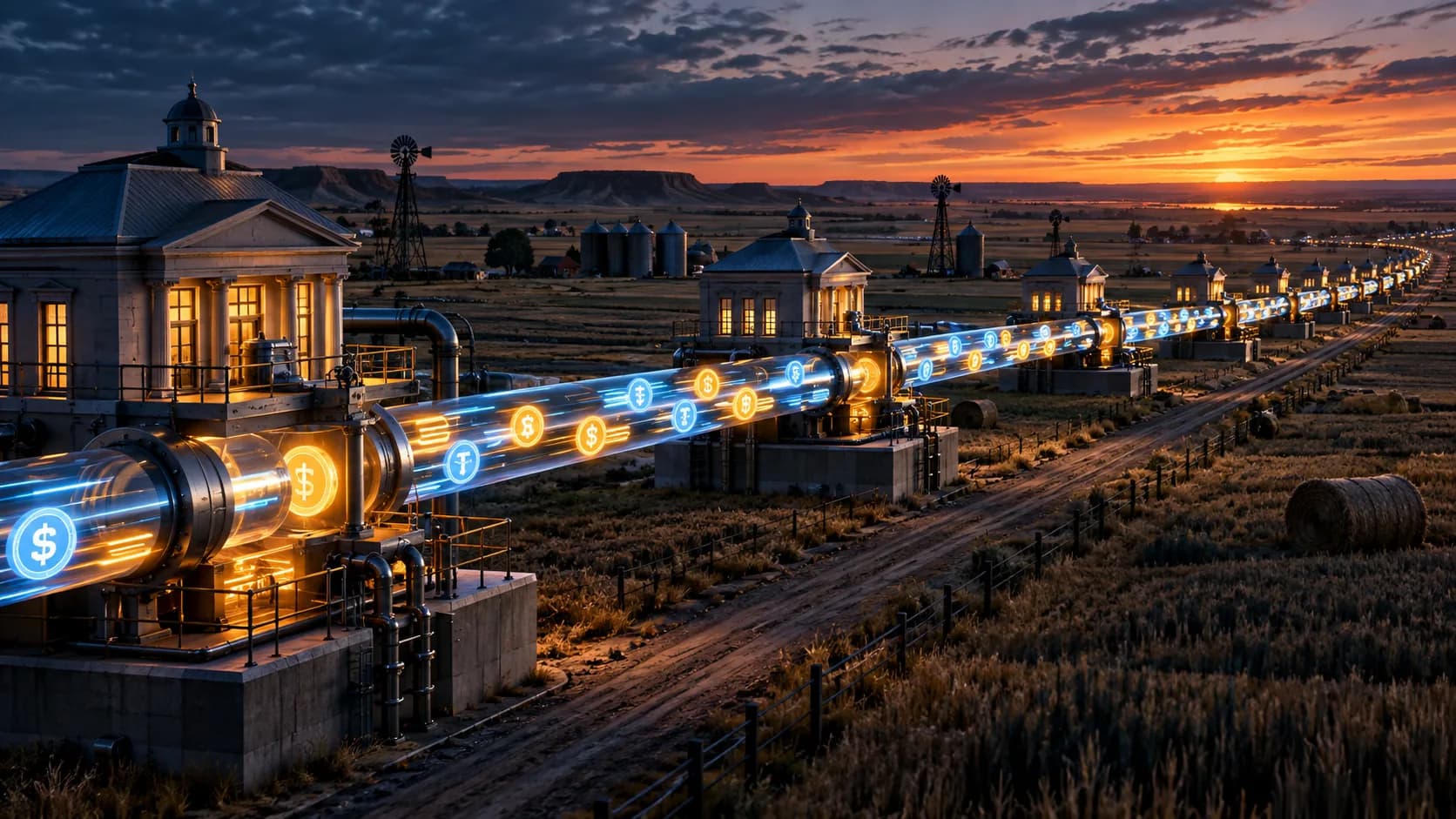
Fiserv, one of the largest payments and core banking processors in the United States, has launched its digital asset platform on Solana, according to a October 1 announcement surfaced by Cointelegraph. The first product on the platform is Roughrider Coin, a token tied to the Bank of North Dakota, which the company says lets more than 90 banks and credit unions settle payments in seconds.
The detail that matters here is who is involved, not the token itself. Fiserv sits in the plumbing of American banking, running card processing, account systems, and payment rails for thousands of financial institutions. A processor of that size routing a state-affiliated bank's settlement onto a public blockchain is a different kind of event than another exchange listing a token.
A core processor moving onchain
Most crypto-payment headlines involve companies built around crypto from the start. This one does not. Fiserv's customer base is banks and credit unions that use its software to run day-to-day operations. When that infrastructure provider builds a digital asset platform, the distribution is already there: the institutions do not need to find a new vendor or rebuild their stack to reach it.
Roughrider Coin is the first asset on the platform. It is tied to the Bank of North Dakota, the only state-owned bank in the country, which gives the launch an unusual public-sector angle. The stated function is settlement. Banks and credit unions on the network can move value between each other and have it clear in seconds rather than waiting on batch processing or correspondent banking delays.
The announcement is the primary source for the 90-plus institution figure and the seconds-to-settle claim. We are treating those as Fiserv's own framing rather than independently measured throughput.
Solana and the public-chain tradeoff
Choosing Solana puts the settlement on a high-throughput public chain rather than a private permissioned ledger. That choice carries a tradeoff a bank-facing processor has to weigh: a public chain offers shared liquidity and composability, but it also means the institution is building on infrastructure it does not control.
For the banks and credit unions on the network, the practical appeal is speed and the elimination of settlement lag between members. A payment that would otherwise sit in a clearing window can finalize in the time it takes a Solana block to confirm. Whether that advantage holds under real volume is the open question, and it is the kind of claim that only operational data will settle.
The broader pattern is worth noting. Banks and payment firms have spent the past two years testing tokenized deposits and stablecoin settlement, from Citi's stablecoin work with Coinbase to the Clearing House tapping Quant for tokenized deposits. Fiserv's launch is another data point in that shift, with the difference being the processor's reach into smaller institutions that would not build onchain rails on their own.
Settlement tokens and spending rails are not the same thing
For readers who spend crypto day to day, it is worth separating what this is from what it is not. Roughrider Coin is a settlement instrument for banks, not a consumer product. It does not change what you can do with a crypto card at checkout tomorrow.
The connection is indirect but real. The rails that clear payments between banks sit underneath the cards and accounts consumers actually touch. Faster, cheaper interbank settlement is the layer that eventually determines how quickly a merchant gets paid and how much friction sits in the system. Stablecoin and tokenized-deposit settlement also overlaps with the stablecoin spending rails that card issuers increasingly rely on, so a core processor normalizing onchain settlement is a signal about where the backend is heading.
What this is not is a direct consumer launch. There is no card, no cashback, no account feature in this announcement. The significance is upstream, in the part of the system most people never see.
The institutional-adoption read
Market context is quiet. As of October 2, 2026, Bitcoin trades at $84,774, up 1.6% over 24 hours, and Solana sits at $118.94, up 0.8%, with the Fear and Greed index at 68 ("Greed"). The Fiserv news did not move those prices in any measurable way, which fits the story: this is infrastructure, not a trade.
The reason to pay attention is the identity of the builder. When a processor embedded in the core of US banking puts a state bank's settlement token on a public chain, it lowers the activation cost for every institution already on its platform. That is how adoption at the infrastructure layer tends to spread, through vendors that thousands of banks already depend on, rather than through any single flashy product.
Overview
Fiserv has launched a digital asset platform on Solana, with Roughrider Coin, a token tied to the Bank of North Dakota, as the first asset. The company says more than 90 banks and credit unions can use it to settle payments in seconds. The weight of the news is in the builder: a core banking processor moving settlement onto a public chain, which lowers the barrier for the many smaller institutions already on its rails. It is a backend settlement development, not a consumer card product, and it did not move crypto prices.