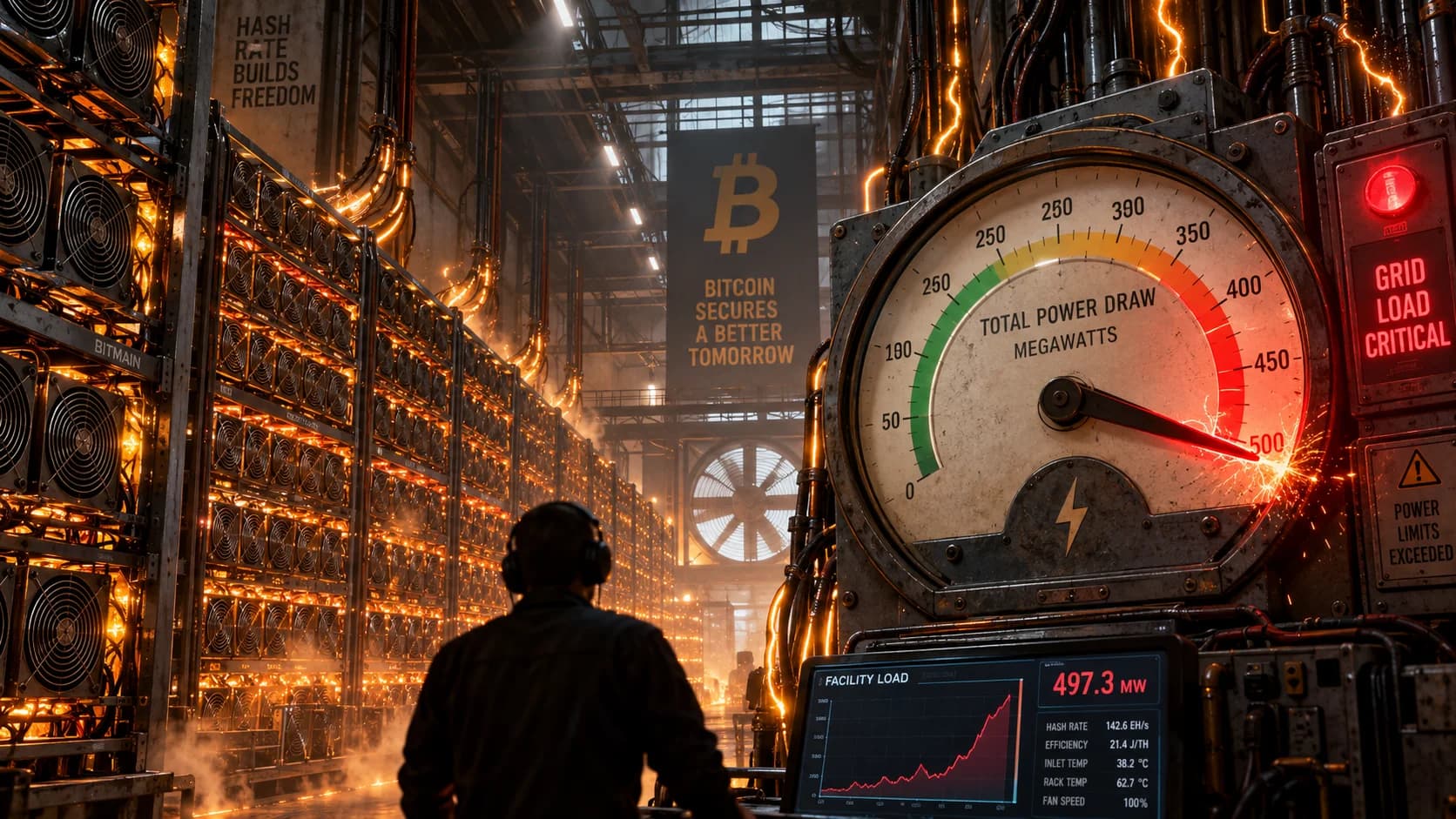
A Bitcoin mining operation watched its single biggest cost multiply by 100 in the span of an hour. Wholesale electricity at the site ran from roughly $10 per megawatt-hour to about $1,000 per megawatt-hour inside sixty minutes, according to a report shared by BitcoinNews on August 16, 2026, citing analysis from Managers Diary. The swing captures a problem that rarely makes headlines but decides who survives in mining: the price of power is not fixed, and when a grid tightens, it can move faster than any operator can react.
Bitcoin traded at $62,994 as of August 16, 2026, down 3% over the prior seven days, with the Fear and Greed index sitting at 37 (Fear). For a miner, the coin price is only half the equation. The other half is the cost to keep machines running, and that half just proved it can turn hostile in real time.
The math behind a 100x power move
Mining economics come down to a race between two numbers: the value of the Bitcoin a machine earns and the electricity it burns to earn it. At $10 per megawatt-hour, almost any modern rig prints a profit. At $1,000 per megawatt-hour, the same rig can burn more in power than the Bitcoin it produces is worth.
Take a facility drawing 100 megawatts. At $10, an hour of full-tilt mining costs $1,000. At $1,000, that same hour costs $100,000. Nothing about the machines changed. The hashrate is identical, the Bitcoin earned is identical, but the cost side exploded by a factor of 100. That is the difference between a healthy margin and a loss that compounds every minute the machines stay on.
Wholesale power markets price electricity in short intervals, often every five to fifteen minutes. When demand surges or supply drops, such as a heatwave straining air conditioning or a generation unit tripping offline, prices in deregulated markets like Texas can spike toward regulatory caps that reach thousands of dollars per megawatt-hour. Miners exposed to those spot prices feel the full force immediately.
Curtailment as a survival tool
Large mining operations have turned this volatility into a strategy rather than a pure threat. Many sign interruptible power agreements: they run when electricity is cheap and shut down when prices spike, sometimes selling their reserved power capacity back to the grid at the elevated rate. In a real spike, powering off and collecting the demand-response payment can out-earn mining itself.
That flexibility is exactly why grid operators increasingly welcome miners as a controllable load. A data center that can drop 100 megawatts within seconds is a stabilizing force during a supply crunch. The miners that manage this well treat a 100x price event as a payday, not a disaster.
The operators that get hurt are the ones on fixed schedules or thin balance sheets, unable to curtail fast enough or lacking a hedge. For them, a single bad afternoon can wipe out a month of margin. Open interest in Bitcoin futures recently climbed to a three-year high, hinting at more volatility ahead, which only sharpens the pressure on the cost side of the ledger.
The distance between mining and spending
This kind of grid drama sits far upstream from anyone tapping a card at a checkout. The Bitcoin that eventually funds a purchase carries none of the volatility that produced it, and cardholders spending stablecoins or BTC through everyday crypto card options never see the megawatt-hour price behind the coin.
Still, the episode is a reminder of where network security actually comes from. Bitcoin's proof-of-work relies on miners staying online through exactly these shocks, and the ones that endure are the ones with the cheapest, most flexible power contracts, not the biggest machines. Mining is, at its core, an energy trade wearing a computing costume.
Overview
A Bitcoin mining site recorded a 100x jump in wholesale power prices, from about $10 to $1,000 per megawatt-hour, in a single hour on August 16, 2026, per a BitcoinNews report citing Managers Diary. The event shows how grid volatility, not the Bitcoin price, often determines mining profitability. Operators with interruptible power deals can turn spikes into revenue by curtailing and selling capacity back; those on fixed schedules can lose a month of margin in an afternoon. With Bitcoin at $62,994 and futures open interest at a three-year high, the cost side of mining is where the real risk now lives.