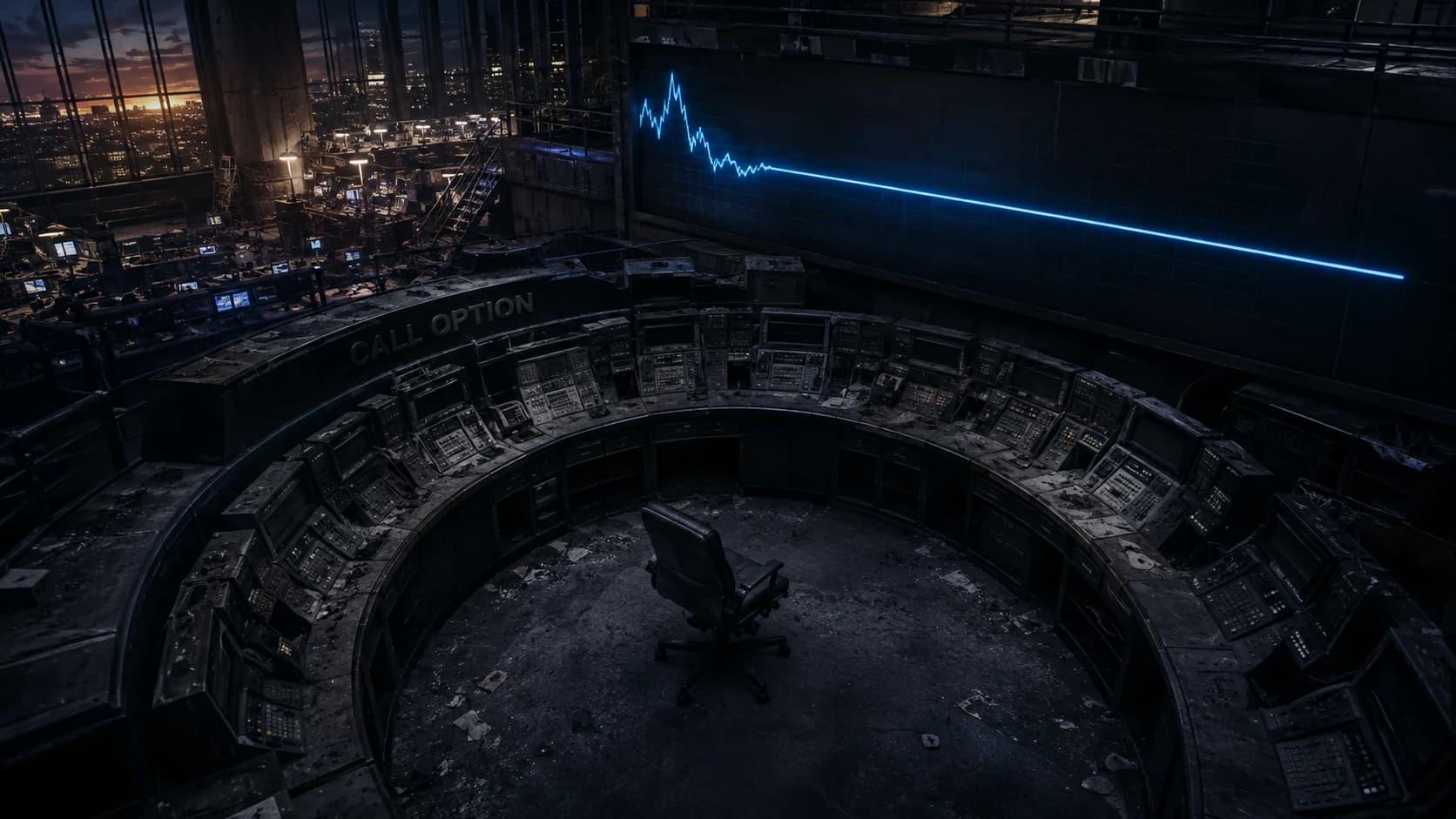
Bitcoin's upside implied volatility has fallen to a record low of 23%, according to Glassnode data flagged by Cointelegraph on August 6, 2026. The reading measures how much traders are willing to pay for options that profit if Bitcoin climbs. At 23%, they are paying almost nothing. The market has stopped pricing in a meaningful rally.
The context is a price that has gone nowhere. Bitcoin trades at $64,448 as of August 6, 2026, up 0.1% over the past 24 hours and down 0.45% on the week. The Crypto Fear and Greed Index sits at 38, in "Fear" territory. Neither the price action nor the sentiment gauge points to traders bracing for a sharp move in either direction.
A market that has priced out surprises
Implied volatility is a forward-looking number. It reflects what options buyers expect, not what has already happened. When upside implied volatility collapses to a record low, it means demand for call options, the contracts that pay off when price rises, has dried up. Traders are no longer paying a premium to bet on Bitcoin going higher.
That is a shift in posture. For most of the last cycle, spikes in call demand accompanied every push toward a new high. Buyers wanted leverage on the way up and were willing to pay for it. A 23% reading says that appetite is gone, at least for now. The people who trade Bitcoin options are treating a breakout as unlikely enough that they will not pay for the option to catch one.
Low implied volatility cuts two ways, and neither is a directional call. It can mark the kind of exhaustion that shows up near a bottom, when the last sellers have left and nobody expects anything to happen. It can also mark complacency, the calm that precedes a violent repricing. The Glassnode figure does not resolve which one this is. It only tells you the market is not positioned for a big move.
The mechanics behind the number
Options pricing bakes in an expectation of future price swings. When that expectation falls, option premiums fall with it, because a seller demands less compensation for writing a contract on an asset nobody thinks will move. Record-low upside implied volatility means call sellers are collecting historically thin premiums, and call buyers see no reason to bid them up.
There is a feedback element worth noting. Cheap options can themselves become fuel. When volatility is priced this low, a sudden move forces dealers who sold those options to hedge, buying or selling spot Bitcoin to stay neutral. That hedging can amplify whatever move breaks the calm. A market that has priced out volatility is, mechanically, a market that can manufacture it once something forces a repricing.
None of this is a forecast. This is a read on positioning, not a prediction. Anyone treating a low volatility print as a timing signal is speculating, and this is not financial advice.
A quieter tape is the friendlier backdrop for spenders
For anyone who holds Bitcoin and spends against it, a quiet tape is the friendlier environment. Volatility is the enemy of predictable spending. When you fund a card from a crypto balance, a sharp drop between top-up and swipe can eat into what you thought you had. A stretch of low realized volatility makes day-to-day budgeting less of a moving target.
It also strengthens the case many users already make for stablecoin-denominated spending. Holders who do not want to gamble their grocery money on the next repricing tend to keep spending balances in USDC or USDT and leave Bitcoin as a longer-term hold. A calm market is a good window to set that structure up rather than reacting to the next spike.
Cards that pull directly from a Bitcoin balance carry the timing risk in full, since the conversion happens at the point of sale. That matters more, not less, when the options market is signaling that a dormant tape could wake up abruptly. Keeping a buffer, or spending stablecoins while holding BTC separately, is the standard way to sidestep it.
The reading in context
A record low in a single metric is a data point, not a verdict. Upside implied volatility at 23% tells you that Bitcoin options traders have stopped paying for a rally and are not braced for a crash either. It fits a broader picture of a market in Fear, trading sideways near $64,400, waiting for a catalyst that the derivatives market is not yet pricing.
The one concrete takeaway: the cheapest optionality Bitcoin has offered on record is available right now, precisely because almost nobody wants it.
Overview
Bitcoin's upside implied volatility fell to a record low of 23% on August 6, 2026, per Glassnode data reported by Cointelegraph, meaning traders have stopped paying for options that profit from a rally. Bitcoin trades near $64,448 with Fear and Greed at 38. The reading signals neither a top nor a bottom, only that the market is not positioned for a large move. For crypto spenders, low volatility is the calmer backdrop for funding cards, though balances pulled directly from Bitcoin still carry point-of-sale timing risk.