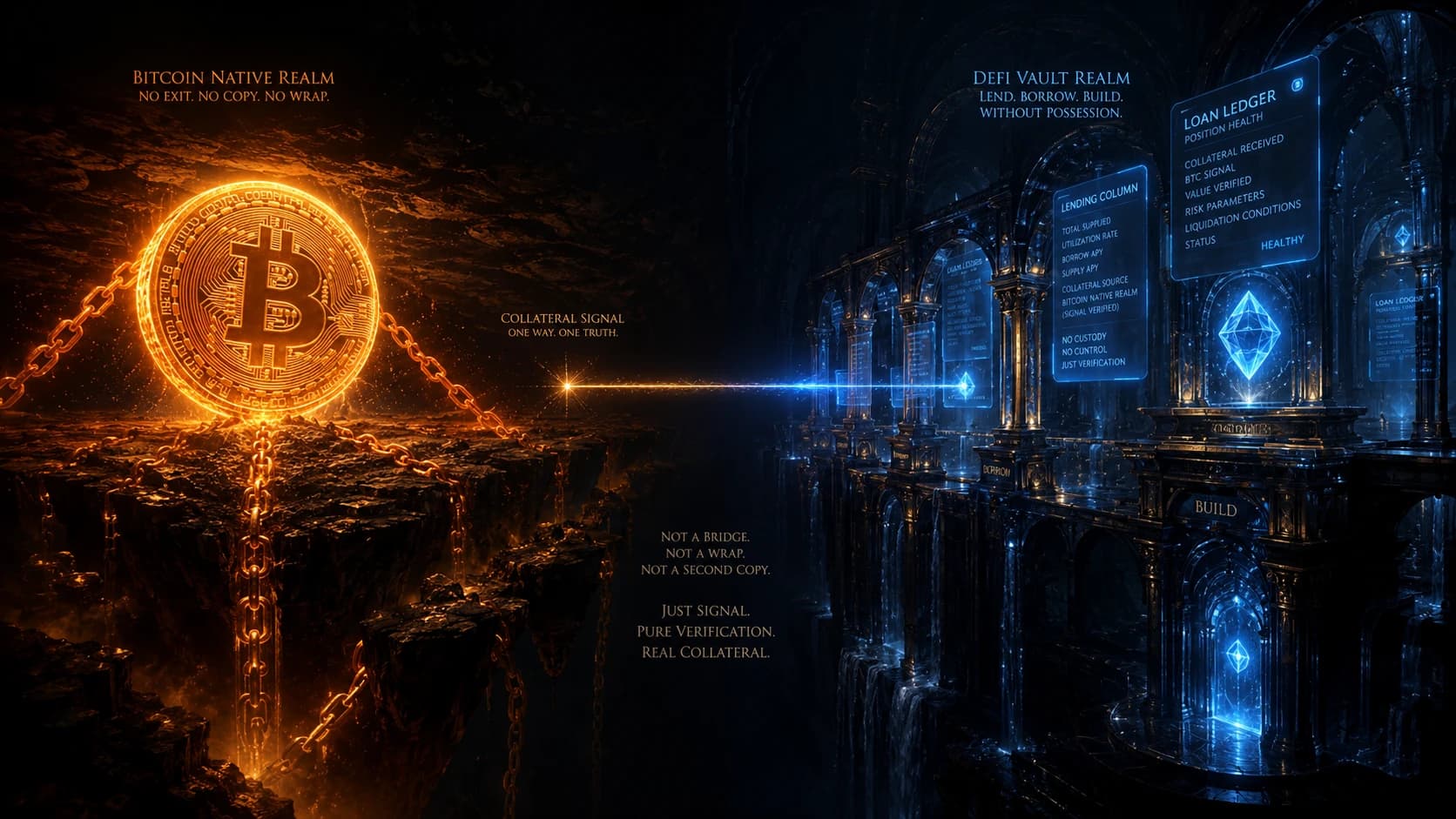
Aave founder Stani Kulechov confirmed on May 25, 2026 that the Babylon team has submitted the first novel Spoke implementation proposal for Aave V4. The proposal introduces Bitcoin as collateral on Aave without BTC ever leaving the Bitcoin network. If accepted by governance, it would be the protocol's first attempt at trustless BTC collateral inside the V4 Hub-and-Spoke architecture.
The post is short on engineering details, but the framing is unusual for a lending protocol. Most BTC-collateral DeFi to date relies on wrapped Bitcoin: a custodian holds native BTC, mints a token on Ethereum or another L1, and the token serves as the on-chain claim. Babylon's design avoids that step entirely.
The Hub-and-Spoke Architecture Behind V4
Aave V4 splits the protocol into a single Liquidity Hub and multiple Spokes. The Hub holds liquidity and sets risk parameters. Spokes are independent modules that can plug into the Hub to offer specialized collateral types, isolated markets, or chain-specific integrations.
A Spoke is the mechanism Aave V4 uses to onboard new collateral without forcing the entire Hub to take on its risk. Babylon's proposal is, by Kulechov's framing, the first time an outside team has proposed a novel Spoke rather than a copy of an existing pattern. That makes the technical review for governance more involved than a typical asset listing.
Babylon's Approach to Native BTC Collateral
Babylon's main product line is a protocol that lets Bitcoin holders stake BTC to secure proof-of-stake chains without bridging. The same self-custodial primitive, which uses Bitcoin script and time-locked transactions, is the basis for the Aave proposal. A user locks BTC on the Bitcoin network. Cryptographic proofs of that lock are made available to the Spoke on Aave. The Spoke uses those proofs as the basis for credit on the Hub.
Three things are notable about this:
- The collateral remains on Bitcoin. No custodian holds it. No multisig signs withdrawals. No bridge contract can be exploited.
- The borrower can hold a native BTC position while drawing stablecoins, ETH, or other Aave-supported assets against it.
- A liquidation has to settle on Bitcoin, which is slower and more complex than a same-chain liquidation. The Spoke design has to absorb that latency without putting the Hub at risk.
The proposal text on Aave's governance forum will determine how the liquidation path actually works. Until it is published, the third point is the open question.
The BTCFi Race and Aave's Position
Bitcoin DeFi, often shorthanded as BTCFi, has been a thesis without a winner. Wrapped BTC peaked above $10 billion in supply but stalled as users grew uncomfortable with custodian risk after several bridge failures across 2022 and 2023. New BTC L2s, restaking protocols, and threshold-signature wrappers have all tried to claim the same liquidity. None has approached the scale of WBTC at its peak.
Aave is the largest money market in DeFi by deposits. If the Babylon Spoke ships and works, Aave becomes a venue where Bitcoin holders can borrow without giving up custody and without trusting a wrapper. That is a meaningfully different value proposition from the current options. It also lets the Hub access whatever fraction of Bitcoin's $1.5 trillion market cap is willing to be productive collateral, without Aave having to launch its own bridge.
The proposal arrives in a market where Bitcoin is trading at $77,629 as of May 25, up 1.4% on the day per CoinMarketCap data. Fear and Greed sits at 41, in the Neutral band. Demand for BTC-backed credit has been muted in 2026 alongside the broader ETF outflow trend, but trustless collateral changes the addressable base of users, not just the price-sensitive ones.
Governance Path From Here
The proposal is at the discussion stage. Aave governance has three steps before it goes live: an ARFC (Aave Request for Final Comment), a Snapshot vote, and an on-chain AIP. Each stage has historically taken weeks. For a novel Spoke with a new cryptographic dependency on Bitcoin, expect risk providers (Chaos Labs, LlamaRisk) to ask for additional analysis on liquidation paths, oracle design, and worst-case Bitcoin congestion scenarios.
Until that review lands, the proposal is a statement of architectural intent, not a live market. But if Aave's largest competitor in lending wanted a moat against newer protocols building BTC-native credit, this is what it would look like.
Overview
Stani Kulechov flagged Babylon's submission as the first novel Spoke proposal for Aave V4, designed to bring Bitcoin as collateral into Aave without bridging or wrapping. The collateral stays on Bitcoin, with cryptographic proofs feeding the Spoke. If it clears governance, it gives Aave a trustless BTCFi product the wrapped-BTC market has not delivered, and changes which Bitcoin holders can become DeFi borrowers without compromising on custody.