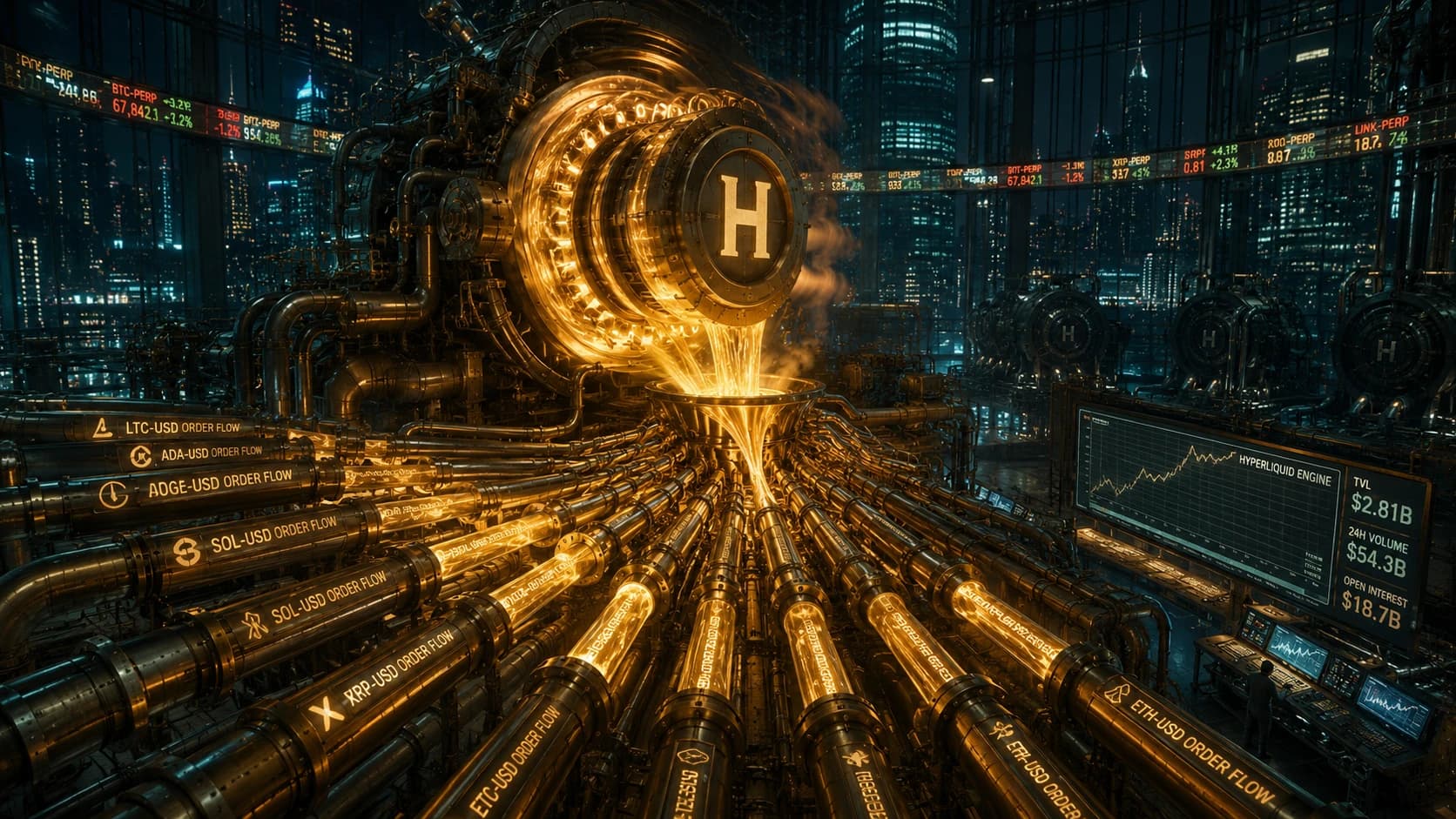
Hyperliquid has used nearly all of its trading fee revenue to date, over $1.16 billion, to buy back HYPE tokens, according to a Forbes contributor citation flagged by Wu Blockchain on May 24, 2026. The figure puts hard numbers on a mechanism that has been quietly running since the token launched and explains why HYPE recently overtook Solana on fully diluted valuation.
The mechanic in plain numbers
Hyperliquid routes fee income from its perpetual futures exchange into a programmatic buyback of its own token. The protocol does not pay out fees as cash to stakers or LPs in the way most DeFi venues do. Instead, accrued fees are converted on a continuous basis into HYPE purchases on the open market, shrinking circulating supply against any given level of demand.
The cumulative $1.16B figure represents close to 100% of trading fee revenue captured since HYPE went live. There is no large discretionary war chest sitting on the balance sheet for grants, marketing, or yield programs; the design choice is to push fees back to holders by the simplest possible route.
For context on the volume that generated it: perpetual DEX trading on Hyperliquid has run in the multi-billions of daily notional through most of 2026, with takers paying low single-digit basis points per trade. Over months, that adds up to the nine-figure revenue stack now redeployed into HYPE.
Contrast with other perp DEXs
dYdX uses a portion of fees to fund staking rewards and ecosystem programs. GMX splits fees between GLP liquidity providers and stakers of its native token. Jupiter's perp product, which sits on Solana, sends a share of fees to JLP holders and to JUP buybacks but does not currently route close to 100% to a single token.
Hyperliquid's choice to send essentially all of it into a buyback creates a much sharper feedback loop. As volume rises, the bid for HYPE rises mechanically. Holders receive value through price appreciation rather than yield, which is more tax-efficient in many jurisdictions and avoids the securities-law friction that explicit dividend-like distributions can attract in the United States.
The trade-off is concentration risk. A pause in trading volume directly removes the bid that has supported HYPE through 2026. If a competitor captures share, the buyback shrinks with it.
The valuation context
HYPE recently flipped SOL on fully diluted valuation at $54.47B, as covered in the FDV flip earlier this month. The buyback math is the cleanest explanation for why a sub-two-year-old perpetual venue is trading at a fully diluted value comparable to one of the largest L1s.
Critics argue that FDV comparisons flatter HYPE because most of the supply is not yet circulating, and that the buyback effectively redistributes value from future unlocks to current holders. That objection is not new, but the $1.16B disclosure puts a number on it. Future supply that gets released into the market is being met with a mechanically programmed bid funded by the live exchange business.
Supporters frame it as the closest thing in crypto to a corporate buyback program funded out of operating cash flow. There is no token issuance to staking contracts, no inflationary emissions to liquidity mining, and no off-balance-sheet treasury deployment to dress up returns.
The risks the chart does not show
A few items worth noting against the bullish frame:
- Concentration of revenue. If perpetual trading rotates back to centralized venues in a calmer macro environment, the buyback engine shrinks. The buyback rate is not a floor; it tracks fee revenue.
- Regulatory posture. Programmatic buybacks funded from a fee-generating exchange that lists derivatives can attract scrutiny from US regulators in particular. The mechanism does not currently have a clean US legal opinion in public.
- Unlock schedule. Token holders benefit from buybacks at the current rate, but a large share of supply remains scheduled for future release to insiders and the team. Continued buyback intensity is needed just to keep circulating supply roughly flat.
None of these change the headline number. They affect how to read it.
Overview
Hyperliquid has used $1.16 billion, nearly all of its trading fee revenue to date, to buy back HYPE on the open market. The design pushes value to token holders through programmatic supply pressure rather than yield distribution, and is the cleanest single explanation for HYPE's recent flip of SOL on fully diluted valuation. The mechanism only works as long as the exchange continues to capture perpetual trading volume, and concentration risk and US regulatory posture remain real overhangs.