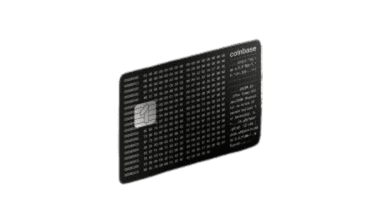
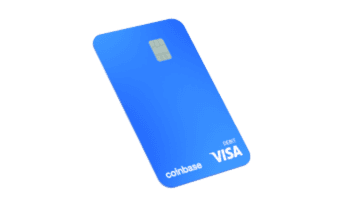
Issued by Coinbase

CASHBACK
Verified

NO ANNUAL FEE
Verified

NO FX FEE
Verified
Our Official Verdict
Safe & Simple: US Regulated Prepaid Visa with Rotating Crypto Rewards
The Coinbase prepaid Visa is the benchmark for safety in US crypto spending. With 4% rotating crypto rewards, Free annual fee, and FDIC-insured funds via Pathward, it remains the most practical daily driver for US investors who value regulatory trust over extreme yield.
Fees & Charges
Annual Fee
Free
FX Fee
0%
ATM Fee
0%
Requirements
Supported Regions
US
Spendable Assets
USDC, BTC, ETH, SOL
Coinbase Card (Prepaid Visa) Review
The Coinbase Card is a custodial prepaid Visa debit card issued by Pathward N.A. (Member FDIC, powered by Marqeta) that connects to your Coinbase account, offering up to 4% rewards in rotating crypto assets, $0 annual fee, zero USDC spending fees, FDIC-insured USD balances, and Apple Pay/Google Pay support, available to US residents in all states except Hawaii.
The Safest Crypto Card in the US Market
SpendNode's 2026 review covers the prepaid Visa tier. The Coinbase Card exists at the intersection of crypto innovation and traditional banking regulation. It is issued by Pathward N.A., a federally chartered bank and FDIC member. Your USD balance is insured. Your crypto sits on a NASDAQ-listed exchange (COIN) that files quarterly 10-K reports with the SEC. No other crypto card in the US market offers this level of regulatory transparency.
The card itself is straightforward: fund with USDC (0% spending fee) or any supported crypto (variable spread applies), choose a reward crypto from a rotating list, and earn up to 4% back on every purchase. No staking, no token lockup, no membership required.
Card Specs: What You Are Actually Getting
Physical and Virtual Cards
- Virtual card: Issued instantly upon application approval. Usable immediately for Apple Pay, Google Pay, and online purchases
- Physical card: Free Visa-branded debit card shipped to US addresses
- No credit check: This is a prepaid debit card, not a credit card. No impact to your credit score
Payment Network
- Network: Visa prepaid debit
- Acceptance: 60M+ merchants worldwide (Visa network)
- Contactless: Yes (NFC)
- Mobile wallets: Apple Pay, Google Pay
- Funding: USDC (0% fee), BTC, ETH, SOL, and other supported Coinbase assets (variable spread)
Security Features
- FDIC insurance: USD balances insured up to $250,000 via Pathward N.A.
- 2FA: Biometric and PIN authentication
- Instant freeze/unfreeze: Toggle card on/off in the Coinbase app
- Real-time notifications: Push alerts for every transaction
- Visa Zero Liability: Unauthorized transaction protection
- SEC-regulated custodian: Coinbase (NASDAQ: COIN) files quarterly financial reports
How Spending Works: Transaction Flow
Example: $120 dinner in New York City
Step 1: Fund your Coinbase account
- Transfer USD via bank account (ACH) or deposit USDC
- USDC can be purchased on Coinbase with zero fees (1:1 USD peg)
- Maximum balance: $25,000
Step 2: Choose your reward crypto
- In the Coinbase app, select which crypto you want as your reward from the current rotation
- Options rotate and may include BTC, ETH, XLM, GRT, AMP, DOGE, and others
- Rates vary: typically 1% for BTC/ETH, up to 4% for select rotating assets
Step 3: Pay at the restaurant
- Tap your Coinbase Card or use Apple Pay
- The restaurant charges $120
- If funded with USDC: Coinbase converts USDC to USD at 1:1 with 0% fee
- If funded with BTC: Coinbase sells BTC at market price with a small spread (typically 0.5-2%)
Step 4: Reward credited
- If you selected the 4% rotating asset: $120 x 4% = $4.80 in crypto
- If you selected BTC at 1%: $120 x 1% = $1.20 in BTC
- Reward is credited immediately to your Coinbase account
The USDC strategy: Fund with USDC for zero spending fees. This makes the Coinbase Card a true zero-cost card where 100% of your reward is profit. At the 4% rotating rate, this is one of the highest net-positive returns in the US market.
Fee Deep Dive: The Real Cost
| Fee | Amount | Notes |
|---|---|---|
| Annual fee | $0 | No subscription or maintenance charge |
| USDC spending | 0% | Zero fee on USDC-to-USD conversion |
| Crypto conversion | Variable spread | Typically 0.5-2% when spending BTC, ETH, etc. |
| FX fee | 0% | No Coinbase foreign transaction fee |
| ATM fee (Coinbase) | $0 | No fee from Coinbase |
| ATM fee (operator) | Varies | ATM operators may charge their own fee |
| ATM daily limit | $1,000 | Maximum 6 withdrawals per day |
Net Return by Spending Scenario
| Scenario | Reward Rate | Spending Fee | Net Return |
|---|---|---|---|
| USDC, 4% rotating asset | 4.0% | 0% | +4.0% |
| USDC, 1% BTC | 1.0% | 0% | +1.0% |
| BTC, 4% rotating asset | 4.0% | -0.5-2% spread | +2.0-3.5% |
| BTC, 1% BTC | 1.0% | -0.5-2% spread | -1.0% to +0.5% |
| ETH, 4% rotating asset | 4.0% | -0.5-2% spread | +2.0-3.5% |
Optimal strategy: Always fund with USDC. The 0% spending fee means your full reward rate is pure profit. Never fund with volatile crypto unless you specifically want to spend that asset (the spread eats into or eliminates rewards).
Rewards Deep Dive: The Rotation System
How Reward Rotation Works
- Coinbase periodically changes which crypto assets are available for card rewards and at what rate
- Typical structure: 1-2% on BTC and ETH (stable options), 3-4% on rotating altcoins (XLM, GRT, AMP, DOGE, etc.)
- You choose one reward asset at a time and can switch at any time in the app
- Rewards are credited immediately in your chosen crypto
The 4% Rate Availability
The 4% rate is not always available for every asset. It typically rotates across smaller-cap tokens. If maximizing rewards is your priority, check the app regularly and switch to the highest-rate option. If you prefer BTC accumulation, accept the lower 1% rate for consistency.
ROI at Different Spending Levels (USDC-funded, 4% rate)
| Monthly Spend | Annual Rewards (4%) | Notes |
|---|---|---|
| $500 | $240 | Casual spender |
| $1,000 | $480 | Moderate spender |
| $2,000 | $960 | Active spender |
| $2,500 | $1,200 | At daily POS limit |
Tax Note
Crypto rewards from the Coinbase Card are considered income by the IRS at the time of receipt. If you receive $960 in crypto rewards over a year, that is $960 in taxable income. Subsequent gains or losses when you sell the rewarded crypto are subject to capital gains tax. The Coinbase One Amex BTC rewards are NOT reported on 1099 forms.
Limits and Restrictions
Spending and Load Limits
| Limit | Amount |
|---|---|
| POS daily (signature + PIN) | $2,500 |
| Monthly spending | $75,000 |
| Maximum card balance | $25,000 |
| Daily load | $5,000 |
| ATM daily | $1,000 |
| ATM daily count | 6 withdrawals |
Reward Exclusions
Standard Visa exclusions apply. Additionally:
- Crypto purchases on exchanges (including Coinbase itself)
- Peer-to-peer transfers and money orders
- Cash equivalents
Important: This Is a Prepaid Card
The Coinbase Card is a prepaid Visa, not a credit card. This means:
- You can only spend what you have loaded on the card
- No credit line, no interest charges, no debt risk
- No credit history reporting (positive or negative)
- For a credit card with BTC rewards and Amex protections, see the Coinbase One Card
What Happens If Coinbase Goes Bankrupt?
Your USD balance:
- Held by Pathward N.A. (Member FDIC) in a custodial account
- FDIC-insured up to $250,000 per depositor
- This is the strongest protection of any crypto card. Even if Coinbase fails, your USD is insured by the federal government
Your crypto balance on Coinbase:
- Custodial. Coinbase holds your crypto assets
- As a NASDAQ-listed public company, Coinbase publishes quarterly financial statements
- In Coinbase's 2022 10-K filing, they disclosed that customer crypto could be subject to bankruptcy proceedings (as unsecured creditors)
- Mitigation: Keep only spending amounts on Coinbase. Withdraw long-term holdings to self-custody
Your crypto rewards:
- Once credited to your Coinbase account, rewards are subject to the same custodial risk as your crypto balance
- Mitigation: Periodically withdraw earned rewards to self-custody
Risk comparison:
| Card | USD Protection | Crypto Protection | Regulatory Status |
|---|---|---|---|
| Coinbase Card | FDIC-insured via Pathward | Custodial, SEC-regulated | NASDAQ-listed, SOC 2 audited |
| Gemini Credit Card | N/A (credit card) | Custodial, NYDFS-regulated | SOC 2 audited |
| Crypto.com | E-money segregation | $750M Lloyd's insurance | Multi-jurisdiction regulated |
| Gnosis Pay | N/A | Self-custody Safe wallet | Zero custodial risk |
Assessment: After reviewing the risk profile, low risk for USD (FDIC-insured). Medium risk for crypto (public company, SEC-regulated, but crypto could be subject to bankruptcy proceedings). This is the best regulatory profile of any crypto card in the US.
Real User Scenarios
Scenario 1: David (Austin Software Engineer, $2,000/month spending)
Setup:
- Coinbase Card funded with USDC (zero spending fee)
- Rotates reward selection to maximize 4% rate when available, defaults to 1% BTC otherwise
- Average effective rate across the year: 2.5% (mix of 4% and 1% periods)
- Keeps $5,000 USDC on Coinbase for spending buffer
Results after 12 months:
- Eligible spending: $24,000
- Crypto rewards (2.5% average): $600
- Spending fees: $0 (USDC-funded)
- Total annual value: $600 from a free, zero-fee card
His verdict: "I treat this as my default spending card for everything that accepts Visa. USDC funding means zero costs. When the 4% rotation hits an asset I like, I switch and earn double. The FDIC insurance on my USD gives me peace of mind that no pure-crypto card can match. I would not hold more than $5K on Coinbase though - my long-term crypto is on a Ledger."
Scenario 2: Maria (Miami Freelancer, $1,500/month spending)
Setup:
- Coinbase Card funded with USDC
- Always selects the highest reward rate available (typically the 4% rotating asset)
- Sells rotating altcoin rewards immediately for BTC (consolidates into one asset)
- $3,000 USDC balance as buffer
Results after 12 months:
- Eligible spending: $18,000
- Crypto rewards (3.5% average, heavy rotation selection): $630
- Conversion cost selling altcoins for BTC: approx. -$15 (spreads)
- Total annual value: $615
Her verdict: "The strategy of always picking the 4% option and immediately converting to BTC works well. I lose a tiny amount on conversion, but the higher rate more than compensates. My only frustration is the $2,500 daily POS limit - I have to split large purchases across days. For US residents with no other crypto card option, Coinbase is the obvious choice."
Scenario 3: Kevin (Chicago Part-Time Trader, $800/month spending)
Setup:
- Coinbase Card funded with BTC (does not want to convert to USDC)
- Selects 1% BTC rewards for simplicity
- Holds $10,000 in BTC and ETH on Coinbase for trading
Results after 12 months:
- Eligible spending: $9,600
- BTC rewards (1%): $96
- Spread on BTC-to-USD conversion: approx. -$96 (1% average spread)
- Total annual value: approx. $0 (rewards offset by spread)
His verdict: "I learned the hard way that spending BTC directly is a wash. The spread eats the reward. Now I keep USDC for card spending and BTC separately for holding. The card is not magic - it is only great if you fund with USDC. That said, even at break-even, it is better than a traditional debit card that gives me nothing."
How the Coinbase Card Compares
For US crypto holders:
- Coinbase One Card (Amex): 2-4% BTC rewards as a credit card with Amex protections. Requires $49.99/year Coinbase One membership. Better for users who want guaranteed BTC rewards, credit card benefits, and higher spending limits
- Gemini Credit Card: Up to 4% BTC on dining as a Mastercard credit card. No membership. Better category rates (4% dining, 3% groceries). Coinbase wins on the rotating 4% across all spending categories
For users outside the US:
- The Coinbase Card is US-only. EEA/UK users should consider Krak Mastercard (0% fees, 1% cashback), Plutus (up to 9%), or Gnosis Pay (self-custodial, up to 5%). APAC users should consider Bybit or OKX
Coinbase Card's unique value: The only crypto card in the US backed by FDIC insurance on USD balances, issued by a federally chartered bank, and connected to a NASDAQ-listed exchange. No other card combines this level of regulatory protection with up to 4% crypto rewards and zero USDC spending fees.
Is the Coinbase Card Worth It in 2026?
Use the Coinbase Card if:
- You are a US resident who wants the simplest, safest way to earn crypto rewards on daily spending
- You hold USDC and want to spend it with zero fees while earning up to 4% back
- You value regulatory protection: FDIC-insured USD, SEC-regulated custodian, NASDAQ-listed company
- You want a no-commitment card: no staking, no subscription, no lockup
Skip the Coinbase Card if:
- You want guaranteed BTC rewards at a fixed rate. The rotating system means the 4% rate is not always available in BTC. Get the Coinbase One Amex for consistent BTC rewards
- You want credit card protections. This is a prepaid debit card with no purchase protection, extended warranty, or travel insurance. The Coinbase One Amex or Gemini Credit Card offer full credit card benefits
- You spend over $2,500/day frequently. The $2,500 daily POS limit is restrictive for high-value purchases
- You are outside the US. This card is not available internationally
Final verdict: SpendNode tracks every US crypto card, and the Coinbase Card is the gold standard for regulated crypto spending in the US. The combination of FDIC-insured USD, zero USDC spending fees, up to 4% rotating rewards, and backing by a publicly traded exchange creates a trust profile no other crypto card can match. The rewards system is modest compared to international options (Plutus 9%, Wirex 8%, Crypto.com 8%), but the regulatory safety net is unmatched. For US residents, this is the responsible default - the card you can use daily without worrying about platform risk.
Sources and Verification
All card specs, fees, and limits verified from:
FAQ
How do you choose Coinbase Card (Prepaid Visa) crypto cards?
We compare verified issuer sources, fees, and eligibility. Availability can change, so confirm with the issuer before applying.
Do all cards in this list offer the same benefits?
No. Each issuer defines its own program terms. Review the sources on each card profile.
Are these rankings or recommendations?
No. Lists are filtered views of cards in our database and do not imply rankings.
This is a prepaid card. Merchants that require pre-authorization holds (gas stations, hotels, car rentals, toll booths) may decline it. Fund only what you plan to spend.
Your funds are held by Coinbase. If the provider faces insolvency, your balance may be at risk. This card does not offer self-custody protection.
Fees shown above are the card's disclosed fees. Additional costs may apply: Visa/Mastercard network spread (typically 0.5-0.9%), crypto-to-fiat conversion spread at point of sale, and blockchain gas fees for on-chain top-ups.
Last verified: Mar 5, 2026 · Data sourced from official Coinbase documentation. · Methodology
★★★★☆4.7/5 App Store (1.8M ratings)