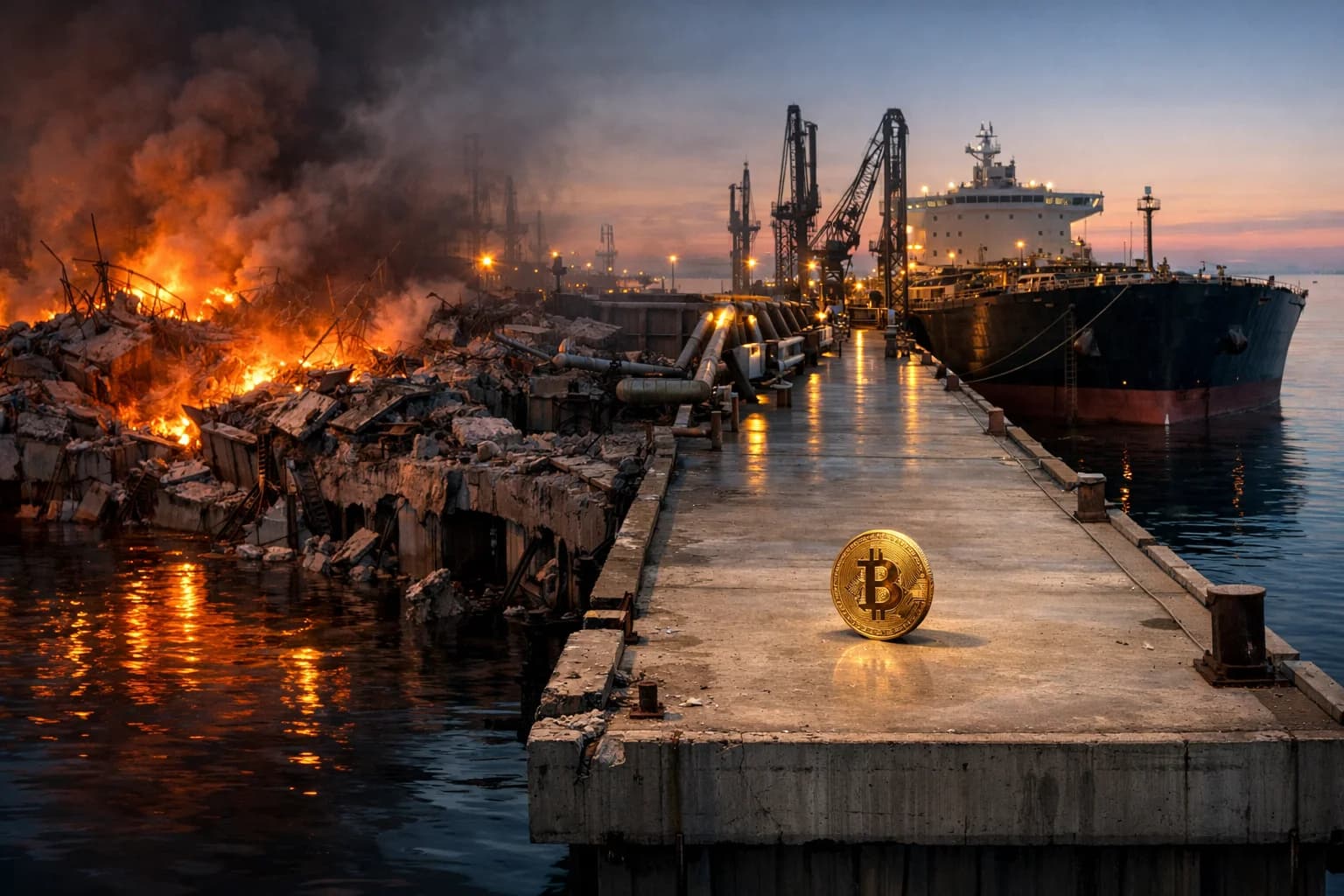
US forces struck military targets on Kharg Island early Saturday, hitting the facility that handles roughly 90% of Iran's crude oil exports. It was described as the "most powerful bombing raid" of the two-week-old conflict. Oil pushed above $100 per barrel. Bitcoin, as of March 14, 2026, was trading at $70,930, down less than 1% over 24 hours. The Fear and Greed Index sat at 30 (Fear).
Four days ago, Trump told CBS the war was "very complete." Now the US is bombing the single most economically significant piece of infrastructure in Iran.
Kharg Island Is Not a Random Target
Kharg Island processes approximately 90% of Iran's crude exports. Before the war, Iran was producing around 3.2 million barrels per day, making it OPEC's third-largest producer. Striking military installations on the island itself, even while sparing the oil loading terminals, sends a message that goes beyond tactical degradation.
Trump framed the decision as restrained. He said the US spared oil infrastructure "for reasons of decency" but would "immediately reconsider" if Iran continued blocking the Strait of Hormuz. That conditional threat is doing more to move oil markets than the bombs themselves.
Brent crude crossed $100 again after the strike, creating the largest sustained energy supply disruption in recent history. The Strait of Hormuz, which carries roughly 20% of the world's daily oil supply, remains largely shut. Shipping traffic through the chokepoint has not meaningfully recovered since the conflict began on February 28.
Bitcoin's War Premium Has Evaporated
Two weeks ago, the first US-Israeli strikes on Iran sent Bitcoin from $67,000 to $63,000 in hours, liquidating $209 million in longs. A week later, oil touching $119 drove BTC to its crisis low. Each escalation headline triggered a selloff.
That pattern has broken. Bitcoin is now absorbing Kharg Island bombing headlines with sub-1% moves. The weekly chart tells the story more clearly: BTC is up 4.4% over seven days. ETH gained 5.7% to $2,089. SOL climbed 4.6% to $88. Even XRP, typically the most volatile major token during geopolitical stress, lost only 1.9% in the past 24 hours.
The market has done what markets eventually do with sustained conflict: it stopped reacting to each new headline and started pricing the war as a persistent condition rather than a series of shocks.
The Oil-Crypto Disconnect
The crude oil market and the crypto market are telling two different stories.
Oil is pricing in supply destruction. Kharg Island strikes, a largely closed Hormuz strait, and Trump's conditional threat to escalate further all point toward sustained high energy prices. Brent above $100 feeds directly into inflation expectations, which feeds into rate policy, which has historically been bearish for risk assets including crypto.
Crypto is pricing in something else: that the worst-case scenario for digital assets specifically, a global liquidity crunch driven by an oil shock, has not materialized. The Fed has not raised rates. Stablecoin volumes have held. DeFi protocols have not seen the kind of cascading liquidations that would signal systemic stress. Aave hit record monthly active users even as the conflict escalated.
The disconnect is real, but it has an expiration date. The Federal Reserve meets March 17-18. If oil above $100 shifts the committee's inflation calculus toward hawkish language, or worse, toward pausing rate cuts, Bitcoin's war-proof thesis gets tested against something it has never handled well: a Fed that tightens into a supply shock.
Trump's Conditional Escalation
The most consequential line from Trump's statement was not about Kharg Island. It was about what comes next.
By publicly stating he would "immediately reconsider" sparing oil infrastructure if Iran keeps blocking Hormuz, Trump created a binary for markets. Either Iran reopens the strait, oil falls, and the inflationary pressure eases, or Iran holds its position, the US strikes oil terminals directly, and the energy crisis enters a new phase.
For crypto holders, the second scenario is the one to watch. Direct strikes on oil export infrastructure would push Brent well past $120, likely triggering the kind of stagflationary environment that forces central banks into impossible choices. Bitcoin's correlation with equities during macro stress events remains high. A Fed forced to choose between fighting inflation and avoiding recession would create volatility across every asset class.
The first scenario is better for risk assets broadly but removes the geopolitical narrative that has been supporting gold, and by extension, Bitcoin's "digital gold" framing.
The $73,000 Ceiling
Beyond the war, Bitcoin has a technical problem. It has been rejected at the $73,000-$74,000 resistance level four times in two weeks. Each attempt has come on decreasing volume. Friday's push to $73,838 was the most recent failure, and the Kharg Island headlines arrived while BTC was already retreating from that level.
The weekly gain of 4.4% is real, but it is happening within a narrowing range. Bitcoin is bouncing between $68,000 support and $74,000 resistance. A breakout in either direction will likely require a catalyst that has nothing to do with Iran: the Fed's March 18 rate decision, a shift in ETF flow trends, or a stablecoin market event.
Overview
The US struck military targets on Kharg Island, Iran's primary oil export terminal, pushing crude above $100 while Bitcoin held at $71,000 with minimal reaction. Trump threatened to escalate to oil infrastructure itself if Iran keeps blocking the Strait of Hormuz. The crypto market has stopped reacting to individual war headlines, but the Fed meeting on March 17-18 could reintroduce the inflation-rate volatility that war headlines alone no longer trigger. Bitcoin remains stuck below $74,000 resistance after four failed breakout attempts in two weeks.