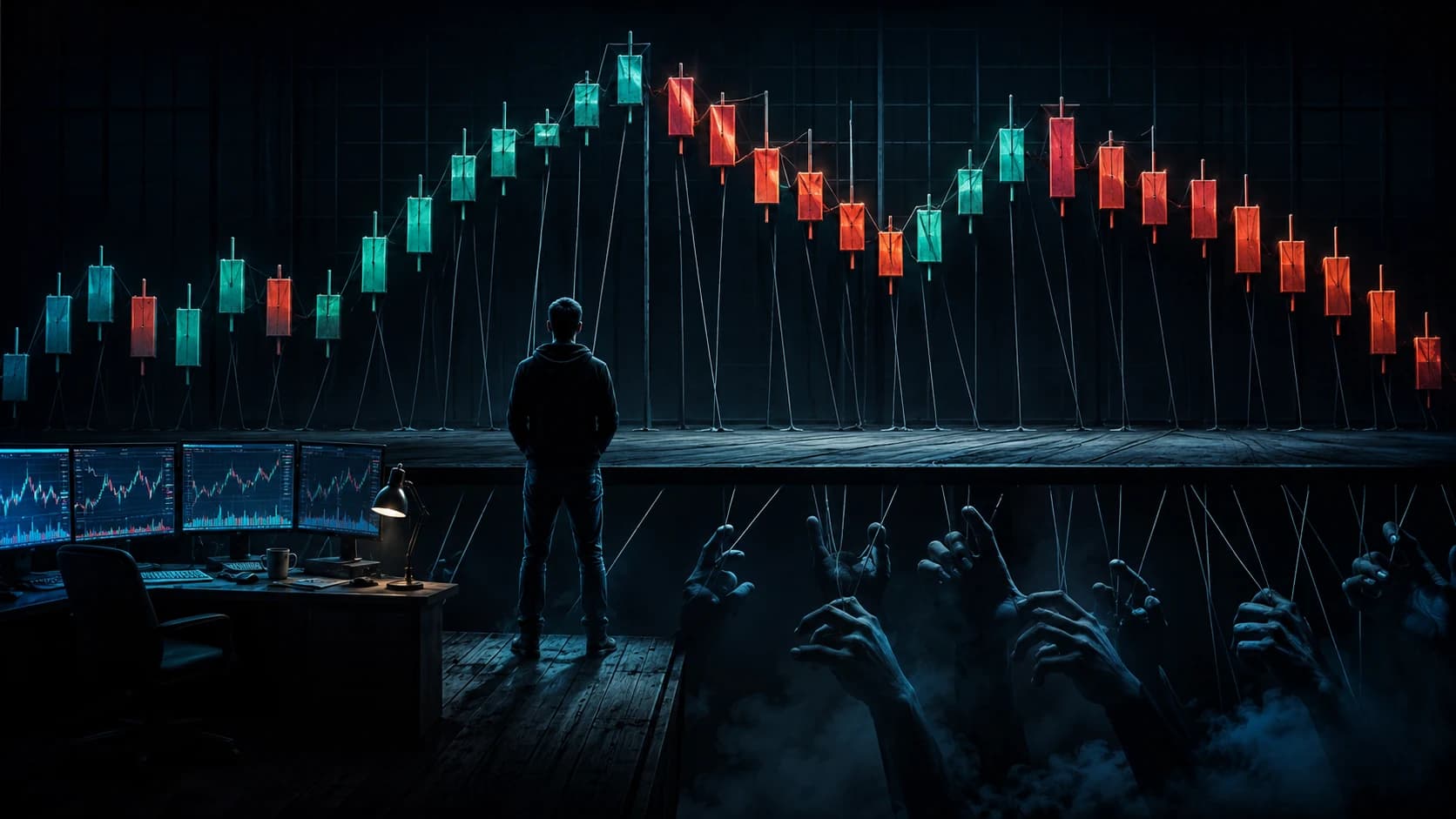
Researchers at Stanford have documented patterns consistent with coordinated manipulation inside Bitcoin's shortest trading windows, according to a summary circulated by Coin Bureau on July 16, 2026. The work focuses on five-minute price intervals, the timeframe where high-frequency strategies and short-term traders operate, and where retail participants are least equipped to tell a real move from an engineered one.
Bitcoin traded at roughly $64,853 as of July 16, 2026, up 0.1% on the day and 3.8% over the week, per CoinMarketCap. The broader market read as cautious, with the Fear and Greed Index at 36, in "Fear" territory. That backdrop matters: manipulation tactics tend to bite hardest when sentiment is fragile and order books are thin, because it takes less capital to push price through a nervous market.
The specific claim
The study centers on the five-minute candle, not daily or weekly closes. That distinction is the whole point. Over a day or a week, large flows, macro news, and genuine supply and demand dominate. Inside a five-minute window, a small number of well-placed orders can move price enough to trigger stop losses, bait momentum traders, or paint a chart pattern that others then react to.
The research, as summarized, describes these short-window moves as widespread rather than isolated to a single venue or a single bad actor. That framing is the escalation. Individual cases of spoofing and wash trading have been prosecuted before. A finding that the behavior is systematic across intraday Bitcoin markets is a harder problem, because it implies the structure of short-term trading itself rewards it.
We are working from the study summary rather than the full peer-reviewed text, so treat the exact magnitudes with caution until the complete paper is public. The direction of the finding, that shorter timeframes carry more manipulation risk, is consistent with years of market-structure research in both crypto and traditional equities.
Who actually gets hurt
Day traders and leveraged scalpers sit directly in the blast radius. Someone running a five-minute strategy with a tight stop is exactly the participant a manipulative order flow is designed to shake out. A brief, engineered spike down can liquidate a leveraged long, then the price recovers seconds later with the manipulator on the other side.
Long-horizon holders are largely insulated. If you buy Bitcoin and hold it for months, a manufactured five-minute wick is noise. It does not change your cost basis in any way that survives to your next decision. The practical lesson is not "Bitcoin is fake," it is "the timeframe you choose determines how much of this you absorb."
For anyone who moves between crypto and everyday spending, the same logic applies to how you fund a card. Converting a large balance to fiat during a thin, volatile window exposes you to a worse rate than converting in calmer conditions. Cards that let you spend stablecoins directly sidestep this entirely, because your spending balance is not riding intraday Bitcoin volatility. The disclosed card fee is never the whole cost either: the point-of-sale conversion spread and network markup stack on top, and they widen when the underlying market is choppy.
The regulatory gap
Spot crypto markets still lack the unified surveillance layer that governs regulated equities and futures. In US stock markets, cross-venue monitoring and audit trails give regulators a way to reconstruct who did what. Spot Bitcoin trades across dozens of global venues with uneven oversight, which makes systematic spoofing harder to catch and prosecute. A Stanford finding that the behavior is common, rather than rare, adds academic weight to the argument that spot venues need consolidated surveillance.
That is also why the finding is more than a trading-desk curiosity. Regulators weighing how far to extend oversight of spot crypto now have peer-reviewed evidence to cite. Exchanges that can demonstrate real market-integrity controls may turn that into a competitive point rather than a compliance burden.
Overview
Stanford researchers say Bitcoin's five-minute markets carry patterns consistent with widespread manipulation, per a July 16, 2026 summary. The finding hits short-term and leveraged traders hardest and barely touches long-term holders. Bitcoin sat near $64,853 with a "Fear" reading of 36 as the report circulated. The practical response is not to abandon Bitcoin but to lengthen your timeframe, avoid tight stops in thin conditions, and convert to spending balances when the market is calm rather than during a volatile intraday window. Until spot venues carry unified surveillance, the shortest windows will stay the riskiest place to trade.