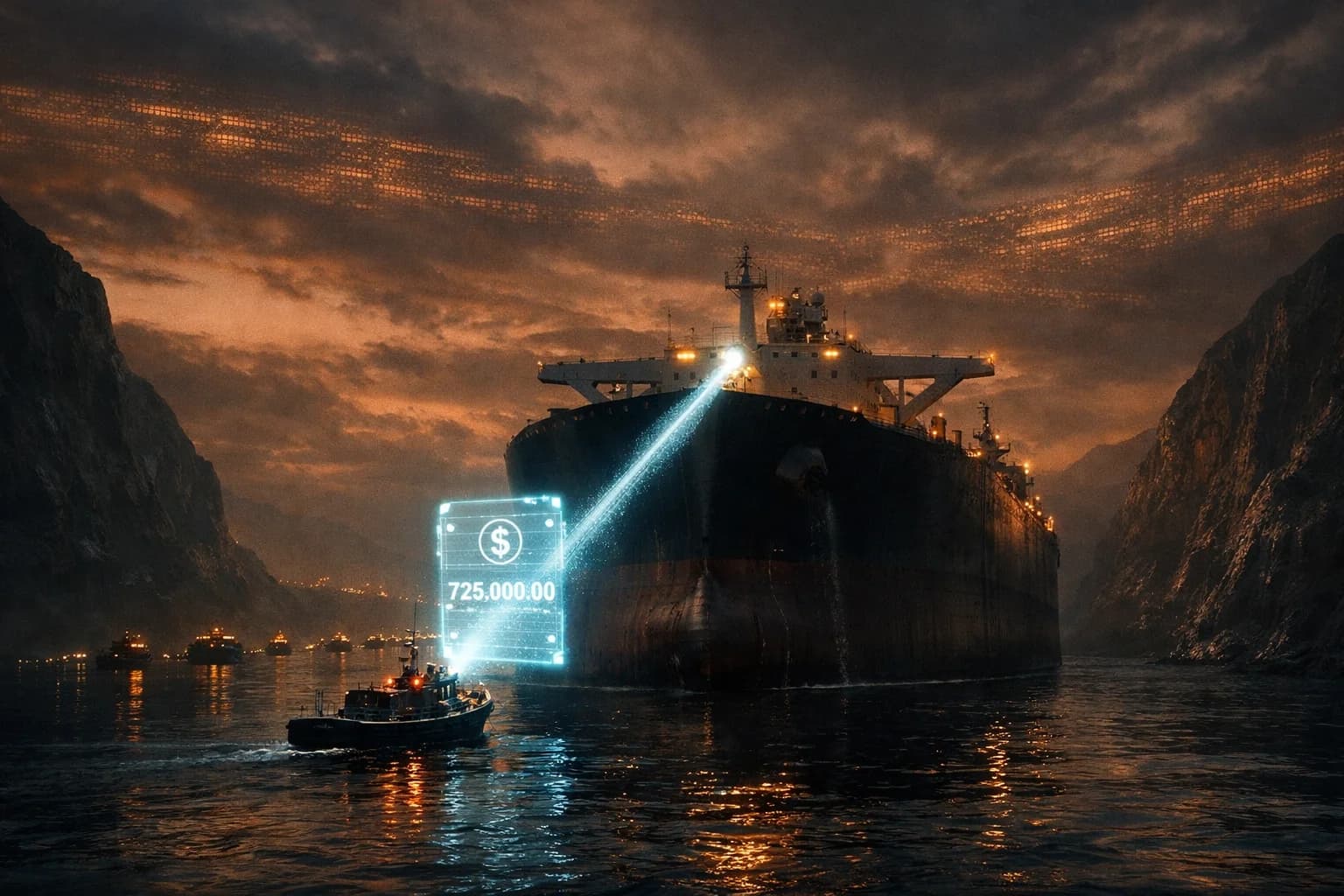
Iran's Islamic Revolutionary Guard Corps has built a formal toll system at the Strait of Hormuz, demanding payment in stablecoins or Chinese yuan for naval escort through the chokepoint that handles roughly 20% of all globally traded oil and gas. Bloomberg reported the system on April 1, 2026, citing parliamentary approval of a transit fee bill and accounts from multiple shipping sources.
The opening rate for oil tankers is approximately $1 per barrel of cargo. A Very Large Crude Carrier loaded with 2 million barrels faces a $2 million toll for a single transit. As of April 5, 2026, BTC was trading at $67,366 (+0.1% in 24 hours), ETH at $2,058 (+0.1%), with the Fear & Greed Index sitting at 30 (Fear).
How the Toll System Works
The IRGC operates through an intermediary front company. Vessel operators submit ship particulars, ownership records, cargo manifests, crew lists, and AIS tracking data. The IRGC's regional naval units then screen each vessel for connections to the United States, Israel, or other adversarial nations.
Iran assigns every country a "friendliness ranking" from one to five. This ranking determines the toll rate, which is negotiated case by case from a tiered pricing schedule. Some nations have secured favorable terms: Pakistan and China have reportedly negotiated reduced or zero-fee transits.
Once payment clears, the vessel receives a VHF-broadcast passcode valid for one strait crossing. Ships transmit the code at the Qeshm-Larak checkpoint, and an IRGC Navy escort guides them through to the Gulf of Oman.
Stablecoins, Not Bitcoin
The accepted payment methods are Chinese yuan and fiat-pegged stablecoins, specifically USDT and USDC. Bitcoin and Ethereum are not accepted.
The logic is straightforward. Yuan settles entirely outside the SWIFT-dependent dollar clearing system. Stablecoins reference dollar value but move on blockchain rails that bypass correspondent banking. Both routes achieve the same goal: collecting revenue without touching the U.S. financial system that enforces sanctions.
This creates an immediate compliance problem for Tether and Circle. USDT and USDC are dollar-denominated instruments. If those tokens are being used to pay an IRGC-administered toll, the stablecoin issuers face pressure from OFAC and U.S. regulators regardless of whether the underlying transaction touches American banks. Circle, which operates under U.S. jurisdiction and holds reserves in U.S. Treasuries, is in a particularly difficult position. Tether, domiciled in the British Virgin Islands, has historically been slower to freeze addresses but has cooperated with law enforcement on sanctioned wallets.
At least two vessels have already paid in yuan. The stablecoin payment volume is harder to verify, but the system is operational.
The Shipping Backlog
The toll system has not restored normal traffic. Only a handful of vessels are using the Iranian-controlled lane each day. On March 31, just three ships transited inbound and three outbound through the Hormuz checkpoint.
The numbers behind that bottleneck are severe. Over 320 tankers and gas carriers remain trapped inside the Arabian Gulf. Nearly 2,000 commercial vessels of various types are backed up on both sides of the strait.
Insurance is a major factor. Most marine insurers will not cover vessels that pay tolls to a sanctioned entity, which means operators choosing the IRGC lane may lose their P&I coverage. For ship owners carrying hundreds of millions of dollars in cargo, that is not a trivial risk.
Why This Matters for Crypto
This is the first documented case of a nation-state imposing crypto-denominated tolls on a critical piece of global infrastructure. The Strait of Hormuz is not a niche waterway. It is the single most important oil transit point on the planet.
The implications run in several directions at once. For stablecoin regulation, the Hormuz tolls hand critics a concrete example of dollar-pegged tokens being used to circumvent sanctions at scale. The GENIUS Act stablecoin framework now in rulemaking at the Treasury Department will face questions about whether issuers can or should blacklist wallets associated with the toll system.
For the broader crypto market, the signal is mixed. Nation-state adoption of stablecoins validates the utility of blockchain payment rails in high-stakes, adversarial environments. But validation through sanctions evasion is the kind of adoption that invites regulatory backlash rather than institutional confidence.
For users holding stablecoins in self-custody wallets, there is no direct risk unless their specific addresses interact with IRGC-linked wallets. But the episode is a reminder that stablecoins are not censorship-resistant in the way native cryptocurrencies are. Circle and Tether can freeze tokens, and if OFAC designates specific wallet addresses tied to the toll system, any USDC or USDT that passes through those addresses becomes tainted.
What Happens Next
Iran's toll system is functioning but barely. Three ships per day through a chokepoint that normally handles dozens per hour is not sustainable for global energy markets. Brent crude remains elevated, and the backlog will keep upward pressure on energy prices until either military or diplomatic intervention clears the strait.
The stablecoin angle will likely accelerate regulatory timelines in Washington. OFAC has been slow to act on crypto sanctions enforcement relative to traditional finance, but a $2 million per-transit toll system denominated in USDT is exactly the kind of headline that forces a response.
Overview
Iran's IRGC has implemented a formal toll system at the Strait of Hormuz, accepting stablecoins (USDT, USDC) and Chinese yuan for naval escort through the chokepoint. Rates start at $1 per barrel, translating to up to $2 million per tanker. Over 320 tankers and 2,000 commercial vessels are backed up as only a handful transit daily. The system bypasses SWIFT and U.S. correspondent banking entirely, creating immediate compliance pressure on stablecoin issuers and a likely catalyst for faster sanctions enforcement from OFAC.