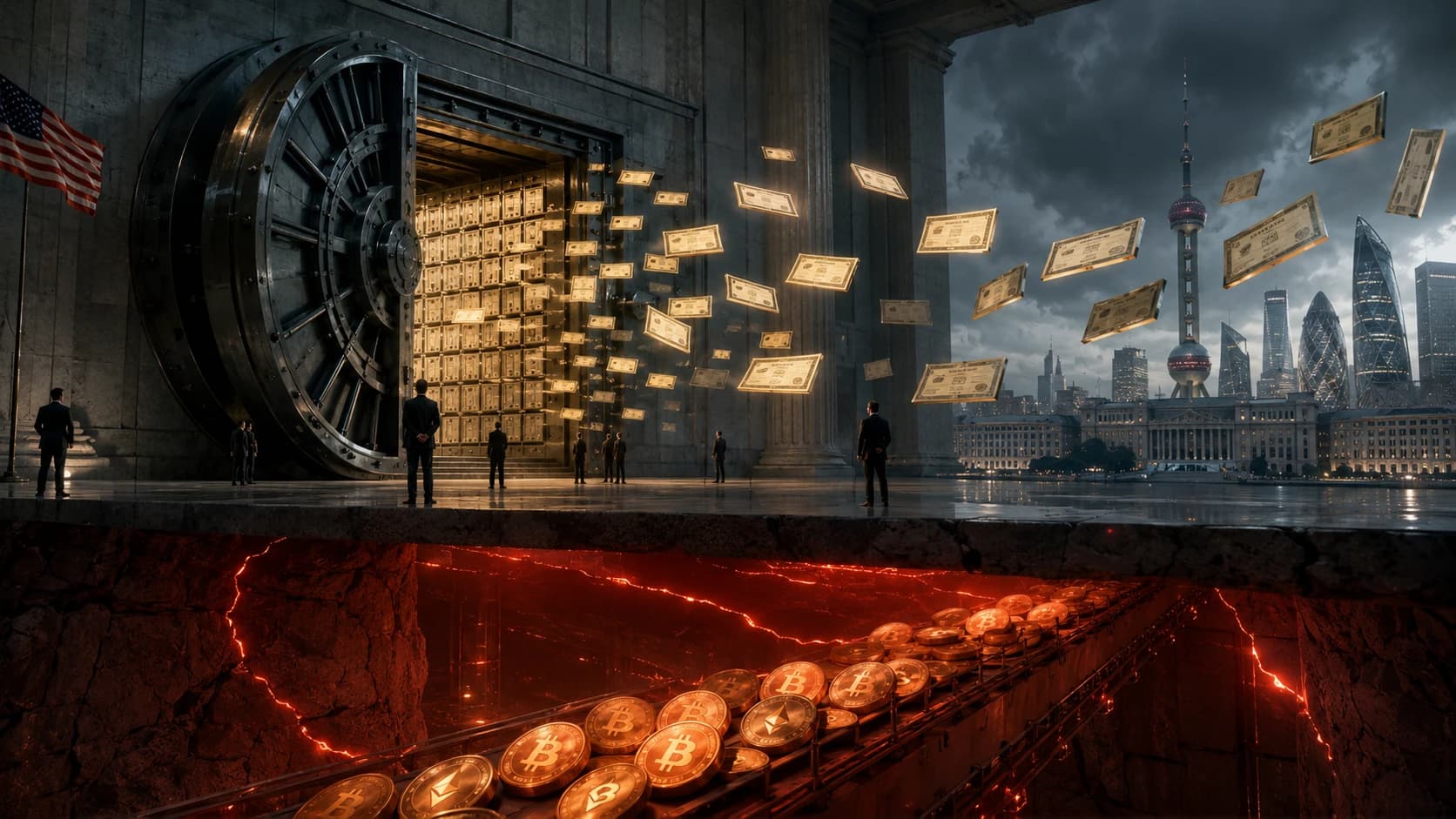
Foreign holdings of US Treasuries held in custody at the Federal Reserve fell to $2.68 trillion this week, the lowest level in years, according to a Cointelegraph post citing the Fed's weekly H.4.1 data. The drop landed on the same morning Bitcoin slid back under $73,000 and Ethereum lost more than 4.6% in a 24-hour window.
The two stories are not the same story, but they are reading the same tape.
The custody number, in plain terms
The Federal Reserve holds Treasury and agency securities on behalf of foreign central banks and official institutions through its custody account. That account is one of the cleanest available signals for how much of the world's reserve capital is parked in dollar-denominated government paper.
As of late May 2026, that figure is $2.68 trillion. The previous run rate sat closer to $2.85 to $2.9 trillion through most of 2025, so the recent slide is a measurable shift, not a rounding error. The composition matters too. The Treasury portion of the account is the part that has been visibly compressing, while agency holdings have stayed relatively flat.
There are several plausible drivers. Some foreign holders may be rotating to domestic balance sheets to defend their currencies. Some may be quietly moving to custody arrangements outside the Fed system. Some may simply be letting paper run off without rolling it. The H.4.1 cannot tell you which is which.
What the H.4.1 can tell you is that the pool of foreign dollars choosing to sit at the Fed is smaller than it was last quarter.
Crypto reads the same risk-off page
As of May 28, 2026, the live tape looks like this: Bitcoin trades near $72,997, down 3.6% on the day and 5.8% on the week. Ethereum is at $1,979, off 4.6% in 24 hours and almost 7% on the week. Solana sits at $80.84, also down 3.6%. XRP and BNB are off 3.6% and 2.9% respectively. The CoinMarketCap Fear and Greed index reads 31, which lands in Fear territory.
This is not a clean macro chart, but it rhymes. Risk assets and reserve-asset rotation tend to move together when the underlying signal is the same: a marginal reduction in confidence that long-duration dollar exposure is the right place to be.
CoinEx's morning desk note already pinned the proximate cause for crypto on the ETF side, citing heavy spot Bitcoin ETF outflows led by BlackRock. Those flows have been the dominant short-term variable for two weeks. The custody data adds a slower, structural layer underneath it.
Two implications for the crypto thesis
For crypto specifically, two implications stand out.
First, the long thesis that Bitcoin is a hedge against dollar reserve erosion has always rested on a quiet assumption: that the erosion would be visible in official data before it was priced in. The custody account is one of the places where that visibility shows up. A multi-quarter slide here, even a slow one, is the kind of signal that gold and Bitcoin bulls have historically pointed to as a "why now" anchor.
Second, the near-term price action argues against that being a clean trade. When BTC is dropping in lockstep with risk assets on the same day that foreign Treasury custody slips, the correlation that should support the hedge narrative is missing. Bitcoin is currently behaving like a risk asset on the daily, not like a reserve substitute.
Both can be true. The structural story can support a multi-year accumulation case while the tactical tape still bleeds.
The on-ramp angle
The detail that does not get said often enough: when reserve flows shift, the practical surface where it touches everyday users is on payment rails and dollar access, not on price charts. Stablecoin demand from non-US jurisdictions has run at record highs for most of 2026, and the stablecoin float now exceeds the FX reserves of most countries. That is part of the same trend the H.4.1 is showing. Foreign demand for dollar-denominated assets is not vanishing. It is migrating, partly off the Fed's books and partly onto chain.
For users holding USDC or USDT to spend through cards or wallets, this dynamic is the macro tailwind that keeps stablecoin issuance growing even when crypto-native prices are red. That part of the system has not flinched this week.
Overview
Foreign holdings of US Treasuries at the Federal Reserve fell to $2.68 trillion, the lowest reading in years, on the same morning that Bitcoin lost 3.6% and Ethereum lost 4.6%. The two data points are not causally linked on the day, but they sit on the same continuum: a slow rotation away from long-duration dollar exposure and a faster rotation away from risk assets. The structural picture supports a long-run case for non-sovereign reserve assets. The tactical picture, with Fear and Greed at 31 and ETF outflows leading the move, does not.