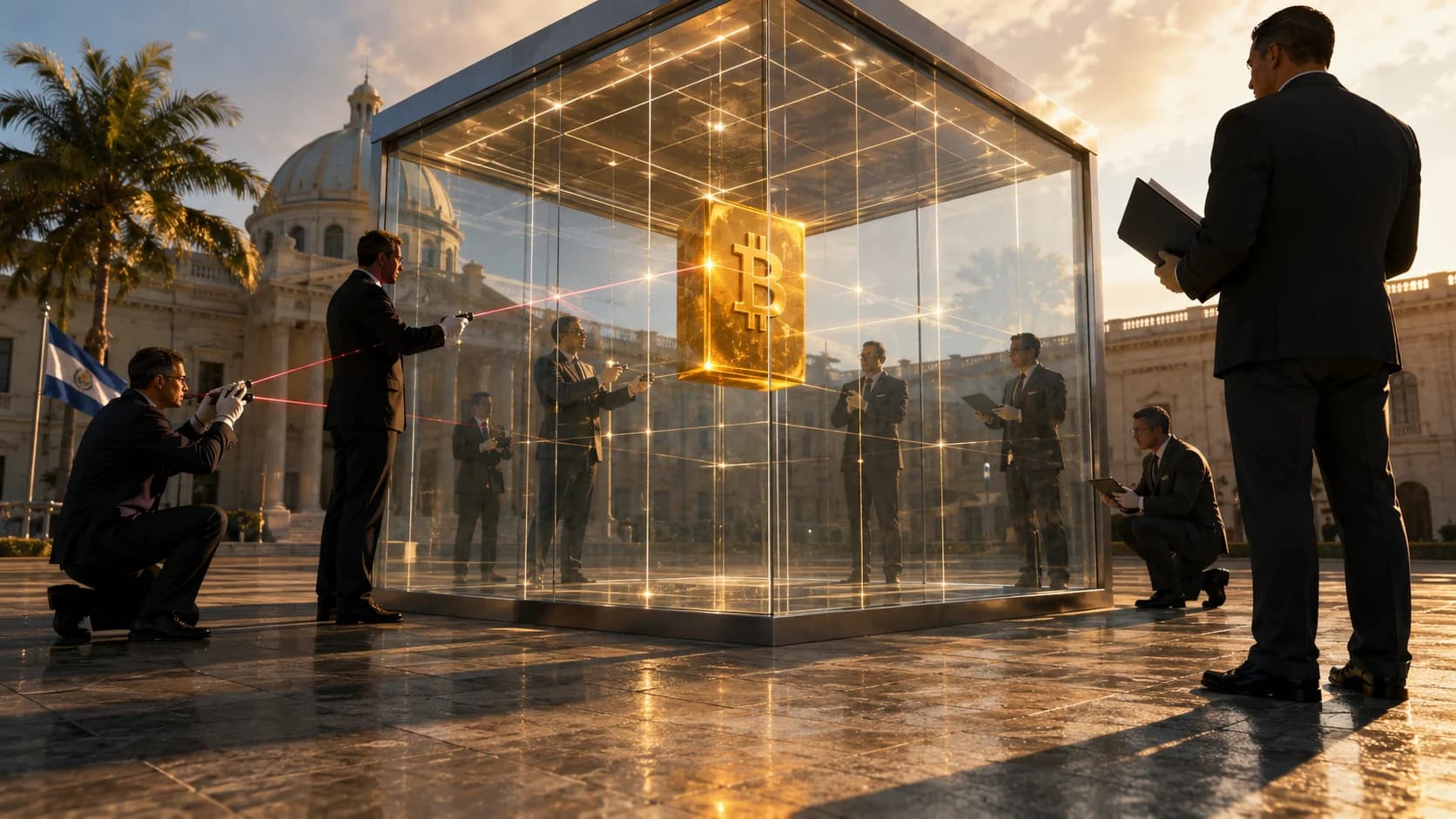
El Salvador's national Bitcoin holdings are being pulled into the kind of scrutiny the country spent years avoiding. According to a CryptoSlate report published June 29, 2026, the country's 7,696 BTC reserve now has to remain legible through a drawdown, wallet-level scrutiny, and a set of program conditions tied to its International Monetary Fund agreement. At a Bitcoin price near $59,888 as of June 29, 2026, that stack is worth roughly $461 million, and for the first time it has to answer to an outside accounting standard rather than a presidential social media post.
A sovereign bet meets an external auditor
For most of its Bitcoin experiment, El Salvador ran the reserve on its own terms. Purchases were announced on X, balances were tracked by independent on-chain sleuths, and the government rarely tied itself to a formal reporting cadence. That informality is now the friction point. An IMF program does not just hand over money. It attaches conditions, and those conditions demand that public assets stay visible, valued on a consistent basis, and managed inside agreed limits.
A Bitcoin reserve complicates each of those requirements. The asset is volatile, so its book value swings with the market. It can be moved between wallets, so custody has to be documented rather than assumed. And it sits outside the traditional banking rails the IMF is built to monitor, which means the fund needs the holdings to be traceable on-chain instead of through a custodian's statement.
Legibility becomes the real condition
The core demand here is not that El Salvador sell its coins. It is that the country make the position auditable. Wallet scrutiny means the specific addresses holding state Bitcoin have to be identified and tracked. A drawdown means the reserve has to be managed against rules about when and how coins can be spent or sold, rather than at discretion. Program conditions tie all of it to the broader fiscal commitments the country signed up for in exchange for financing.
That is a meaningful shift in how a nation-state can hold crypto. Bitcoin's design lets anyone verify a balance without trusting an institution, but it does not force anyone to disclose which addresses they control. El Salvador is now being asked to do exactly that for its public stack, turning a feature built for privacy into a transparency obligation. The same on-chain visibility that lets the public watch the reserve also lets the IMF hold the government to its word.
Timing works against the balance sheet
The accounting question lands during a weak stretch for the asset. Bitcoin is down about 6.6% over the past seven days and the broader market is in what CoinMarketCap's Fear and Greed index labels Extreme Fear, reading 16 as of June 29, 2026. A reserve marked to market in that environment looks smaller on paper than it did weeks ago, which sharpens every conversation about valuation and drawdown limits.
A government that has to report holdings on a consistent basis cannot pick the price it likes. If the IMF program requires periodic valuation, the reserve's contribution to the national balance sheet rises and falls with a market the country does not control. That is the trade for holding a volatile asset as a public reserve, and the program structure makes it explicit rather than optional.
The signal for everyday crypto users
El Salvador built its early reputation on consumer-facing Bitcoin, from the Chivo wallet to merchants accepting on-chain payments. The reserve and the retail experiment are separate, but credibility ties them together. A reserve that survives an external audit strengthens the case that a country can hold crypto responsibly. A messy reckoning does the opposite and gives every skeptical regulator a reference point.
There is also a quieter lesson about transparency. The pressure on El Salvador comes down to proving control of specific addresses and managing them by clear rules. For individuals, the parallel is custody. Holding crypto in a wallet you control gives you the same verifiable position the IMF now wants from El Salvador, without a counterparty deciding what you can see or move. The difference is that a sovereign has to publish its proof, while a private holder keeps it.
Overview
El Salvador's 7,696 BTC reserve, worth roughly $461 million as of June 29, 2026, now has to stay legible through wallet scrutiny, drawdown discipline, and IMF program conditions. The fight is not about selling coins. It is about whether a country can hold Bitcoin and still satisfy a traditional accounting standard, and it arrives while the market sits in Extreme Fear with prices down on the week. The outcome will shape how seriously the next government considers a sovereign crypto reserve.