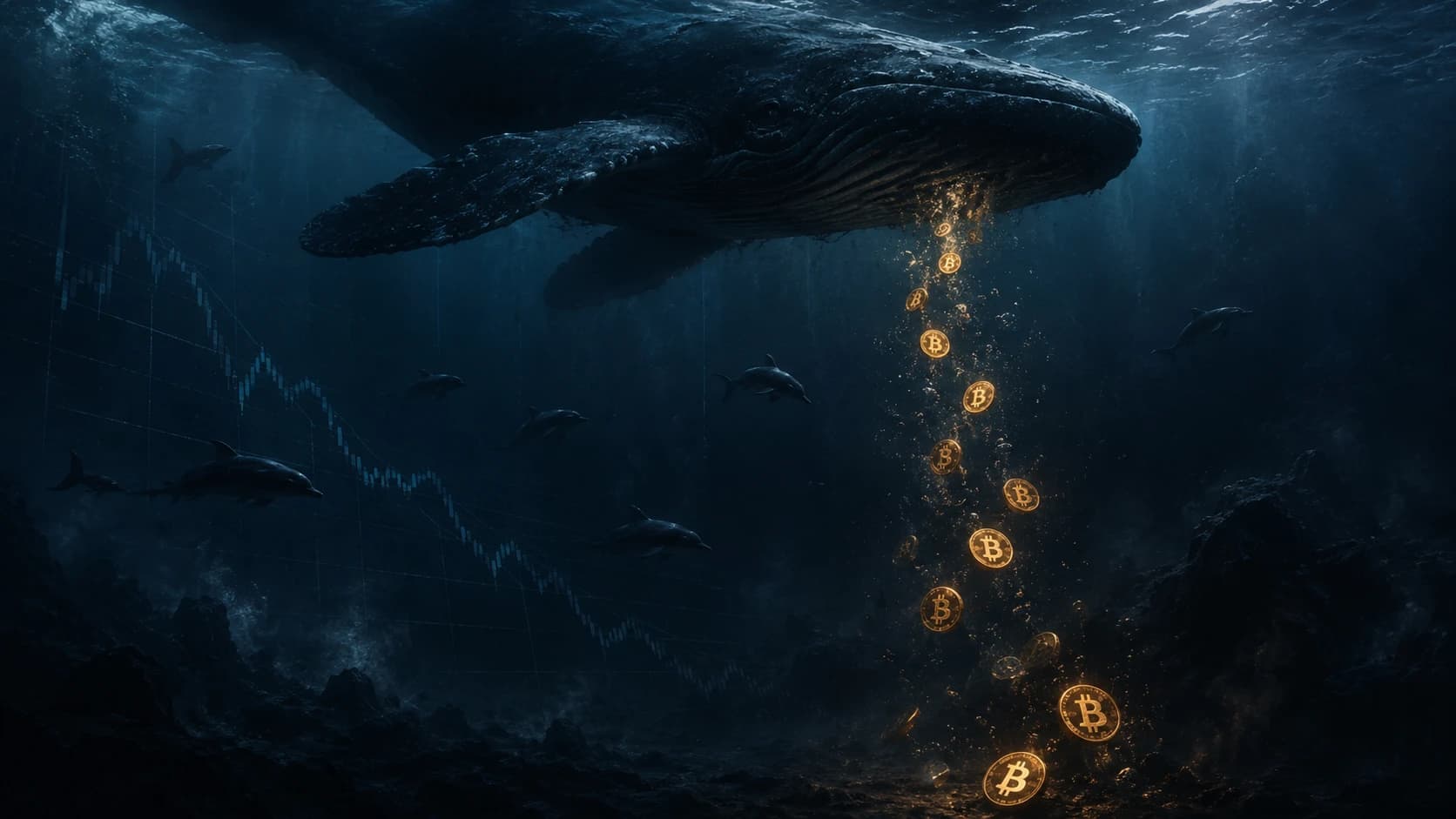
Bitcoin whale balances are shrinking at the fastest rate seen so far this year while mid-tier "dolphin" wallet growth has flatlined, according to a CryptoQuant report flagged by CoinMarketCap on May 29. The combination is unusual: it last appeared together during the 2022 bear market, when BTC fell from $48,000 in March to under $16,000 by November.
As of May 29, 2026, BTC trades at $73,320, down 5.22% on the week, with the Fear and Greed Index reading 32 (Fear). The cohort data lands at a moment when spot ETF flows have already turned negative for nine straight sessions and futures positioning on Ethereum has stretched to record open interest, painting a coherent picture of large holders stepping back.
Whale Selling and Dolphin Stalling Are Different Signals
CryptoQuant's framework splits BTC holders into cohort bands. Whales are wallets holding more than 1,000 BTC. Dolphins sit in the 100 to 1,000 BTC range and historically include funds, exchanges with smaller treasuries, and high-net-worth individuals.
In healthy bull phases, whale balances can compress while dolphin counts expand, because coins move from concentrated old holders into a wider mid-tier base. That distribution pattern marked most of 2024 and the first half of 2025.
The current setup breaks that pattern. Whales are selling at the fastest 2026 pace and dolphins are not absorbing the supply. New wallets in the 100 to 1,000 BTC band are not forming. That points to a distribution phase without a counterweight, which is mechanically what produces drawdowns rather than rotations.
The 2022 Parallel and Where It Breaks
The 2022 comparison carries weight because that was the last bear market with sustained whale liquidation and stalled mid-cohort accumulation. Coins moved out of the top tier and either landed on exchanges or sat in dormant addresses, with no fresh institutional wallet creation to soak them up.
The structural backdrop in 2026 is not identical. Spot Bitcoin ETFs exist, hold meaningful supply, and have become a primary on-ramp for traditional capital. That mechanism did not exist in 2022. In theory, ETF demand could substitute for the dolphin cohort by pulling coins into custodied institutional baskets that do not show up as new on-chain wallets.
The catch is that ETF demand is currently negative. The same week CryptoQuant flagged the cohort divergence, US spot Bitcoin ETFs logged a ninth consecutive session of net outflows, including a $733M single-day exit on May 27. With both on-chain mid-tier accumulation and ETF inflows missing at the same time, the absorption mechanism that distinguishes 2026 from 2022 is not firing.
Price Context and Liquidations
BTC has already given up the $75,000 level, with $150M in long positions liquidated in the most recent leg down. Ether has slipped below $2,000 even as futures open interest on the asset hit a record 16M ETH, suggesting traders are positioning around volatility rather than directional conviction.
For context: the 2022 cohort divergence was not a one-week event. It played out over months as whales steadily distributed into a market that lacked structural buyers. The market did not bottom until exchange reserves had absorbed most of the selling and forced liquidations cleared leveraged longs across centralized venues.
The current week resembles the early innings of that pattern more than the late innings. Exchange reserves have not seen the kind of sustained inflow that marked the November 2022 bottom, and forced liquidations remain moderate by historical standards.
Implications for Spot Holders and Card Users
For long-term spot holders, cohort divergence is the kind of signal that matters more than a single weekly candle. Persistent whale distribution without mid-tier absorption tends to compress prices for weeks, not days. Holders who card-spend from BTC balances, including users of self-custody options like Gnosis Pay or Cypher, may want to think about how a drawdown of 15 to 25% would affect their available collateral.
Card programs that convert at point of sale convert at the prevailing spot rate. A user with a $1,000 grocery bill paid from a BTC balance spends roughly 1.36% of one BTC at $73,320, but 1.92% at $52,000. That is a real cost difference if the cohort pattern plays through to a deeper retrace.
Users running stablecoin-funded cards are insulated from this dynamic at the spending layer but still face it on any BTC treasury they hold against the card. Cards that require token staking, particularly in the CRO and PLU ecosystems, carry an additional cost: a drop in the staked token's price during a broader market drawdown can wipe out months of cashback gains before the user has a chance to rebalance.
Signals That Would Flip the Setup
Three data points define whether this divergence resolves up or down. First, ETF flows: a return to consistent net inflows would signal the institutional substitute for dolphin accumulation is back online. Second, exchange reserves: a meaningful uptick in BTC sitting on centralized venues confirms whales are positioning to sell, not just rebalancing custody. Third, the dolphin count itself: a resumption of mid-tier wallet growth would mark the end of the 2022-style divergence.
Until those signals shift, CryptoQuant's framing should be taken at face value. The cohort behavior matches a regime that historically produces drawdowns, and the absorption mechanisms that would distinguish 2026 from 2022 are not currently active.
Overview
Bitcoin whale balances are contracting at the fastest pace of 2026 while dolphin growth has stalled, a combination CryptoQuant compares to 2022 bear market conditions. BTC trades at $73,320 with Fear and Greed at 32, ETF outflows running nine sessions deep, and ETH futures open interest at a record. The 2026 setup has structural differences from 2022 (spot ETFs exist) but the absorption mechanism is currently inactive.