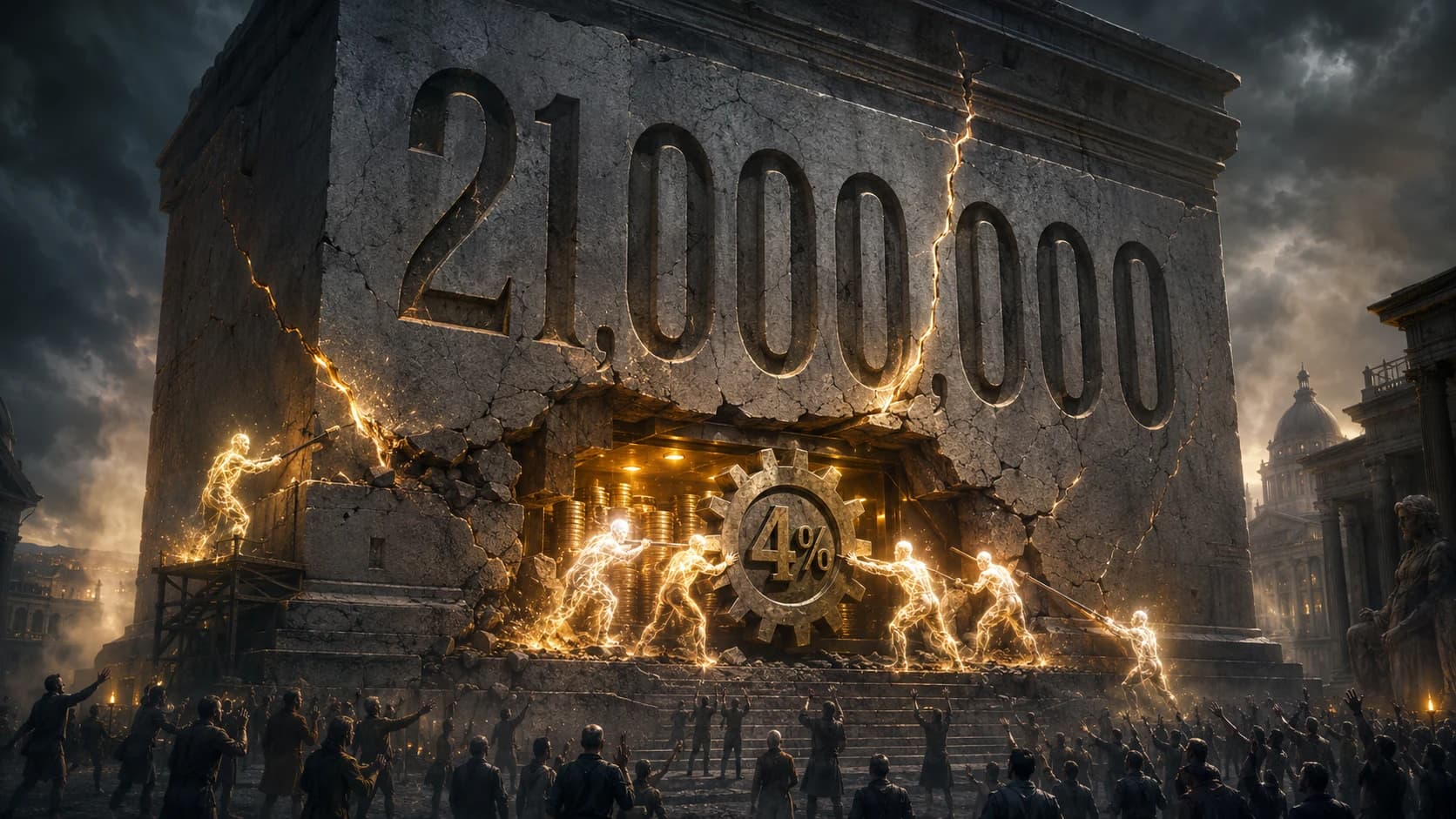
A co-founder of Zcash has suggested Bitcoin abandon its fixed 21 million coin supply cap and instead issue new coins at roughly 4% a year, according to a July 8, 2026 post from crypto outlet WuBlockchain. The idea directly targets the rule that Bitcoiners treat as untouchable: a hard ceiling on how many bitcoin can ever exist.
The proposal landed on a soft tape. Bitcoin was trading near $61,850 as of July 8, 2026, down about 2.1% on the day, with the Fear & Greed index sitting at 26 ("Fear"). The market reaction to the comment itself was muted, but the debate it reopened is one of the oldest fault lines in the asset's history.
The case the proposal is trying to make
Bitcoin's issuance halves roughly every four years. Block rewards, currently the main pay for miners, keep shrinking toward zero around the year 2140. After that, miners are meant to survive on transaction fees alone. Critics have argued for years that fee revenue may not be enough to pay for the hashpower that keeps the chain secure, and that a security budget funded only by fees could leave the network cheaper to attack during quiet periods.
A modest, predictable inflation rate, the argument goes, would give miners a permanent subsidy and keep security spending stable over decades. A 4% figure is close to the kind of steady expansion that central banks aim for with fiat money, which is exactly why the comparison is provocative. It swaps Bitcoin's absolute scarcity for a managed money-supply model that looks more like the system Bitcoin was built to route around.
21 million is the product, not a setting
For most Bitcoin holders, the fixed cap is not a technical detail that can be tuned. It is the product. The promise that no central authority can print more is the reason many people hold bitcoin at all, and it is the marketing spine behind every "digital gold" and "hardest money" pitch of the past decade.
Changing the cap would require a change to Bitcoin's consensus rules, which means near-universal agreement across node operators, miners, exchanges, and custodians. Anyone who kept running the old software would stay on a chain that still enforces 21 million, splitting the network. The last time Bitcoin went through a contentious rule fight, over block size in 2017, it produced a permanent fork rather than a clean upgrade. A move to end the supply cap would be far more divisive than block size ever was.
There is also a credibility problem that no vote can fix. The value of a "21 million forever" guarantee comes partly from the fact that it has never been broken. Break it once, even for a reason as reasonable-sounding as long-term security, and the door is open to breaking it again. Scarcity that can be amended on demand is not the same asset.
A familiar debate, not a live threat
This is a suggestion from one figure, reported through a single account, not a Bitcoin Improvement Proposal or anything close to a formal change. The security-budget question is genuine and has been raised by respected researchers before, but the "raise the cap" answer has repeatedly failed to gain traction inside Bitcoin's core development community. Other proposed fixes, from higher fee throughput to demand-driven fee markets during congestion, keep the 21 million ceiling intact.
It is worth separating the messenger from the message. Zcash itself is a privacy coin with its own monetary design and its own tradeoffs, and its team has spent this year working through a supply-verification bug ahead of its Ironwood upgrade. A monetary-policy suggestion aimed at Bitcoin from that corner will draw scrutiny on those grounds alone.
For anyone holding bitcoin, spending it, or building products around it, nothing changes today. The scarcity narrative that anchors demand, including the wave of public-company treasury buying that outpaced miner supply this year, rests on that cap staying exactly where it is. That is also why proposals to remove it tend to generate a lot of noise and very little code.
Overview
A Zcash co-founder suggested Bitcoin replace its fixed 21 million supply cap with roughly 4% annual issuance to fund long-term network security, per a July 8, 2026 WuBlockchain report. The idea addresses a real question about how miners get paid once block rewards fade, but it collides with the one rule most holders consider non-negotiable. Changing the cap would need overwhelming consensus, would likely fork the chain, and would undercut the scarcity that gives bitcoin much of its value. As of now it is a talking point, not a formal proposal, and Bitcoin's core community has rejected similar ideas before.