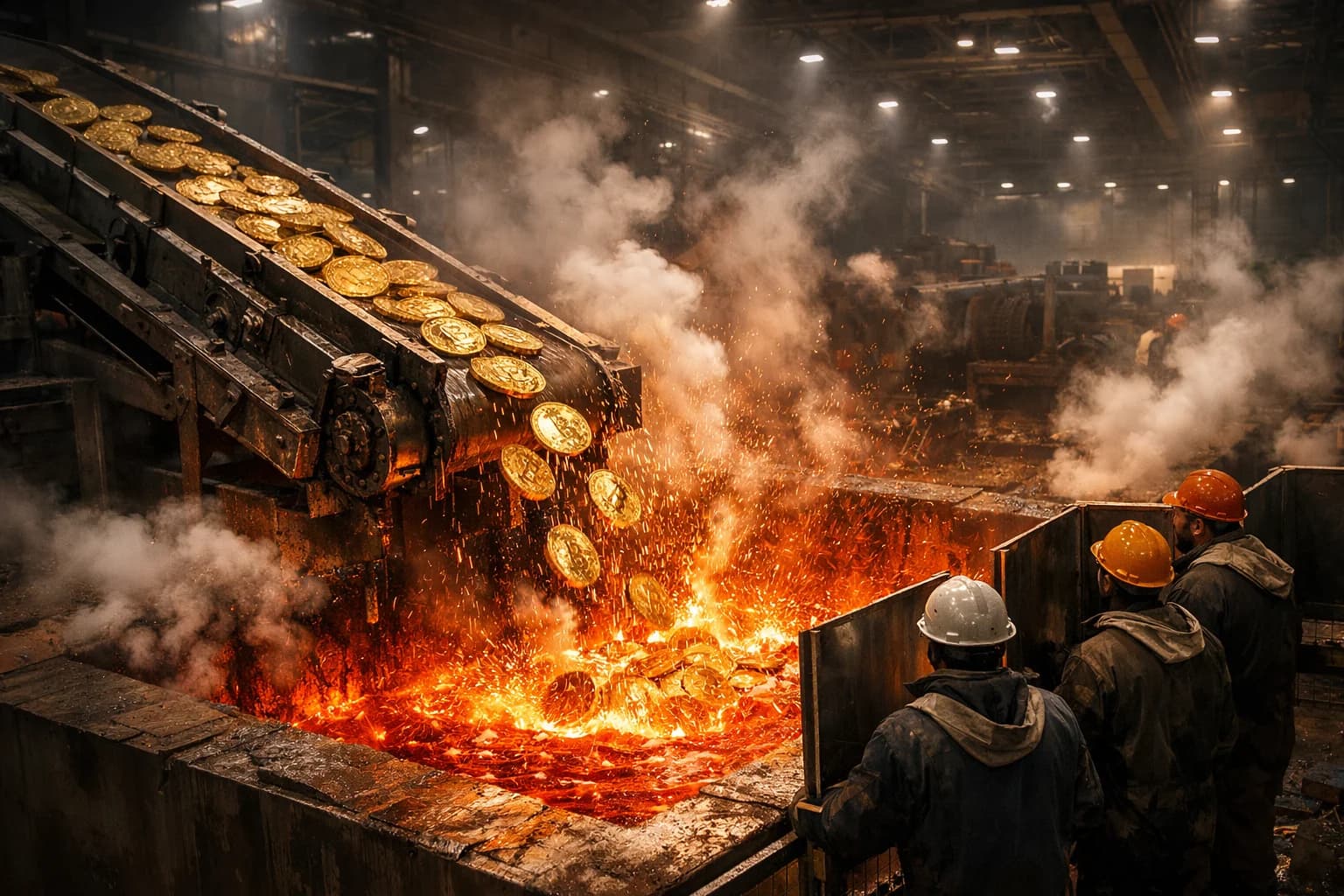
The average cost to mine one Bitcoin has hit $88,000. The coin itself trades near $69,000 as of March 22, 2026. That is a $19,000 loss on every unit produced, a 21% negative margin that is forcing the industry to adapt or shut down.
The Second Difficulty Drop in a Month
Bitcoin's network difficulty fell 7.76% on Saturday, landing at 133.79 trillion. This is the second major downward adjustment in recent weeks, following February's 11.16% plunge during Winter Storm Fern, which knocked power infrastructure offline across parts of Texas and the U.S. Southeast.
The network's difficulty peaked near 155 trillion in November 2025. It has now fallen roughly 14% from that all-time high.
Average block times had stretched to 12 minutes and 36 seconds before the adjustment, well above the 10-minute target. Miners were finding blocks slower because hashrate has dropped from the 1 zetahash milestone reached in late 2025 to roughly 920 EH/s today. The difficulty adjustment is doing what it was designed to do: recalibrating the network to match the actual computing power pointed at it.
$88,000 to Produce Something Worth $69,000
Hashprice, the revenue a miner earns per petahash per second per day, sits at $33.30 according to Luxor's Hashprice Index. That is barely above the all-time low of $28 set on February 23, 2026.
The production cost figure accounts for electricity, equipment depreciation, cooling, hosting, and overhead. At $88,000 per BTC, every miner running at average efficiency is burning cash. Only operations with unusually cheap power contracts (below $0.04/kWh) or newer-generation ASIC hardware can approach breakeven.
Geopolitical pressure is compounding the problem. Oil prices have pushed above $100 per barrel with the Strait of Hormuz effectively closed to commercial traffic, driving up energy costs globally. An estimated 8-10% of global hashrate sits in energy-sensitive Middle Eastern markets where these price increases hit hardest.
43% of All Bitcoin Is Underwater
The production cost squeeze is happening against a broader backdrop: 43% of total Bitcoin supply is now held at a loss, based on on-chain cost basis data. BTC has fallen roughly 3.25% over the past week, with the Fear and Greed Index reading 28 (Fear) as of March 22.
For miners specifically, the math is unforgiving. A mining operation producing 10 BTC per month at current difficulty is running a $190,000 monthly deficit before any debt service or capital expenditure. That deficit has to come from reserves, equity raises, or asset sales. None of those options improve with a falling BTC price.
The AI Pivot Is Accelerating
Marathon Digital and Cipher Mining, two of the largest publicly traded miners, have been diversifying into AI and high-performance computing (HPC) hosting. The logic is straightforward: the same physical infrastructure that houses mining rigs (power capacity, cooling, land, network connectivity) can host GPU clusters for machine learning workloads at higher margins.
This is not a new trend. The post-halving economics of April 2024 started the shift. But the current margin crisis is accelerating it. When every Bitcoin you produce costs $19,000 more than you can sell it for, the urgency to find alternative revenue becomes existential.
The next difficulty adjustment is projected for early April. If hashrate continues to decline, another downward adjustment could bring production costs closer to market price. But "closer" is not "profitable," and miners who have already exhausted their cash buffers may not survive long enough to benefit.
What This Means for the Network
Difficulty drops are a self-correcting mechanism. As unprofitable miners switch off, difficulty falls, and the remaining miners become relatively more profitable. This cycle has played out after every halving and every prolonged bear market.
The concern this time is the speed. Two major difficulty drops in a month, combined with hashrate falling 8% from its peak, suggests the shakeout is happening faster than in previous cycles. The miners who survive will control a larger share of block rewards when (and if) BTC recovers. The miners who do not will join the list of companies that underestimated how long unfavorable economics can persist.
For crypto card users and the broader ecosystem, miner capitulation does not directly change how you spend or hold crypto. But it does affect network security, transaction processing speed, and the supply dynamics that influence price. When miners sell BTC to cover operating costs, that is sustained sell pressure on an already weak market.
Overview
Bitcoin production costs have reached $88,000 per BTC while the market price hovers near $69,000, creating a $19,000 loss per coin mined. Network difficulty dropped 7.76% on March 22, the second major downward adjustment in a month, with hashrate falling from 1 zetahash to 920 EH/s. Hashprice sits at $33.30 per PH/s/day, near its all-time low. Major miners are accelerating their pivot to AI hosting as the margin crisis deepens. The next difficulty adjustment in early April will determine whether the shakeout stabilizes or intensifies.