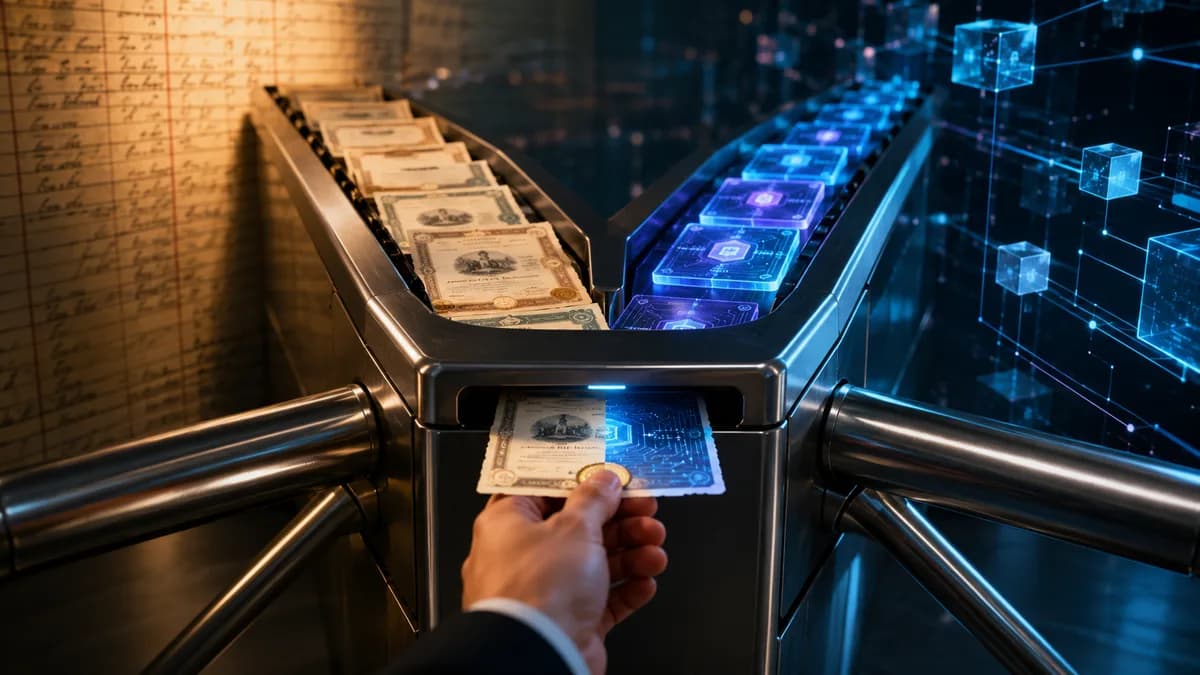
Binance opened commission-free trading on roughly 7,000 US stocks for eligible customers outside the United States and United Kingdom, and previewed a tokenized-equity product it is calling "bStocks." CoinDesk flagged the launch on June 1, 2026, and Decrypt reported the same day that the exchange paired the cash-equities rollout with a preview of the on-chain version.
The move lands during a soft week for crypto prices. Bitcoin traded at $71,364 as of June 1, 2026, down 3.0% on the day and 7.9% over the week, with the Fear & Greed Index reading 31 (Fear). Pushing into equities while its core market cools reads as a bid to keep users inside the app regardless of what they want to trade.
Equities trading inside a crypto exchange
Commission-free stock access is not new on its own. Brokers in the US have charged zero per-trade commissions since 2019, and that model spread worldwide. The novelty here is the venue: the largest crypto exchange by volume is now offering the same product to its existing account base, so a user can sit in a stablecoin balance and a stock position behind one login.
Eligibility carves out two of the most heavily regulated retail markets. US and UK customers are excluded, which matches how Binance has handled most of its newer products. Both jurisdictions hold exchanges to strict broker-dealer and listing rules, and offering equities there would invite a separate licensing fight Binance has so far avoided.
The commercial logic is retention. Every dollar a user moves to an outside broker is a dollar that stops generating fees and stops sitting in the ecosystem. Folding equities in keeps that capital one tap away from spot crypto, futures, and the exchange's own Binance card. The all-in-one account is the strategy, and stocks are the latest item on the menu.
bStocks and the tokenization question
The second piece is the harder one. "bStocks" would put equities on-chain as tokens rather than as conventional brokerage entries. Per Decrypt's reporting, experts are divided over whether tokenization meaningfully improves on what already exists.
The case for tokenized stocks rests on settlement and access. Conventional equities still clear on a delayed cycle and trade during fixed market hours. A tokenized share can in principle move 24/7, settle near-instantly, and serve as collateral inside on-chain systems. That is the same pitch behind the DTCC's tokenization work with Stellar and the broader institutional push into on-chain securities.
The skeptical case is that a tokenized stock is only as useful as its legal backing. A token that represents a share has to be redeemable for the real thing, governed by a real custodian, and recognized by regulators who treat securities seriously. Without that, it is a synthetic wrapper carrying counterparty risk rather than a genuine ownership claim. The 2021 wave of tokenized-stock products that quietly disappeared is the cautionary precedent, and the reason "previewed" rather than "launched" is the operative word for bStocks.
Citi sketched the upside on the same day, forecasting that tokenized real-world assets could grow from about $17 billion today to as much as $5.5 trillion. Forecasts that large are worth treating as direction, not destination. This is speculative framing, not financial advice, and the gap between a preview and a regulated, redeemable product is where most tokenization plans have stalled.
Implications for crypto users
For the account holder, the immediate change is optionality. Eligible users can now hold crypto, stablecoins, and US equities in one place, which simplifies how some people manage cash they are not actively deploying into crypto. Balances that move on-chain also sit closer to spending rails: stablecoin-funded cards and exchange-linked cards draw from the same pool of assets, so the convenience compounds.
The risk is concentration. Holding crypto, stocks, and spending access on a single platform means a single counterparty failure touches all of it at once. That is the same lesson from past exchange and custodian collapses, and it applies whether the asset is a token, a coin, or a tokenized share. Spreading assets and understanding what a tokenized instrument legally entitles you to matter more as exchanges absorb more of the financial stack. The 0% commission applies to the trade; it does not erase platform or custody risk.
Overview
Binance opened commission-free trading on around 7,000 US stocks for eligible non-US and non-UK customers and previewed "bStocks," a tokenized-equity product, on June 1, 2026. The cash-equities launch deepens the exchange's all-in-one account model and competes directly with brokers. The tokenized version remains a preview, and experts are split on whether wrapping shares on-chain delivers real benefits beyond marketing. Bitcoin sat at $71,364 the same day, down 3.0% on 24 hours, a reminder the push came during weak crypto demand rather than a rally.