The First Presidential Family Real Estate Token
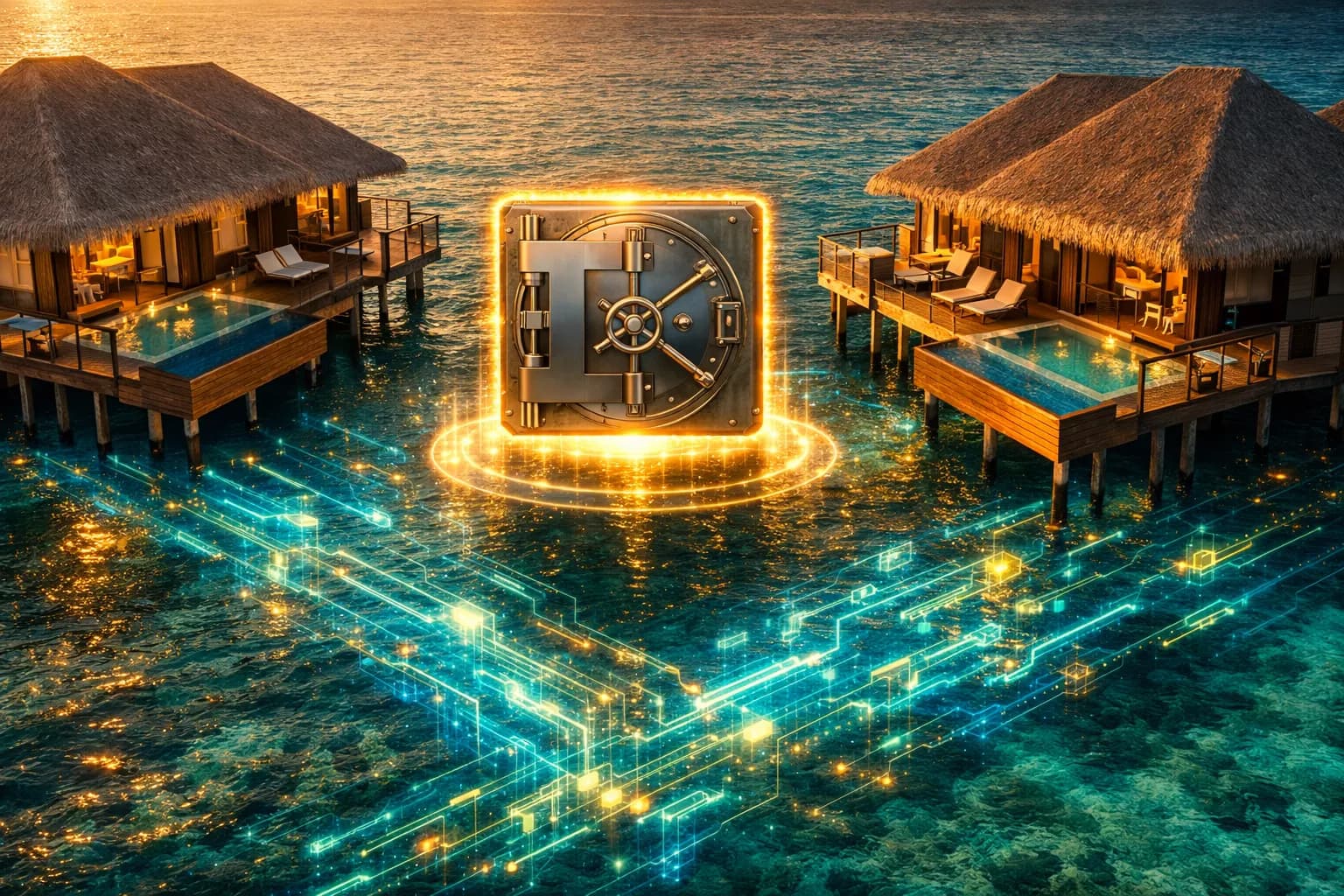
World Liberty Financial, the crypto venture co-founded by Eric Trump and Donald Trump Jr., announced on February 19, 2026 that it will tokenize loan revenue interests from Trump International Hotel and Resort in the Maldives. The project taps Securitize, the BlackRock-backed digital securities platform, to structure and issue the tokens, while London-listed DarGlobal PLC handles the physical development of approximately 100 ultra-luxury beach and overwater villas slated for completion in 2030.
The announcement dropped during the World Liberty Forum at Mar-a-Lago, where nearly 400 attendees from finance, technology, and government convened to discuss blockchain's role in reshaping capital markets. WLFI token surged roughly 18% around the event, trading near $0.12 as of the announcement, with a market capitalization of approximately $3.2 billion.
"We built World Liberty Financial to open up decentralized finance to the world," Eric Trump stated. "With today's announcement, we are now extending that access to tokenized real estate."
Why This Tokenization Is Different From Every Other RWA Deal
The on-chain tokenized real-world asset market now exceeds $19 billion excluding stablecoins, with US Treasuries comprising roughly 45% of the total. BlackRock's BUIDL fund alone accounts for billions in tokenized government debt. Real estate, however, remains a fraction of that figure despite projections from BCG that the sector could reach $3.2 trillion by 2030.
What makes this deal distinct is not the asset class but the issuer. This is the first time a sitting US president's family business has tokenized any asset on a public blockchain. The Trump Organization operates the resort under a licensing agreement with DarGlobal, meaning the family earns fees from the brand without direct property ownership. WLFI now sits in the middle as the tokenization layer, creating a financial instrument that channels loan revenue from a presidential family's branded project to blockchain investors.
Securitize's involvement adds institutional gravity. The same platform powers BlackRock's BUIDL Treasury fund and has processed billions in compliant digital securities. CEO Carlos Domingo framed the deal in institutional terms: "On-chain real estate products with compliance and governance will be globally sought after."
How the Token Structure Works
Investors will not own equity in the resort. Instead, the tokens represent interests in development loans tied to the project, delivering a fixed yield plus performance-linked payments. Think of it as a tokenized bond collateralized by future hotel revenue rather than a fractional ownership stake.
The offering follows a strict regulatory framework. In the US, tokens will be sold under Rule 506(c) of Regulation D, limiting access to verified accredited investors. Non-US buyers can participate through Regulation S offshore exemptions, but the tokens carry transfer restrictions and are not registered under federal or state securities laws.
WLFI has also signaled that these tokens could eventually serve as collateral on its Markets platform, where legally permitted. That would create a DeFi loop: tokenized real estate yield as borrowing collateral for on-chain lending, a structure that bridges traditional commercial real estate with programmable finance.
The specific yield rate, minimum investment threshold, and blockchain deployment details have not been disclosed. The tokens will launch on public blockchains "subject to applicable requirements," leaving the exact chain undecided.
Retail Investors Watch From the Sideline
The accredited-only structure is the deal's most significant limitation. Under Reg D 506(c), only individuals with $200,000+ annual income (or $300,000 jointly) or $1 million+ in net assets excluding their primary residence qualify. That excludes the vast majority of crypto-native retail investors who drive WLFI's own token market.
This creates a visible contradiction. WLFI's governance token trades freely on secondary markets at a $3.2 billion market cap, accessible to anyone with a crypto wallet. But the actual yield-bearing product, the tokenized resort loan, remains gated behind securities regulations designed for institutional and high-net-worth participants.
For crypto card users and everyday DeFi participants, the practical takeaway is that tokenized real estate yield remains largely inaccessible through the channels they actually use. The cashback rewards and staking yields available through crypto card products continue to offer the most direct path for non-accredited individuals to earn passive returns on their crypto holdings.
The Broader Mar-a-Lago Announcements
The resort tokenization was one of several moves WLFI unveiled at the World Liberty Forum. The venture also announced a strategic collaboration with Apex Group, a $3.5 trillion financial solutions provider, to pilot its USD1 stablecoin for subscriptions, distributions, and redemptions in tokenized fund products.
WLFI co-founder Zak Folkman pitched USD1 as an institutional-grade stablecoin for cross-border payments, with plans to expand beyond the US-Mexico corridor to 40 currencies. Apex Group will also explore pathways to make WLFI assets available on the London Stock Exchange Group's Digital Market Infrastructure platform.
Combined with the Maldives tokenization, the announcements position WLFI as a full-stack crypto finance operation: stablecoin issuance, real estate tokenization, and institutional settlement infrastructure, all branded with the Trump name and all built on existing regulated platforms like Securitize.
The Political Dimension No One Can Ignore
The elephant in the room is conflict of interest. The Trump Organization earns licensing fees from the resort. The president's sons co-founded WLFI. And the administration is actively shaping crypto regulation, including stablecoin legislation and the SEC's evolving stance on tokenized securities.
Senate Democrats have already demanded a CFIUS review of a separate $500 million UAE stake in WLFI. The Maldives resort tokenization adds another layer: a presidential family profiting directly from the same blockchain infrastructure that federal agencies are racing to regulate.
Whether this accelerates institutional adoption or invites regulatory blowback depends on which political force proves stronger. The CLARITY Act and GENIUS Act stablecoin legislation both remain pending, and any perception that crypto rules are being written to benefit insiders could derail both.
Overview
World Liberty Financial's partnership with Securitize and DarGlobal to tokenize Trump Maldives resort loans marks the first time a sitting US president's family business has issued a blockchain-based financial product tied to physical real estate. The accredited-only structure under Reg D keeps retail investors on the sidelines while institutional players gain yield exposure to luxury hospitality development. The broader Mar-a-Lago forum also produced a USD1 stablecoin pilot with $3.5 trillion Apex Group and plans for London Stock Exchange integration. As the tokenized RWA market surpasses $19 billion and regulatory frameworks for digital securities remain in flux, this deal will test whether political proximity to crypto policymaking accelerates adoption or triggers backlash.