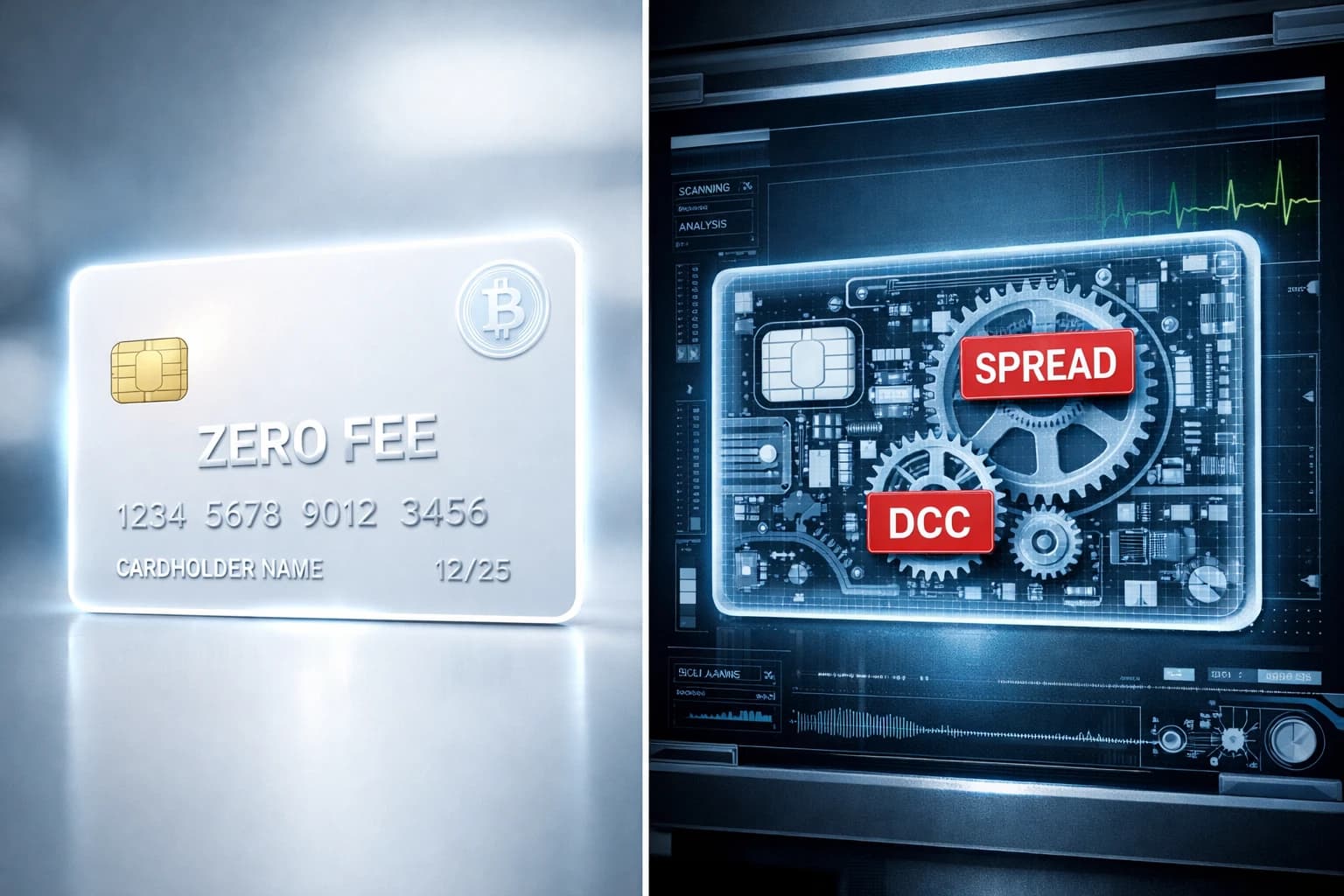
Seeing a "zero FX fees" claim on a crypto card page can sound like a full waiver of international costs. In practice, treat it as a statement about issuer surcharges, not a guarantee of the final rate.
This guide explains what zero FX fees cover, what they do not, and how to estimate true value before you spend.
Why Zero FX Fees Need Scrutiny
When your billing currency and the merchant currency do not match, conversion mechanics shape the final outcome. A zero FX fee policy can still coexist with a network exchange rate, issuer-added fees, and merchant-side conversion choices.
If you want a crypto card to behave like a true travel card, you need clarity on where pricing is set and who sets it. That is the only way to separate a clean rate from a convenient one.
What Zero FX Fees Actually Cover
Zero FX fees on a crypto card usually mean the issuer is not adding its own foreign transaction surcharge; they do not guarantee the best exchange rate or block merchant-side conversion.
Think of the transaction in three steps:
-
Network conversion (when you pay in local currency). Card networks publish conversion rates for cross-border purchases and ATM transactions. Issuers may use those rates and may add their own fees, and the applied rate can depend on the authorization or processing time.
-
Merchant or ATM conversion (DCC). Dynamic Currency Conversion is a merchant service that converts the purchase into your card currency. When that happens, the merchant's rate applies and the card network rate does not. DCC is often less cost-effective than paying in the local currency.
-
Crypto funding mechanics (issuer-side). If your card converts crypto at the time of purchase, any difference between the in-app crypto sale rate and the network FX rate is a separate cost layer. Zero FX fees only address step 1, not the funding spread in step 3.
Market Benchmarking and ROI Math
Use a simple net-return equation to judge whether a "zero FX" card actually pays off for your spend:
Net value = rewards rate - (conversion loss + merchant conversion markup + crypto funding spread)
Example (illustrative numbers):
- Rewards rate: 2.0%
- Conversion loss vs. the rate you expected: 0.6%
- Merchant conversion markup (DCC): 1.5%
- Crypto funding spread: 0.4%
Net value = 2.0% - (0.6% + 1.5% + 0.4%) = -0.5%
The point is not the specific percentages. The point is that "zero FX fee" can still be negative ROI if the other layers are not managed.
Common Mistakes or Myths
Myth: Zero FX fee means mid-market pricing. The network rate is not necessarily the mid-market rate, and issuers can add fees or use different timing.
Myth: DCC is the same as paying in local currency. DCC uses a merchant-set rate, and network rates do not apply when DCC is used.
Myth: A zero FX fee policy blocks all cross-border costs. Even without an issuer surcharge, merchant conversion can still be more expensive than paying in the local currency.
Myth: FX costs only matter on travel. Cross-border processing can also occur when an online merchant or marketplace bills in a different currency or uses a foreign acquirer.
How This Relates to Crypto Cards
If you want the cleanest FX outcome, focus on three practical levers:
- Choose cards that make DCC easy to decline. The merchant controls the offer, but your choice at checkout determines whether the network rate applies.
- Prefer stablecoin or multi-currency balance cards for predictable pricing. Start with SpendNode's no FX fee cards and stablecoin-focused cards to narrow the field.
- Verify the first few real-world transactions. Compare the posted exchange rate in your card app to the network reference for that day so you can estimate your true spread.
If you want a deeper comparative breakdown, see the full FX cost matrix in Crypto Card FX Fees: Complete 2026 Guide.
Overview
Zero FX fees are useful, but they are not a full pricing guarantee. The real outcome depends on whether the transaction used a network rate or a merchant rate, and whether crypto was converted at a fair in-app price.
Actionable takeaway: Always pay in the local currency when offered a choice, then validate the applied rate against the network reference on your first few transactions.